

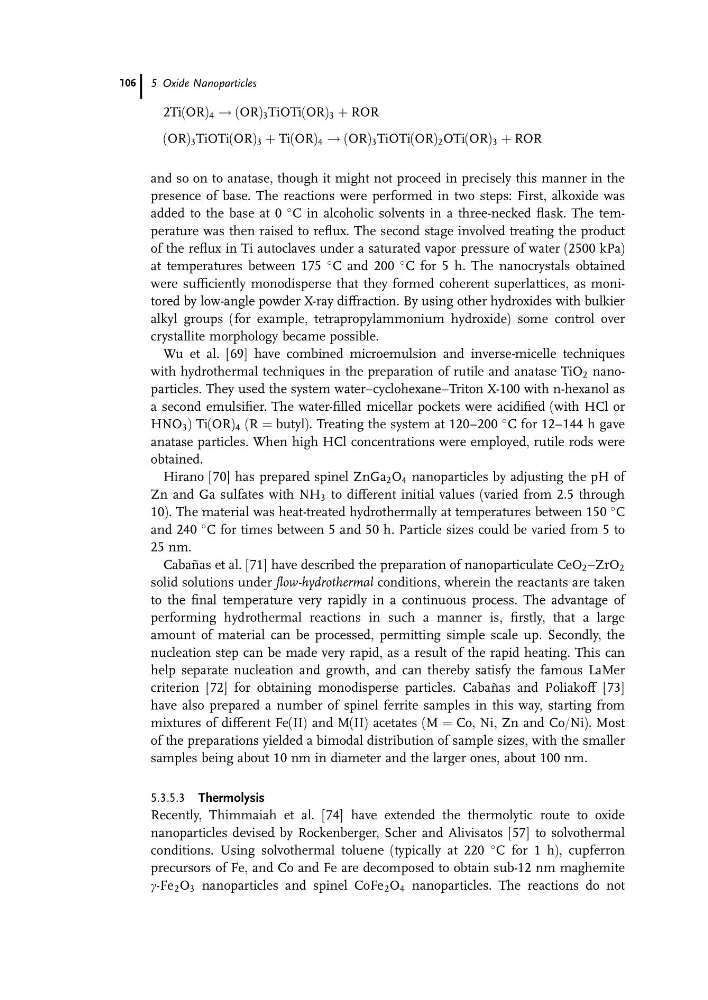
2Ti(OR) 4 ! (OR) 3 TiOTi(OR) 3 þ ROR
(OR) 3 TiOTi(OR) 3 þ Ti(OR) 4 ! (OR) 3 TiOTi(OR) 2 OTi(OR) 3 þ ROR
and so on to anatase, though it might not proceed in precisely this manner in the
presence of base. The reactions were performed in two steps: First, alkoxide was
added to the base at 0
C in alcoholic solvents in a three-necked flask. The temperature was then raised to reflux. The second stage involved treating the product
of the reflux in Ti autoclaves under a saturated vapor pressure of water (2500 kPa)
at temperatures between 175
C and 200
C for 5 h. The nanocrystals obtained
were sufficiently monodisperse that they formed coherent superlattices, as monitored by low-angle powder X-ray diffraction. By using other hydroxides with bulkier
alkyl groups (for example, tetrapropylammonium hydroxide) some control over
crystallite morphology became possible.
Wu et al. [69] have combined microemulsion and inverse-micelle techniques
with hydrothermal techniques in the preparation of rutile and anatase TiO 2 nanoparticles. They used the system water–cyclohexane–Triton X-100 with n-hexanol as
a second emulsifier. The water-filled micellar pockets were acidified (with HCl or
HNO 3 ) Ti(OR) 4 (R ¼ butyl). Treating the system at 120–200
C for 12–144 h gave
anatase particles. When high HCl concentrations were employed, rutile rods were
obtained.
Hirano [70] has prepared spinel ZnGa 2 O 4 nanoparticles by adjusting the pH of
Zn and Ga sulfates with NH 3 to different initial values (varied from 2.5 through
10). The material was heat-treated hydrothermally at temperatures between 150
C
and 240
C for times between 5 and 50 h. Particle sizes could be varied from 5 to
25 nm.
Caban ˜as et al. [71] have described the preparation of nanoparticulate CeO 2 aZrO 2
solid solutions under flow-hydrothermal conditions, wherein the reactants are taken
to the final temperature very rapidly in a continuous process. The advantage of
performing hydrothermal reactions in such a manner is, firstly, that a large
amount of material can be processed, permitting simple scale up. Secondly, the
nucleation step can be made very rapid, as a result of the rapid heating. This can
help separate nucleation and growth, and can thereby satisfy the famous LaMer
criterion [72] for obtaining monodisperse particles. Caban ˜as and Poliakoff [73]
have also prepared a number of spinel ferrite samples in this way, starting from
mixtures of different Fe(II) and M(II) acetates (M ¼ Co, Ni, Zn and Co/Ni). Most
of the preparations yielded a bimodal distribution of sample sizes, with the smaller
samples being about 10 nm in diameter and the larger ones, about 100 nm.
5.3.5.3 Thermolysis
Recently, Thimmaiah et al. [74] have extended the thermolytic route to oxide
nanoparticles devised by Rockenberger, Scher and Alivisatos [57] to solvothermal
conditions. Using solvothermal toluene (typically at 220
C for 1 h), cupferron
precursors of Fe, and Co and Fe are decomposed to obtain sub-12 nm maghemite
g-Fe 2 O 3 nanoparticles and spinel CoFe 2 O 4 nanoparticles. The reactions do not
5 Oxide Nanoparticles
106
(OR) 3 TiOTi(OR) 3 þ Ti(OR) 4 ! (OR) 3 TiOTi(OR) 2 OTi(OR) 3 þ ROR
and so on to anatase, though it might not proceed in precisely this manner in the
presence of base. The reactions were performed in two steps: First, alkoxide was
added to the base at 0
C in alcoholic solvents in a three-necked flask. The temperature was then raised to reflux. The second stage involved treating the product
of the reflux in Ti autoclaves under a saturated vapor pressure of water (2500 kPa)
at temperatures between 175
C and 200
C for 5 h. The nanocrystals obtained
were sufficiently monodisperse that they formed coherent superlattices, as monitored by low-angle powder X-ray diffraction. By using other hydroxides with bulkier
alkyl groups (for example, tetrapropylammonium hydroxide) some control over
crystallite morphology became possible.
Wu et al. [69] have combined microemulsion and inverse-micelle techniques
with hydrothermal techniques in the preparation of rutile and anatase TiO 2 nanoparticles. They used the system water–cyclohexane–Triton X-100 with n-hexanol as
a second emulsifier. The water-filled micellar pockets were acidified (with HCl or
HNO 3 ) Ti(OR) 4 (R ¼ butyl). Treating the system at 120–200
C for 12–144 h gave
anatase particles. When high HCl concentrations were employed, rutile rods were
obtained.
Hirano [70] has prepared spinel ZnGa 2 O 4 nanoparticles by adjusting the pH of
Zn and Ga sulfates with NH 3 to different initial values (varied from 2.5 through
10). The material was heat-treated hydrothermally at temperatures between 150
C
and 240
C for times between 5 and 50 h. Particle sizes could be varied from 5 to
25 nm.
Caban ˜as et al. [71] have described the preparation of nanoparticulate CeO 2 aZrO 2
solid solutions under flow-hydrothermal conditions, wherein the reactants are taken
to the final temperature very rapidly in a continuous process. The advantage of
performing hydrothermal reactions in such a manner is, firstly, that a large
amount of material can be processed, permitting simple scale up. Secondly, the
nucleation step can be made very rapid, as a result of the rapid heating. This can
help separate nucleation and growth, and can thereby satisfy the famous LaMer
criterion [72] for obtaining monodisperse particles. Caban ˜as and Poliakoff [73]
have also prepared a number of spinel ferrite samples in this way, starting from
mixtures of different Fe(II) and M(II) acetates (M ¼ Co, Ni, Zn and Co/Ni). Most
of the preparations yielded a bimodal distribution of sample sizes, with the smaller
samples being about 10 nm in diameter and the larger ones, about 100 nm.
5.3.5.3 Thermolysis
Recently, Thimmaiah et al. [74] have extended the thermolytic route to oxide
nanoparticles devised by Rockenberger, Scher and Alivisatos [57] to solvothermal
conditions. Using solvothermal toluene (typically at 220
C for 1 h), cupferron
precursors of Fe, and Co and Fe are decomposed to obtain sub-12 nm maghemite
g-Fe 2 O 3 nanoparticles and spinel CoFe 2 O 4 nanoparticles. The reactions do not
5 Oxide Nanoparticles
106