

magnetic oxide nanoparticles. Many of the preparative routes involve hydrolysis. In
many cases, the preparation simply involves raising the pH of a solution of metal
ions, taken in the correct proportion, by addition of base. Sorenson, Klabunde and
coworkers [37], have made detailed magnetic and Mo ¨ssbauer studies of MnFe 2 O 4
nanoparticles prepared by precipitation at high pH followed by digestion. Cabuil
and coworkers [38] have shown in the case of the preparation of CoFe 2 O 4 and gFe 2 O 3 particles that changing the temperature and the nature of the base allows
particles of different sizes to be prepared. In addition, they have suggested methods of dispersing the particles in water, through controlling Coulomb repulsion
between the particles. The particles can be dispersed in oils by modifying their
surfaces with long chain surfactants. Cabuil et al. [39] have also shown that sizeselection of particles is possible though control of a combination of surface charge
and ionic strength of the dispersing medium. Morales et al. [40] have made a
careful study of g-Fe 2 O 3 nanoparticles, with sizes ranging from 3 to 14 nm, prepared by hydrolytic means (and also by laser pyrolysis of Fe(CO) 5 in solution).
They show that to account for the magnetic properties of the particles, it is necessary to use a model wherein the moments on the surface of the particle are canted.
The use of polar solvents other than water to perform hydrolysis is an exciting prospect. Ammar et al. [41] have demonstrated that glycols (specifically 1,2propanediol) can be used as a solvent under reflux to hydrolyze a mixture of Co(II)
and Fe(III) salts to obtain equiaxed particles of CoFe 2 O 4 with an average diameter
of 5.5 nm. A combination of Mo ¨ssbauer spectroscopy, X-ray absorption near-edge
structure (XANES) and magnetic measurements suggested that the particles were
well-ordered both in terms of being crystalline and having all Co in the divalent
state. Rajamathi et al. have been able to capitalize on the unusual properties of
glycols – that they are sufficiently polar that they can dissolve metal salts and that
they can support hydrolysis and yet they can dissolve long chain surfactants such
as amines – in the preparation of n-octylamine-capped 5 nm g-Fe 2 O 3 nanoparticles
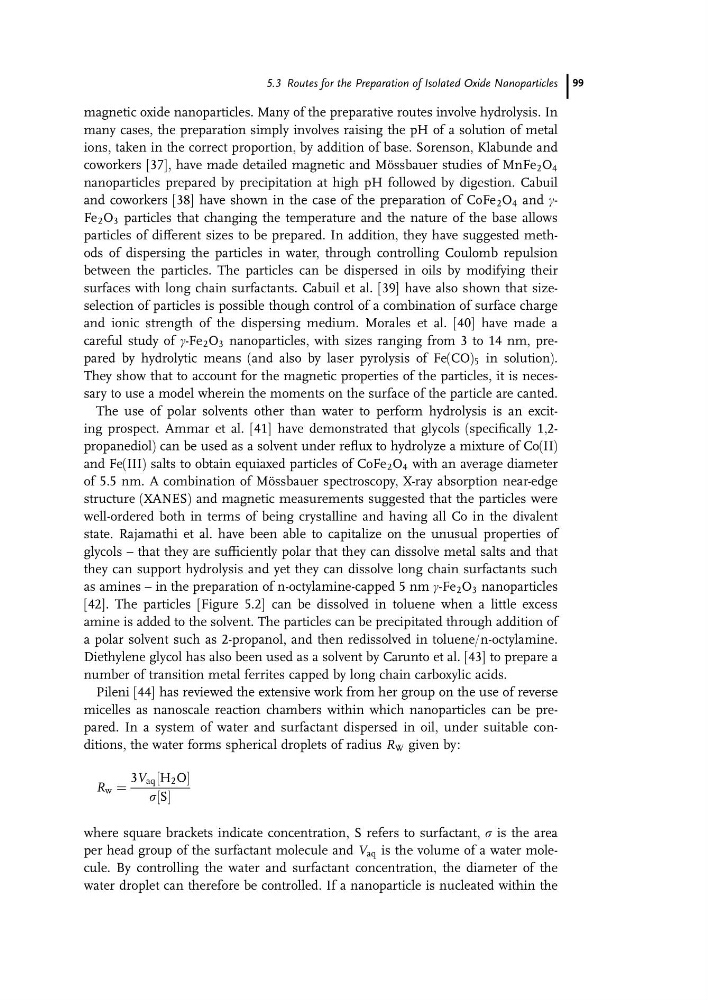
[42]. The particles [Figure 5.2] can be dissolved in toluene when a little excess
amine is added to the solvent. The particles can be precipitated through addition of
a polar solvent such as 2-propanol, and then redissolved in toluene/n-octylamine.
Diethylene glycol has also been used as a solvent by Carunto et al. [43] to prepare a
number of transition metal ferrites capped by long chain carboxylic acids.
Pileni [44] has reviewed the extensive work from her group on the use of reverse
micelles as nanoscale reaction chambers within which nanoparticles can be prepared. In a system of water and surfactant dispersed in oil, under suitable conditions, the water forms spherical droplets of radius R W given by:
R w ¼
3V aq ½H 2 O
s½S
where square brackets indicate concentration, S refers to surfactant, s is the area
per head group of the surfactant molecule and V aq is the volume of a water molecule. By controlling the water and surfactant concentration, the diameter of the
water droplet can therefore be controlled. If a nanoparticle is nucleated within the
5.3 Routes for the Preparation of Isolated Oxide Nanoparticles 99
many cases, the preparation simply involves raising the pH of a solution of metal
ions, taken in the correct proportion, by addition of base. Sorenson, Klabunde and
coworkers [37], have made detailed magnetic and Mo ¨ssbauer studies of MnFe 2 O 4
nanoparticles prepared by precipitation at high pH followed by digestion. Cabuil
and coworkers [38] have shown in the case of the preparation of CoFe 2 O 4 and gFe 2 O 3 particles that changing the temperature and the nature of the base allows
particles of different sizes to be prepared. In addition, they have suggested methods of dispersing the particles in water, through controlling Coulomb repulsion
between the particles. The particles can be dispersed in oils by modifying their
surfaces with long chain surfactants. Cabuil et al. [39] have also shown that sizeselection of particles is possible though control of a combination of surface charge
and ionic strength of the dispersing medium. Morales et al. [40] have made a
careful study of g-Fe 2 O 3 nanoparticles, with sizes ranging from 3 to 14 nm, prepared by hydrolytic means (and also by laser pyrolysis of Fe(CO) 5 in solution).
They show that to account for the magnetic properties of the particles, it is necessary to use a model wherein the moments on the surface of the particle are canted.
The use of polar solvents other than water to perform hydrolysis is an exciting prospect. Ammar et al. [41] have demonstrated that glycols (specifically 1,2propanediol) can be used as a solvent under reflux to hydrolyze a mixture of Co(II)
and Fe(III) salts to obtain equiaxed particles of CoFe 2 O 4 with an average diameter
of 5.5 nm. A combination of Mo ¨ssbauer spectroscopy, X-ray absorption near-edge
structure (XANES) and magnetic measurements suggested that the particles were
well-ordered both in terms of being crystalline and having all Co in the divalent
state. Rajamathi et al. have been able to capitalize on the unusual properties of
glycols – that they are sufficiently polar that they can dissolve metal salts and that
they can support hydrolysis and yet they can dissolve long chain surfactants such
as amines – in the preparation of n-octylamine-capped 5 nm g-Fe 2 O 3 nanoparticles
[42]. The particles [Figure 5.2] can be dissolved in toluene when a little excess
amine is added to the solvent. The particles can be precipitated through addition of
a polar solvent such as 2-propanol, and then redissolved in toluene/n-octylamine.
Diethylene glycol has also been used as a solvent by Carunto et al. [43] to prepare a
number of transition metal ferrites capped by long chain carboxylic acids.
Pileni [44] has reviewed the extensive work from her group on the use of reverse
micelles as nanoscale reaction chambers within which nanoparticles can be prepared. In a system of water and surfactant dispersed in oil, under suitable conditions, the water forms spherical droplets of radius R W given by:
R w ¼
3V aq ½H 2 O
s½S
where square brackets indicate concentration, S refers to surfactant, s is the area
per head group of the surfactant molecule and V aq is the volume of a water molecule. By controlling the water and surfactant concentration, the diameter of the
water droplet can therefore be controlled. If a nanoparticle is nucleated within the
5.3 Routes for the Preparation of Isolated Oxide Nanoparticles 99