

4.4.1
Isolated Nanocrystals
A nanocrystal undergoes a size-induced metal-insulator transition when the diameter of the particles is decreased to below a few nanometers [5, 162, 163]. Scanning
tunneling spectroscopy measurements of nanocrystals of various metals have revealed that the nanocrystals of dimensions @1 nm exhibit a definitive band gap (up
to 70 meV) that decreases gradually as the volume of the nanocrystal increases
[162, 164, 165] (see Figure 4.24). Photoelectron spectroscopic measurements on
mass selected Hg n nanoparticles (n ¼ 3 to 250) in the gas phase reveal that the
characteristic HOMO–LUMO (s–p) energy gap decreases gradually from @3.5 eV
for n < 3 to @0.2 eV for n < 250, as shown in Figure 4.25. The band gap closure is
predicted at n @ 400. The change in the electronic structure of the nanocrystal
manifests itself in many ways, one example being reactivity [166, 167].
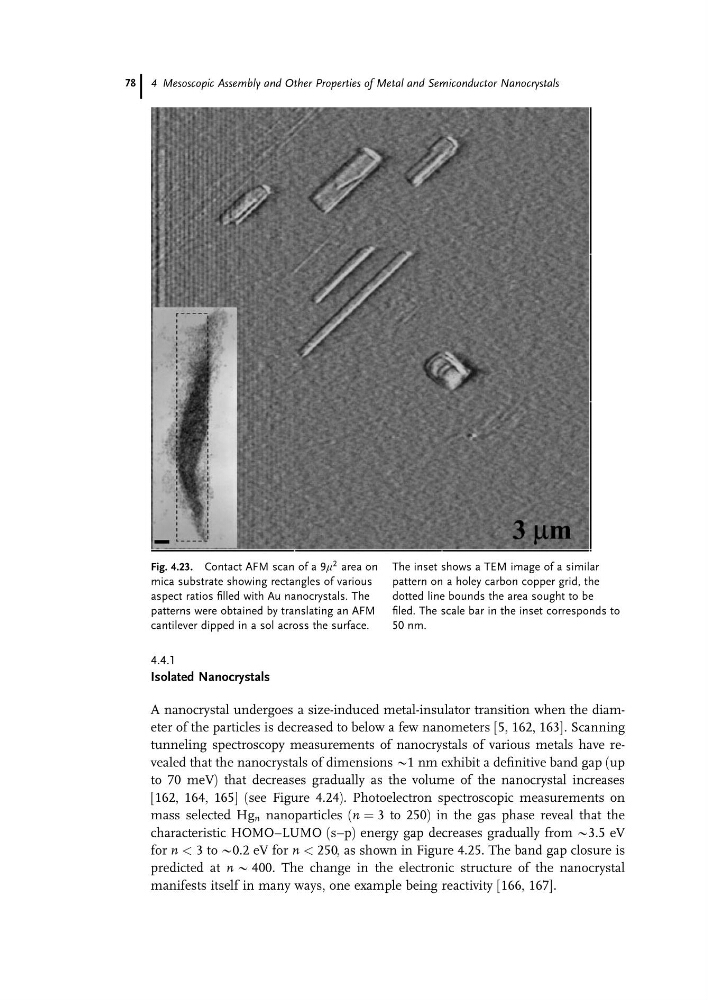
Fig. 4.23. Contact AFM scan of a 9m
2 area on
mica substrate showing rectangles of various
aspect ratios filled with Au nanocrystals. The
patterns were obtained by translating an AFM
cantilever dipped in a sol across the surface.
The inset shows a TEM image of a similar
pattern on a holey carbon copper grid, the
dotted line bounds the area sought to be
filed. The scale bar in the inset corresponds to
50 nm.
4 Mesoscopic Assembly and Other Properties of Metal and Semiconductor Nanocrystals
78
Isolated Nanocrystals
A nanocrystal undergoes a size-induced metal-insulator transition when the diameter of the particles is decreased to below a few nanometers [5, 162, 163]. Scanning
tunneling spectroscopy measurements of nanocrystals of various metals have revealed that the nanocrystals of dimensions @1 nm exhibit a definitive band gap (up
to 70 meV) that decreases gradually as the volume of the nanocrystal increases
[162, 164, 165] (see Figure 4.24). Photoelectron spectroscopic measurements on
mass selected Hg n nanoparticles (n ¼ 3 to 250) in the gas phase reveal that the
characteristic HOMO–LUMO (s–p) energy gap decreases gradually from @3.5 eV
for n < 3 to @0.2 eV for n < 250, as shown in Figure 4.25. The band gap closure is
predicted at n @ 400. The change in the electronic structure of the nanocrystal
manifests itself in many ways, one example being reactivity [166, 167].
Fig. 4.23. Contact AFM scan of a 9m
2 area on
mica substrate showing rectangles of various
aspect ratios filled with Au nanocrystals. The
patterns were obtained by translating an AFM
cantilever dipped in a sol across the surface.
The inset shows a TEM image of a similar
pattern on a holey carbon copper grid, the
dotted line bounds the area sought to be
filed. The scale bar in the inset corresponds to
50 nm.
4 Mesoscopic Assembly and Other Properties of Metal and Semiconductor Nanocrystals
78