

equilibrium state. Initial values of pressure, volume, temperature concentration and all other
parameters in each chamber will take on new thermodynamic equilibrium values. The
primary problem in thermodynamics is the computation of these parameters at the thermodynamic equilibrium.
It is important to point out again, by what we mean by a closed system. Because our
thermodynamic equilibrium is defined for a closed system. According to thermodynamics a
system is considered to be closed if it cannot exchange any energy, matter or anything
whatsoever with its surrounding. This assumption does not prevent us from solving any
engineering problem with fluctuating loads or masses. Because problem is always solved in
incremental time steps. At each step equilibrium must be satisfied” Callen (1985).
3.2 First Law of Thermodynamics
This law of thermodynamics states that the total energy is conserved in every
process. Therefore, it is sometimes referred to as the law of conservation of energy.
The law is independent of path taken between the initial and final states of the
system.
This law is generalized from experimental observations. Therefore, it is an
empirical conclusion. While mathematically, it is very difficult to prove this law,
we assume its validity because there is no way to disprove it mathematically or
experimentally [at least until now]. Now we can formulate the first law of thermodynamics for application in continuum mechanics. The conservation of energy can
be written as
d
dt
u þ k
ð
Þ¼W input þ Q input
ð3:1Þ
where u is the internal potential energy; k is the macro level kinetic energy; W input is
the work done by the system, due to external loads; and Q input is the energy added to
the system by heat transfer. Both W input and Q input do not have exact differentials.
Therefore,
P 1 , V 1 , N 1 , T 1 , C 1 , …
movable
adiabaƟc
separaƟon
wall
P 2 , V 2 , N 2 , T 2 , C 2 , …
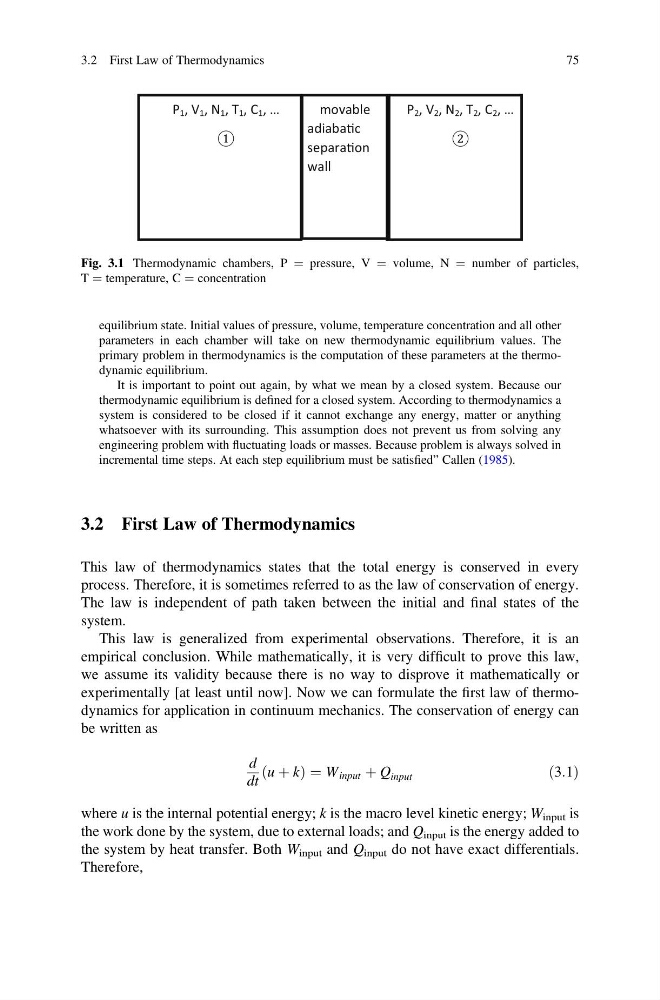
Fig. 3.1 Thermodynamic chambers, P ¼ pressure, V ¼ volume, N ¼ number of particles,
T ¼ temperature, C ¼ concentration
3.2 First Law of Thermodynamics
75
parameters in each chamber will take on new thermodynamic equilibrium values. The
primary problem in thermodynamics is the computation of these parameters at the thermodynamic equilibrium.
It is important to point out again, by what we mean by a closed system. Because our
thermodynamic equilibrium is defined for a closed system. According to thermodynamics a
system is considered to be closed if it cannot exchange any energy, matter or anything
whatsoever with its surrounding. This assumption does not prevent us from solving any
engineering problem with fluctuating loads or masses. Because problem is always solved in
incremental time steps. At each step equilibrium must be satisfied” Callen (1985).
3.2 First Law of Thermodynamics
This law of thermodynamics states that the total energy is conserved in every
process. Therefore, it is sometimes referred to as the law of conservation of energy.
The law is independent of path taken between the initial and final states of the
system.
This law is generalized from experimental observations. Therefore, it is an
empirical conclusion. While mathematically, it is very difficult to prove this law,
we assume its validity because there is no way to disprove it mathematically or
experimentally [at least until now]. Now we can formulate the first law of thermodynamics for application in continuum mechanics. The conservation of energy can
be written as
d
dt
u þ k
ð
Þ¼W input þ Q input
ð3:1Þ
where u is the internal potential energy; k is the macro level kinetic energy; W input is
the work done by the system, due to external loads; and Q input is the energy added to
the system by heat transfer. Both W input and Q input do not have exact differentials.
Therefore,
P 1 , V 1 , N 1 , T 1 , C 1 , …
movable
adiabaƟc
separaƟon
wall
P 2 , V 2 , N 2 , T 2 , C 2 , …
Fig. 3.1 Thermodynamic chambers, P ¼ pressure, V ¼ volume, N ¼ number of particles,
T ¼ temperature, C ¼ concentration
3.2 First Law of Thermodynamics
75