

Force is the time derivative of momentum; therefore, the concept of force is
redundant and subordinate to the conservation of momentum. In this section, we will
derive the force from conservation of momentum. According to the conservation of
momentum principle for a collection of particles, the time rate of change of the total
momentum of a given set of particles equals the vector sum of all the external forces
acting on the particles. It is assumed that Newton’s third law of action and reaction
governs the internal forces.
The continuum form of conservation of momentum principle is the basis for the
Newtonian continuum mechanics. In this book, the term “Newtonian mechanics” is
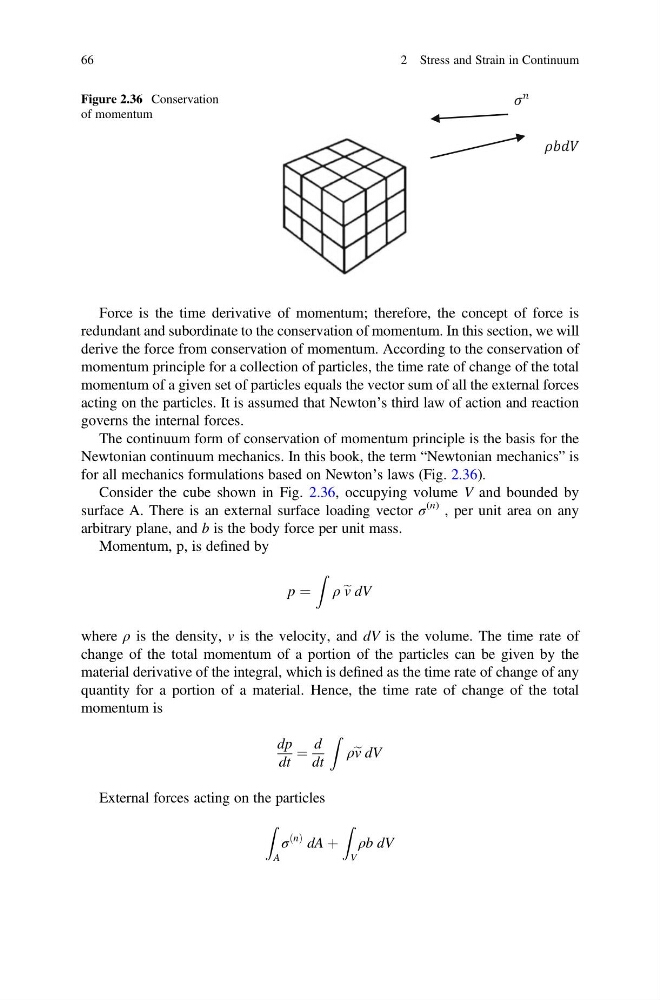
for all mechanics formulations based on Newton’s laws (Fig. 2.36).
Consider the cube shown in Fig. 2.36, occupying volume V and bounded by
surface A. There is an external surface loading vector σ
(n) , per unit area on any
arbitrary plane, and b is the body force per unit mass.
Momentum, p, is defined by
p ¼
Z
ρ e v dV
where ρ is the density, v is the velocity, and dV is the volume. The time rate of
change of the total momentum of a portion of the particles can be given by the
material derivative of the integral, which is defined as the time rate of change of any
quantity for a portion of a material. Hence, the time rate of change of the total
momentum is
dp
dt
¼
d
dt
Z
ρe v dV
External forces acting on the particles
Z
A
σ
n
ð Þ dA þ
Z
V
ρb dV
Figure 2.36 Conservation
of momentum
66
2 Stress and Strain in Continuum
redundant and subordinate to the conservation of momentum. In this section, we will
derive the force from conservation of momentum. According to the conservation of
momentum principle for a collection of particles, the time rate of change of the total
momentum of a given set of particles equals the vector sum of all the external forces
acting on the particles. It is assumed that Newton’s third law of action and reaction
governs the internal forces.
The continuum form of conservation of momentum principle is the basis for the
Newtonian continuum mechanics. In this book, the term “Newtonian mechanics” is
for all mechanics formulations based on Newton’s laws (Fig. 2.36).
Consider the cube shown in Fig. 2.36, occupying volume V and bounded by
surface A. There is an external surface loading vector σ
(n) , per unit area on any
arbitrary plane, and b is the body force per unit mass.
Momentum, p, is defined by
p ¼
Z
ρ e v dV
where ρ is the density, v is the velocity, and dV is the volume. The time rate of
change of the total momentum of a portion of the particles can be given by the
material derivative of the integral, which is defined as the time rate of change of any
quantity for a portion of a material. Hence, the time rate of change of the total
momentum is
dp
dt
¼
d
dt
Z
ρe v dV
External forces acting on the particles
Z
A
σ
n
ð Þ dA þ
Z
V
ρb dV
Figure 2.36 Conservation
of momentum
66
2 Stress and Strain in Continuum