

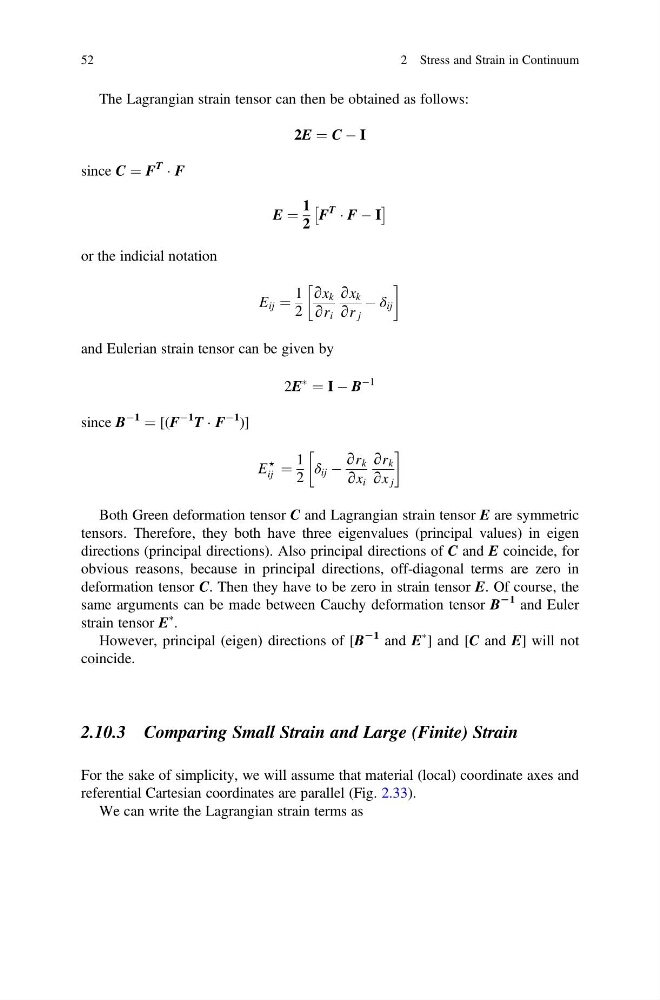
The Lagrangian strain tensor can then be obtained as follows:
2E ¼ C À I
since C ¼ F
T
Á F
E ¼
1
2
F
T
Á F À I
Â
Ã
or the indicial notation
E ij ¼
1
2
∂x k
∂r i
∂x k
∂r j
À δ ij
!
and Eulerian strain tensor can be given by
2E
Ã
¼ I À B
À1
since B
À1
¼ [(F
À1 T Á F
À1 )]
E
⋆
ij ¼
1
2
δ ij À
∂r k
∂x i
∂r k
∂x j
!
Both Green deformation tensor C and Lagrangian strain tensor E are symmetric
tensors. Therefore, they both have three eigenvalues (principal values) in eigen
directions (principal directions). Also principal directions of C and E coincide, for
obvious reasons, because in principal directions, off-diagonal terms are zero in
deformation tensor C. Then they have to be zero in strain tensor E. Of course, the
same arguments can be made between Cauchy deformation tensor B
21 and Euler
strain tensor E
à .
However, principal (eigen) directions of [B
21 and E
à ] and [C and E] will not
coincide.
2.10.3 Comparing Small Strain and Large (Finite) Strain
For the sake of simplicity, we will assume that material (local) coordinate axes and
referential Cartesian coordinates are parallel (Fig. 2.33).
We can write the Lagrangian strain terms as
52
2 Stress and Strain in Continuum
2E ¼ C À I
since C ¼ F
T
Á F
E ¼
1
2
F
T
Á F À I
Â
Ã
or the indicial notation
E ij ¼
1
2
∂x k
∂r i
∂x k
∂r j
À δ ij
!
and Eulerian strain tensor can be given by
2E
Ã
¼ I À B
À1
since B
À1
¼ [(F
À1 T Á F
À1 )]
E
⋆
ij ¼
1
2
δ ij À
∂r k
∂x i
∂r k
∂x j
!
Both Green deformation tensor C and Lagrangian strain tensor E are symmetric
tensors. Therefore, they both have three eigenvalues (principal values) in eigen
directions (principal directions). Also principal directions of C and E coincide, for
obvious reasons, because in principal directions, off-diagonal terms are zero in
deformation tensor C. Then they have to be zero in strain tensor E. Of course, the
same arguments can be made between Cauchy deformation tensor B
21 and Euler
strain tensor E
à .
However, principal (eigen) directions of [B
21 and E
à ] and [C and E] will not
coincide.
2.10.3 Comparing Small Strain and Large (Finite) Strain
For the sake of simplicity, we will assume that material (local) coordinate axes and
referential Cartesian coordinates are parallel (Fig. 2.33).
We can write the Lagrangian strain terms as
52
2 Stress and Strain in Continuum