

It is important to point out that the initial (undeformed) position is the independent variable and as the reference state in these small strain calculations. In other
words, the change in per unit length is with respect to the initial length. If we take the
deformed position as the reference state and as the independent variable, we end up
with a different formulation of strain. Of course, these two reference states will lead
to two different numerically different strain values.
2.7.1.3 Pure Rigid Body Motion
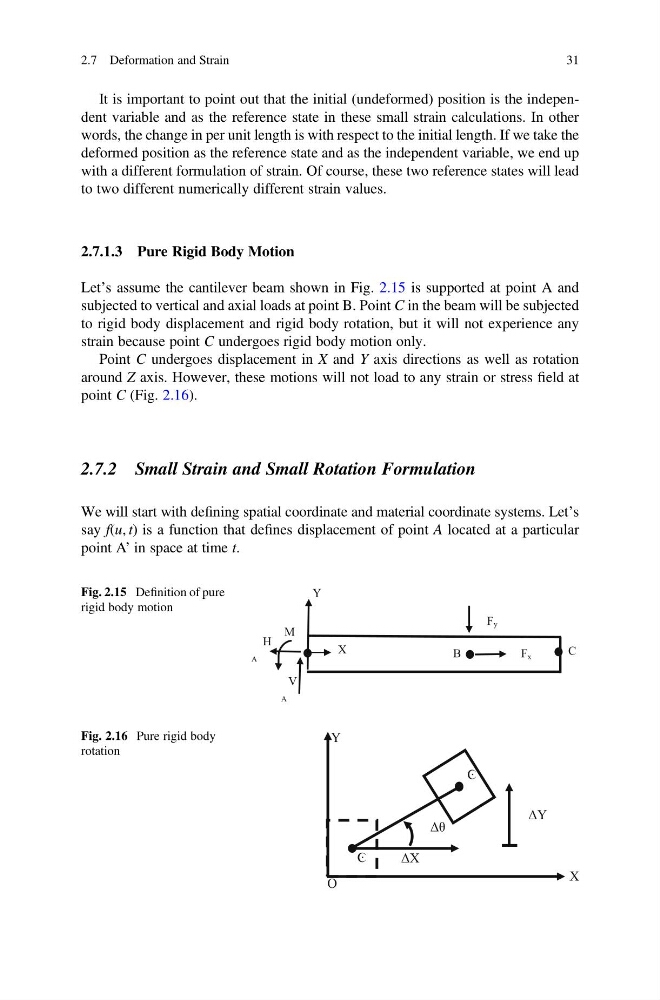
Let’s assume the cantilever beam shown in Fig. 2.15 is supported at point A and
subjected to vertical and axial loads at point B. Point C in the beam will be subjected
to rigid body displacement and rigid body rotation, but it will not experience any
strain because point C undergoes rigid body motion only.
Point C undergoes displacement in X and Y axis directions as well as rotation
around Z axis. However, these motions will not load to any strain or stress field at
point C (Fig. 2.16).
2.7.2 Small Strain and Small Rotation Formulation
We will start with defining spatial coordinate and material coordinate systems. Let’s
say f(u, t) is a function that defines displacement of point A located at a particular
point A’ in space at time t.
V
A
M
Y
X
B
C
H
A
F y
F x
Fig. 2.15 Definition of pure
rigid body motion
Y
X
O
ΔX
Δθ
ΔY
Ͼ
Ͼ
Fig. 2.16 Pure rigid body
rotation
2.7 Deformation and Strain
31
words, the change in per unit length is with respect to the initial length. If we take the
deformed position as the reference state and as the independent variable, we end up
with a different formulation of strain. Of course, these two reference states will lead
to two different numerically different strain values.
2.7.1.3 Pure Rigid Body Motion
Let’s assume the cantilever beam shown in Fig. 2.15 is supported at point A and
subjected to vertical and axial loads at point B. Point C in the beam will be subjected
to rigid body displacement and rigid body rotation, but it will not experience any
strain because point C undergoes rigid body motion only.
Point C undergoes displacement in X and Y axis directions as well as rotation
around Z axis. However, these motions will not load to any strain or stress field at
point C (Fig. 2.16).
2.7.2 Small Strain and Small Rotation Formulation
We will start with defining spatial coordinate and material coordinate systems. Let’s
say f(u, t) is a function that defines displacement of point A located at a particular
point A’ in space at time t.
V
A
M
Y
X
B
C
H
A
F y
F x
Fig. 2.15 Definition of pure
rigid body motion
Y
X
O
ΔX
Δθ
ΔY
Ͼ
Ͼ
Fig. 2.16 Pure rigid body
rotation
2.7 Deformation and Strain
31