

of finite strain (large strain) is quite complex. Therefore, for many engineering
problems, small strain theory is used. For many problems, this approach is satisfactory with a reasonable degree of error.
First, we will present the small strain formulation and then more complex large
strain (finite strain) formulation. Rigid body motion does not lead to any strain.
2.7.1 Small Strain Definition
There is no magic number that defines the boundary between small strain theory and
large strain theory. However, any strain value less than 2% is usually, but not always,
considered a small strain. Decision to use small or large strain formulation depends
on the problem at hand and of the material properties. Now we will define strains
with respect to initial (undeformed) configuration.
2.7.1.1 Elementary Definition of Pure Uniaxial Strain
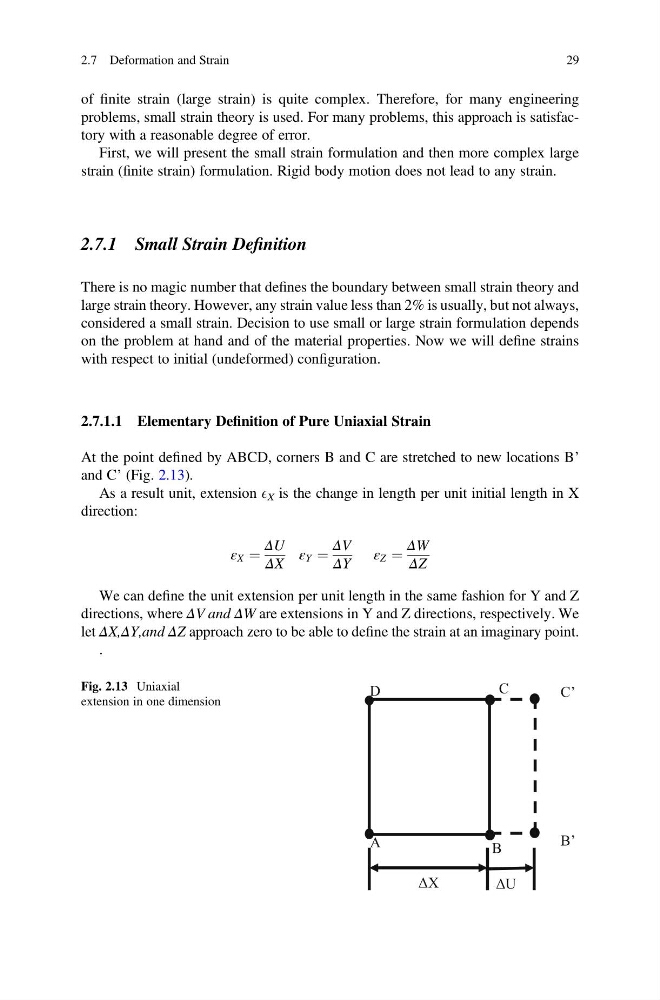
At the point defined by ABCD, corners B and C are stretched to new locations B’
and C’ (Fig. 2.13).
As a result unit, extension E X is the change in length per unit initial length in X
direction:
ε X ¼
ΔU
ΔX
ε Y ¼
ΔV
ΔY
ε Z ¼
ΔW
ΔZ
We can define the unit extension per unit length in the same fashion for Y and Z
directions, where ΔV and ΔW are extensions in Y and Z directions, respectively. We
let ΔX,ΔY,and ΔZ approach zero to be able to define the strain at an imaginary point.
.
A
B
C
D
C’
B’
ΔX
ΔU
Fig. 2.13 Uniaxial
extension in one dimension
2.7 Deformation and Strain
29
problems, small strain theory is used. For many problems, this approach is satisfactory with a reasonable degree of error.
First, we will present the small strain formulation and then more complex large
strain (finite strain) formulation. Rigid body motion does not lead to any strain.
2.7.1 Small Strain Definition
There is no magic number that defines the boundary between small strain theory and
large strain theory. However, any strain value less than 2% is usually, but not always,
considered a small strain. Decision to use small or large strain formulation depends
on the problem at hand and of the material properties. Now we will define strains
with respect to initial (undeformed) configuration.
2.7.1.1 Elementary Definition of Pure Uniaxial Strain
At the point defined by ABCD, corners B and C are stretched to new locations B’
and C’ (Fig. 2.13).
As a result unit, extension E X is the change in length per unit initial length in X
direction:
ε X ¼
ΔU
ΔX
ε Y ¼
ΔV
ΔY
ε Z ¼
ΔW
ΔZ
We can define the unit extension per unit length in the same fashion for Y and Z
directions, where ΔV and ΔW are extensions in Y and Z directions, respectively. We
let ΔX,ΔY,and ΔZ approach zero to be able to define the strain at an imaginary point.
.
A
B
C
D
C’
B’
ΔX
ΔU
Fig. 2.13 Uniaxial
extension in one dimension
2.7 Deformation and Strain
29