

the length of the molecular bond. Evolution of thermal damage is much slower than
evolution of mechanical damage. Remarkable thermal gradients over long periods of
time are necessary to induce permanent cracks and voids in materials, e.g., freezingthawing cycles, thermal shock, etc. Therefore, mechanical and thermal damage
induced in a material have different sources, and damage evolution in both types
must be defined separately in the case of thermo-mechanical loading. As failure in
isothermal stretching of PMMA is completely induced by mechanical loading,
damage evolution must be only based on evolution of irreversible mechanical
entropy production. In experimental studies on metal fatigue fracture, it is found
that cumulative entropy generation was constant at the time of failure (Fatigue
Fracture Entropy) which was independent of structural geometry, load intensity,
and loading frequency. It is observed by many researchers that rate dependence of
critical entropy density is negligible while critical entropy density significantly
increases with increasing temperature because of increasing plastic dissipation
prior to failure. Mechanical damage evolution is completely based on irreversible
mechanical entropy production, i.e., intrinsic dissipation; temperature variation of
plastic dissipation is also observed in critical entropy production values, as well.
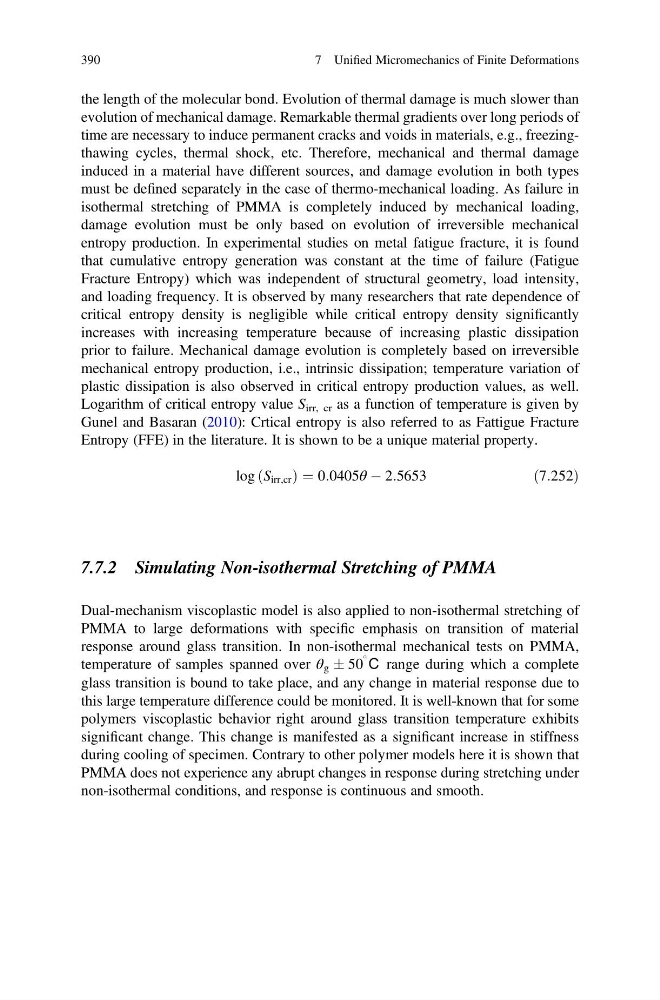
Logarithm of critical entropy value S irr, cr as a function of temperature is given by
Gunel and Basaran (2010): Crtical entropy is also referred to as Fattigue Fracture
Entropy (FFE) in the literature. It is shown to be a unique material property.
log S irr,cr
ð
Þ¼0:0405θ À 2:5653
ð7:252Þ
7.7.2 Simulating Non-isothermal Stretching of PMMA
Dual-mechanism viscoplastic model is also applied to non-isothermal stretching of
PMMA to large deformations with specific emphasis on transition of material
response around glass transition. In non-isothermal mechanical tests on PMMA,
temperature of samples spanned over θ g Æ 50
C range during which a complete
glass transition is bound to take place, and any change in material response due to
this large temperature difference could be monitored. It is well-known that for some
polymers viscoplastic behavior right around glass transition temperature exhibits
significant change. This change is manifested as a significant increase in stiffness
during cooling of specimen. Contrary to other polymer models here it is shown that
PMMA does not experience any abrupt changes in response during stretching under
non-isothermal conditions, and response is continuous and smooth.
390
7 Unified Micromechanics of Finite Deformations
evolution of mechanical damage. Remarkable thermal gradients over long periods of
time are necessary to induce permanent cracks and voids in materials, e.g., freezingthawing cycles, thermal shock, etc. Therefore, mechanical and thermal damage
induced in a material have different sources, and damage evolution in both types
must be defined separately in the case of thermo-mechanical loading. As failure in
isothermal stretching of PMMA is completely induced by mechanical loading,
damage evolution must be only based on evolution of irreversible mechanical
entropy production. In experimental studies on metal fatigue fracture, it is found
that cumulative entropy generation was constant at the time of failure (Fatigue
Fracture Entropy) which was independent of structural geometry, load intensity,
and loading frequency. It is observed by many researchers that rate dependence of
critical entropy density is negligible while critical entropy density significantly
increases with increasing temperature because of increasing plastic dissipation
prior to failure. Mechanical damage evolution is completely based on irreversible
mechanical entropy production, i.e., intrinsic dissipation; temperature variation of
plastic dissipation is also observed in critical entropy production values, as well.
Logarithm of critical entropy value S irr, cr as a function of temperature is given by
Gunel and Basaran (2010): Crtical entropy is also referred to as Fattigue Fracture
Entropy (FFE) in the literature. It is shown to be a unique material property.
log S irr,cr
ð
Þ¼0:0405θ À 2:5653
ð7:252Þ
7.7.2 Simulating Non-isothermal Stretching of PMMA
Dual-mechanism viscoplastic model is also applied to non-isothermal stretching of
PMMA to large deformations with specific emphasis on transition of material
response around glass transition. In non-isothermal mechanical tests on PMMA,
temperature of samples spanned over θ g Æ 50
C range during which a complete
glass transition is bound to take place, and any change in material response due to
this large temperature difference could be monitored. It is well-known that for some
polymers viscoplastic behavior right around glass transition temperature exhibits
significant change. This change is manifested as a significant increase in stiffness
during cooling of specimen. Contrary to other polymer models here it is shown that
PMMA does not experience any abrupt changes in response during stretching under
non-isothermal conditions, and response is continuous and smooth.
390
7 Unified Micromechanics of Finite Deformations