

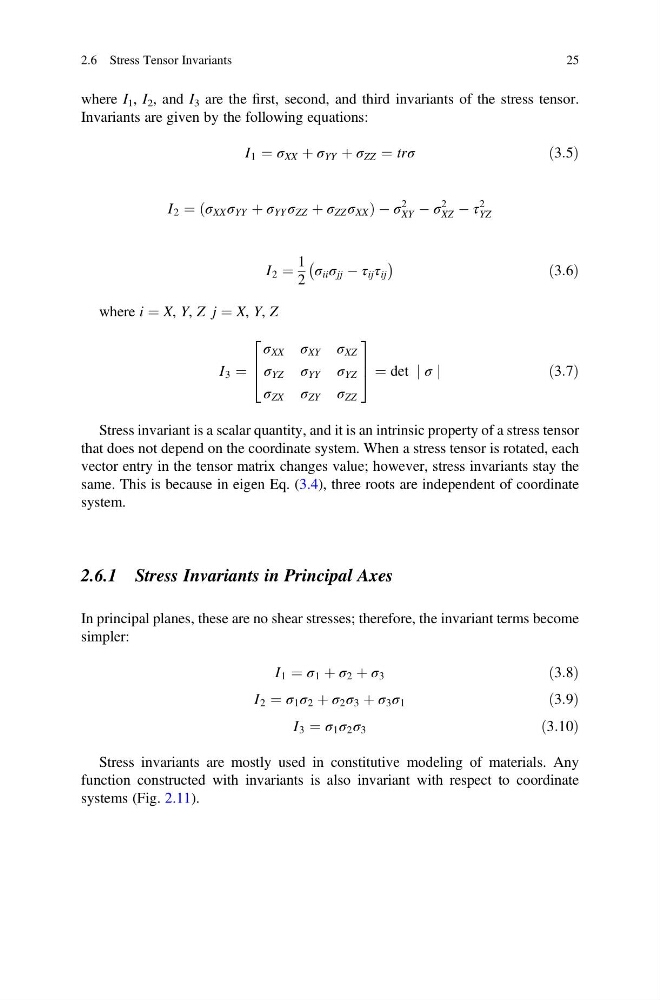
where I 1 , I 2 , and I 3 are the first, second, and third invariants of the stress tensor.
Invariants are given by the following equations:
I 1 ¼ σ XX þ σ YY þ σ ZZ ¼ trσ
ð3:5Þ
I 2 ¼ σ XX σ YY þ σ YY σ ZZ þ σ ZZ σ XX
ð
Þ À σ
2
XY À σ
2
XZ À τ
2
YZ
I 2 ¼
1
2
σ ii σ jj À τ ij τ ij
À
Á
ð3:6Þ
where i ¼ X, Y, Z j ¼ X, Y, Z
I 3 ¼
σ XX σ XY σ XZ
σ YZ σ YY σ YZ
σ ZX σ ZY σ ZZ
2
6
4
3
7
5 ¼ det j σ j
ð 3:7Þ
Stress invariant is a scalar quantity, and it is an intrinsic property of a stress tensor
that does not depend on the coordinate system. When a stress tensor is rotated, each
vector entry in the tensor matrix changes value; however, stress invariants stay the
same. This is because in eigen Eq. (3.4), three roots are independent of coordinate
system.
2.6.1 Stress Invariants in Principal Axes
In principal planes, these are no shear stresses; therefore, the invariant terms become
simpler:
I 1 ¼ σ 1 þ σ 2 þ σ 3
ð3:8Þ
I 2 ¼ σ 1 σ 2 þ σ 2 σ 3 þ σ 3 σ 1
ð3:9Þ
I 3 ¼ σ 1 σ 2 σ 3
ð3:10Þ
Stress invariants are mostly used in constitutive modeling of materials. Any
function constructed with invariants is also invariant with respect to coordinate
systems (Fig. 2.11).
2.6 Stress Tensor Invariants
25
Invariants are given by the following equations:
I 1 ¼ σ XX þ σ YY þ σ ZZ ¼ trσ
ð3:5Þ
I 2 ¼ σ XX σ YY þ σ YY σ ZZ þ σ ZZ σ XX
ð
Þ À σ
2
XY À σ
2
XZ À τ
2
YZ
I 2 ¼
1
2
σ ii σ jj À τ ij τ ij
À
Á
ð3:6Þ
where i ¼ X, Y, Z j ¼ X, Y, Z
I 3 ¼
σ XX σ XY σ XZ
σ YZ σ YY σ YZ
σ ZX σ ZY σ ZZ
2
6
4
3
7
5 ¼ det j σ j
ð 3:7Þ
Stress invariant is a scalar quantity, and it is an intrinsic property of a stress tensor
that does not depend on the coordinate system. When a stress tensor is rotated, each
vector entry in the tensor matrix changes value; however, stress invariants stay the
same. This is because in eigen Eq. (3.4), three roots are independent of coordinate
system.
2.6.1 Stress Invariants in Principal Axes
In principal planes, these are no shear stresses; therefore, the invariant terms become
simpler:
I 1 ¼ σ 1 þ σ 2 þ σ 3
ð3:8Þ
I 2 ¼ σ 1 σ 2 þ σ 2 σ 3 þ σ 3 σ 1
ð3:9Þ
I 3 ¼ σ 1 σ 2 σ 3
ð3:10Þ
Stress invariants are mostly used in constitutive modeling of materials. Any
function constructed with invariants is also invariant with respect to coordinate
systems (Fig. 2.11).
2.6 Stress Tensor Invariants
25