

F
p
¼ V
p R
p
¼ ΩV
p
Ω
T
ΩR
p
ð7:69Þ
V
p
¼ ΩV
p
Ω
T
ð7:70Þ
C
p
¼ U
p U
p
¼ U
p U
p
¼ C
p
ð7:71Þ
B
p
¼ V
p V
p
¼ ΩV
p
Ω
T
ΩV
p
Ω
T
¼ ΩB
p
Ω
T
ð7:72Þ
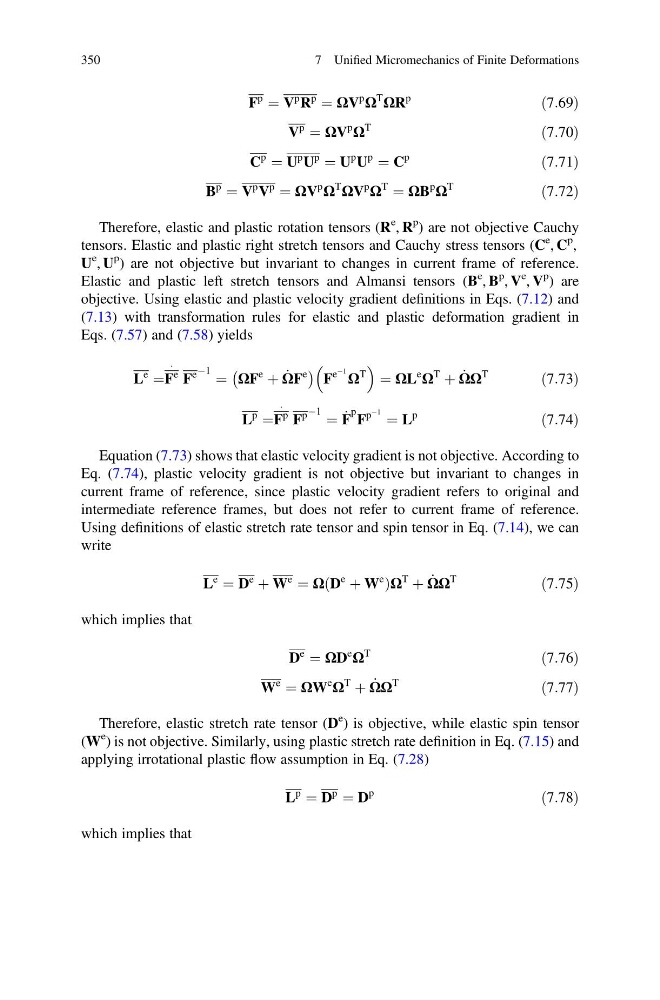
Therefore, elastic and plastic rotation tensors (R
e
, R
p ) are not objective Cauchy
tensors. Elastic and plastic right stretch tensors and Cauchy stress tensors (C
e , C
p ,
U
e
, U
p ) are not objective but invariant to changes in current frame of reference.
Elastic and plastic left stretch tensors and Almansi tensors (B
e , B
p
, V
e , V
p ) are
objective. Using elastic and plastic velocity gradient definitions in Eqs. (7.12) and
(7.13) with transformation rules for elastic and plastic deformation gradient in
Eqs. (7.57) and (7.58) yields
L
e
¼F
e
:
F
e À1 ¼ ΩF
e
þ _
ΩF
e
À
Á
F
e
À1 Ω
T
¼ ΩL
e
Ω
T
þ _
ΩΩ
T
ð7:73Þ
L
p
¼F
p
:
F
p À1 ¼ _
F
p F
p
À1 ¼ L
p
ð7:74Þ
Equation (7.73) shows that elastic velocity gradient is not objective. According to
Eq. (7.74), plastic velocity gradient is not objective but invariant to changes in
current frame of reference, since plastic velocity gradient refers to original and
intermediate reference frames, but does not refer to current frame of reference.
Using definitions of elastic stretch rate tensor and spin tensor in Eq. (7.14), we can
write
L
e
¼ D
e
þ W
e
¼ Ω D
e
þ W
e
ð
Þ Ω
T
þ _
ΩΩ
T
ð7:75Þ
which implies that
D
e
¼ ΩD
e
Ω
T
ð7:76Þ
W
e
¼ ΩW
e
Ω
T
þ _
ΩΩ
T
ð7:77Þ
Therefore, elastic stretch rate tensor (D
e ) is objective, while elastic spin tensor
(W
e ) is not objective. Similarly, using plastic stretch rate definition in Eq. (7.15) and
applying irrotational plastic flow assumption in Eq. (7.28)
L
p
¼ D
p
¼ D
p
ð7:78Þ
which implies that
350
7 Unified Micromechanics of Finite Deformations
p
¼ V
p R
p
¼ ΩV
p
Ω
T
ΩR
p
ð7:69Þ
V
p
¼ ΩV
p
Ω
T
ð7:70Þ
C
p
¼ U
p U
p
¼ U
p U
p
¼ C
p
ð7:71Þ
B
p
¼ V
p V
p
¼ ΩV
p
Ω
T
ΩV
p
Ω
T
¼ ΩB
p
Ω
T
ð7:72Þ
Therefore, elastic and plastic rotation tensors (R
e
, R
p ) are not objective Cauchy
tensors. Elastic and plastic right stretch tensors and Cauchy stress tensors (C
e , C
p ,
U
e
, U
p ) are not objective but invariant to changes in current frame of reference.
Elastic and plastic left stretch tensors and Almansi tensors (B
e , B
p
, V
e , V
p ) are
objective. Using elastic and plastic velocity gradient definitions in Eqs. (7.12) and
(7.13) with transformation rules for elastic and plastic deformation gradient in
Eqs. (7.57) and (7.58) yields
L
e
¼F
e
:
F
e À1 ¼ ΩF
e
þ _
ΩF
e
À
Á
F
e
À1 Ω
T
¼ ΩL
e
Ω
T
þ _
ΩΩ
T
ð7:73Þ
L
p
¼F
p
:
F
p À1 ¼ _
F
p F
p
À1 ¼ L
p
ð7:74Þ
Equation (7.73) shows that elastic velocity gradient is not objective. According to
Eq. (7.74), plastic velocity gradient is not objective but invariant to changes in
current frame of reference, since plastic velocity gradient refers to original and
intermediate reference frames, but does not refer to current frame of reference.
Using definitions of elastic stretch rate tensor and spin tensor in Eq. (7.14), we can
write
L
e
¼ D
e
þ W
e
¼ Ω D
e
þ W
e
ð
Þ Ω
T
þ _
ΩΩ
T
ð7:75Þ
which implies that
D
e
¼ ΩD
e
Ω
T
ð7:76Þ
W
e
¼ ΩW
e
Ω
T
þ _
ΩΩ
T
ð7:77Þ
Therefore, elastic stretch rate tensor (D
e ) is objective, while elastic spin tensor
(W
e ) is not objective. Similarly, using plastic stretch rate definition in Eq. (7.15) and
applying irrotational plastic flow assumption in Eq. (7.28)
L
p
¼ D
p
¼ D
p
ð7:78Þ
which implies that
350
7 Unified Micromechanics of Finite Deformations