

the original coordinate system. One of these orientations will give a maximum stress
value.
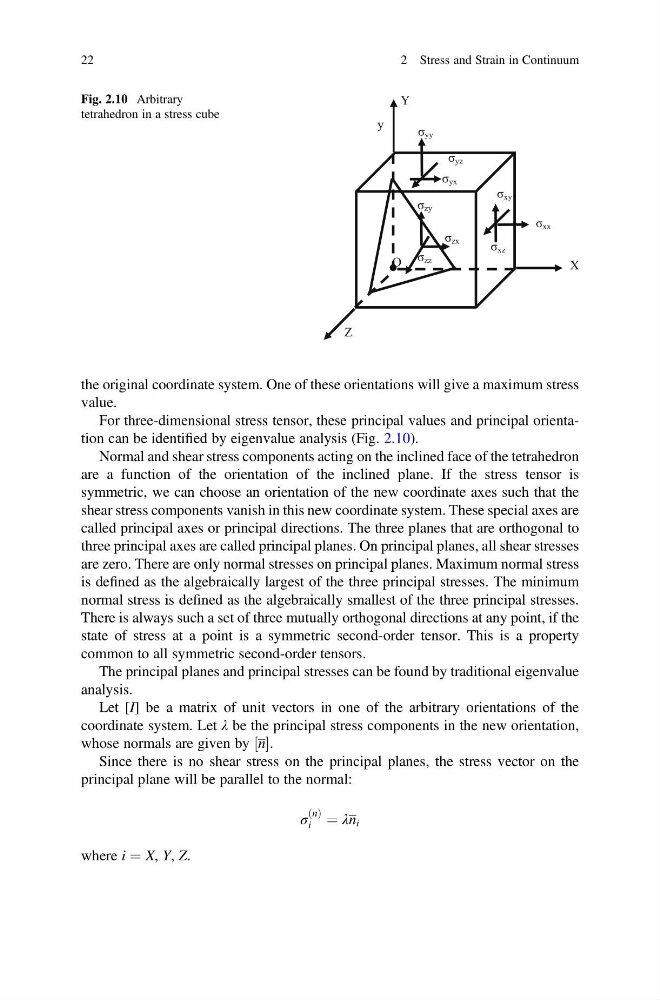
For three-dimensional stress tensor, these principal values and principal orientation can be identified by eigenvalue analysis (Fig. 2.10).
Normal and shear stress components acting on the inclined face of the tetrahedron
are a function of the orientation of the inclined plane. If the stress tensor is
symmetric, we can choose an orientation of the new coordinate axes such that the
shear stress components vanish in this new coordinate system. These special axes are
called principal axes or principal directions. The three planes that are orthogonal to
three principal axes are called principal planes. On principal planes, all shear stresses
are zero. There are only normal stresses on principal planes. Maximum normal stress
is defined as the algebraically largest of the three principal stresses. The minimum
normal stress is defined as the algebraically smallest of the three principal stresses.
There is always such a set of three mutually orthogonal directions at any point, if the
state of stress at a point is a symmetric second-order tensor. This is a property
common to all symmetric second-order tensors.
The principal planes and principal stresses can be found by traditional eigenvalue
analysis.
Let [I] be a matrix of unit vectors in one of the arbitrary orientations of the
coordinate system. Let λ be the principal stress components in the new orientation,
whose normals are given by n
½ .
Since there is no shear stress on the principal planes, the stress vector on the
principal plane will be parallel to the normal:
σ
n
ð Þ
i ¼ λn i
where i ¼ X, Y, Z.
y
Z
σ yz
σ xz
X
O
σ yx
σ yy
σ xx
σ xy
σ zx
σ zy
σ zz
Y
Fig. 2.10 Arbitrary
tetrahedron in a stress cube
22
2 Stress and Strain in Continuum
value.
For three-dimensional stress tensor, these principal values and principal orientation can be identified by eigenvalue analysis (Fig. 2.10).
Normal and shear stress components acting on the inclined face of the tetrahedron
are a function of the orientation of the inclined plane. If the stress tensor is
symmetric, we can choose an orientation of the new coordinate axes such that the
shear stress components vanish in this new coordinate system. These special axes are
called principal axes or principal directions. The three planes that are orthogonal to
three principal axes are called principal planes. On principal planes, all shear stresses
are zero. There are only normal stresses on principal planes. Maximum normal stress
is defined as the algebraically largest of the three principal stresses. The minimum
normal stress is defined as the algebraically smallest of the three principal stresses.
There is always such a set of three mutually orthogonal directions at any point, if the
state of stress at a point is a symmetric second-order tensor. This is a property
common to all symmetric second-order tensors.
The principal planes and principal stresses can be found by traditional eigenvalue
analysis.
Let [I] be a matrix of unit vectors in one of the arbitrary orientations of the
coordinate system. Let λ be the principal stress components in the new orientation,
whose normals are given by n
½ .
Since there is no shear stress on the principal planes, the stress vector on the
principal plane will be parallel to the normal:
σ
n
ð Þ
i ¼ λn i
where i ¼ X, Y, Z.
y
Z
σ yz
σ xz
X
O
σ yx
σ yy
σ xx
σ xy
σ zx
σ zy
σ zz
Y
Fig. 2.10 Arbitrary
tetrahedron in a stress cube
22
2 Stress and Strain in Continuum