

model the imperfect interface condition. The displacement jumps are defined by the
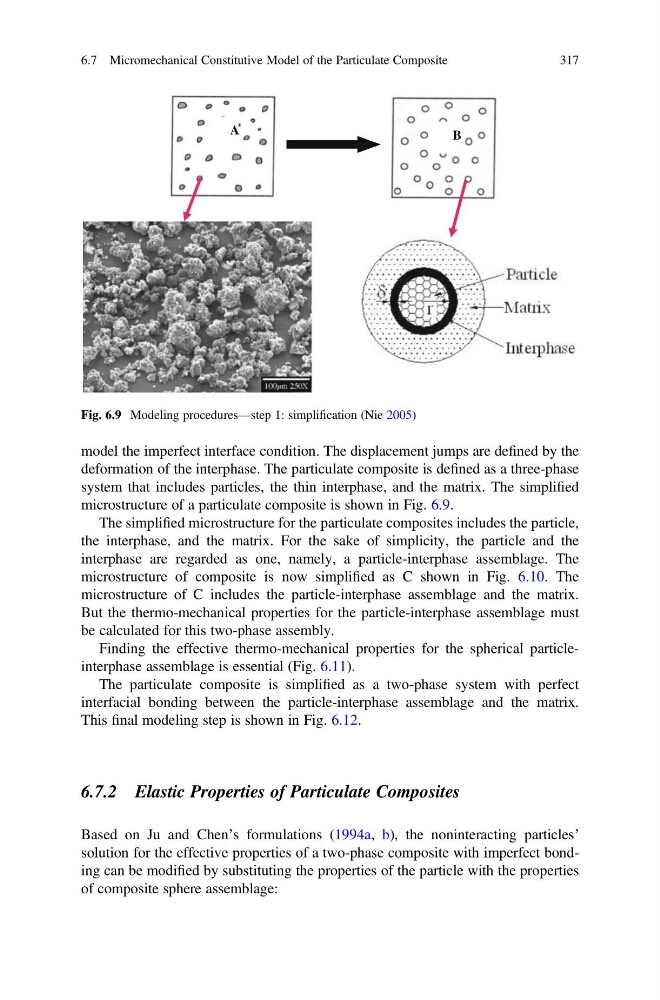
deformation of the interphase. The particulate composite is defined as a three-phase
system that includes particles, the thin interphase, and the matrix. The simplified
microstructure of a particulate composite is shown in Fig. 6.9.
The simplified microstructure for the particulate composites includes the particle,
the interphase, and the matrix. For the sake of simplicity, the particle and the
interphase are regarded as one, namely, a particle-interphase assemblage. The
microstructure of composite is now simplified as C shown in Fig. 6.10. The
microstructure of C includes the particle-interphase assemblage and the matrix.
But the thermo-mechanical properties for the particle-interphase assemblage must
be calculated for this two-phase assembly.
Finding the effective thermo-mechanical properties for the spherical particleinterphase assemblage is essential (Fig. 6.11).
The particulate composite is simplified as a two-phase system with perfect
interfacial bonding between the particle-interphase assemblage and the matrix.
This final modeling step is shown in Fig. 6.12.
6.7.2 Elastic Properties of Particulate Composites
Based on Ju and Chen’s formulations (1994a, b), the noninteracting particles’
solution for the effective properties of a two-phase composite with imperfect bonding can be modified by substituting the properties of the particle with the properties
of composite sphere assemblage:
A
B
Fig. 6.9 Modeling procedures—step 1: simplification (Nie 2005)
6.7 Micromechanical Constitutive Model of the Particulate Composite
317
deformation of the interphase. The particulate composite is defined as a three-phase
system that includes particles, the thin interphase, and the matrix. The simplified
microstructure of a particulate composite is shown in Fig. 6.9.
The simplified microstructure for the particulate composites includes the particle,
the interphase, and the matrix. For the sake of simplicity, the particle and the
interphase are regarded as one, namely, a particle-interphase assemblage. The
microstructure of composite is now simplified as C shown in Fig. 6.10. The
microstructure of C includes the particle-interphase assemblage and the matrix.
But the thermo-mechanical properties for the particle-interphase assemblage must
be calculated for this two-phase assembly.
Finding the effective thermo-mechanical properties for the spherical particleinterphase assemblage is essential (Fig. 6.11).
The particulate composite is simplified as a two-phase system with perfect
interfacial bonding between the particle-interphase assemblage and the matrix.
This final modeling step is shown in Fig. 6.12.
6.7.2 Elastic Properties of Particulate Composites
Based on Ju and Chen’s formulations (1994a, b), the noninteracting particles’
solution for the effective properties of a two-phase composite with imperfect bonding can be modified by substituting the properties of the particle with the properties
of composite sphere assemblage:
A
B
Fig. 6.9 Modeling procedures—step 1: simplification (Nie 2005)
6.7 Micromechanical Constitutive Model of the Particulate Composite
317