

v i ¼ 0:31
α i ¼ 70 Â 10
À6
=
0 C
δ/r ¼ 0.01 and δ/r ¼ 0.001
The nondimensional interface parameter is defined as q ¼ E f /E i . A zero value of
q implies that there are no interface displacement jumps and the perfectly bonded
interface conditions exist. At the other extreme, infinite value of q implies that the
interface tractions do not exist and the filler is debonded from the adjoining matrix
media. Finite positive values for q define an imperfect interface, which lies between
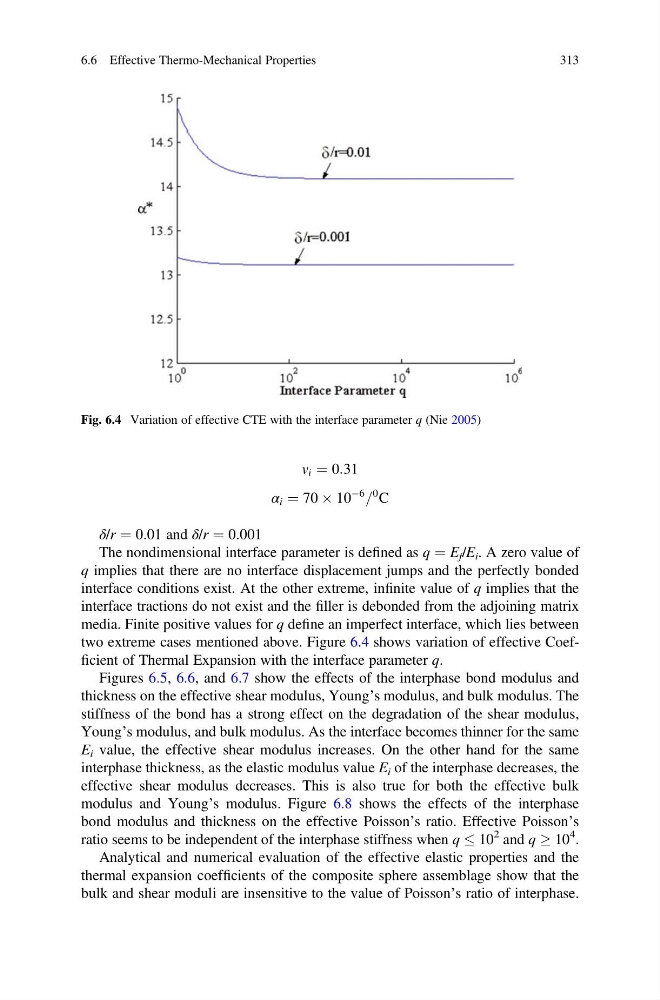
two extreme cases mentioned above. Figure 6.4 shows variation of effective Coefficient of Thermal Expansion with the interface parameter q.
Figures 6.5, 6.6, and 6.7 show the effects of the interphase bond modulus and
thickness on the effective shear modulus, Young’s modulus, and bulk modulus. The
stiffness of the bond has a strong effect on the degradation of the shear modulus,
Young’s modulus, and bulk modulus. As the interface becomes thinner for the same
E i value, the effective shear modulus increases. On the other hand for the same
interphase thickness, as the elastic modulus value E i of the interphase decreases, the
effective shear modulus decreases. This is also true for both the effective bulk
modulus and Young’s modulus. Figure 6.8 shows the effects of the interphase
bond modulus and thickness on the effective Poisson’s ratio. Effective Poisson’s
ratio seems to be independent of the interphase stiffness when q 10
2 and q ! 10
4 .
Analytical and numerical evaluation of the effective elastic properties and the
thermal expansion coefficients of the composite sphere assemblage show that the
bulk and shear moduli are insensitive to the value of Poisson’s ratio of interphase.
Fig. 6.4 Variation of effective CTE with the interface parameter q (Nie 2005)
6.6 Effective Thermo-Mechanical Properties
313
α i ¼ 70 Â 10
À6
=
0 C
δ/r ¼ 0.01 and δ/r ¼ 0.001
The nondimensional interface parameter is defined as q ¼ E f /E i . A zero value of
q implies that there are no interface displacement jumps and the perfectly bonded
interface conditions exist. At the other extreme, infinite value of q implies that the
interface tractions do not exist and the filler is debonded from the adjoining matrix
media. Finite positive values for q define an imperfect interface, which lies between
two extreme cases mentioned above. Figure 6.4 shows variation of effective Coefficient of Thermal Expansion with the interface parameter q.
Figures 6.5, 6.6, and 6.7 show the effects of the interphase bond modulus and
thickness on the effective shear modulus, Young’s modulus, and bulk modulus. The
stiffness of the bond has a strong effect on the degradation of the shear modulus,
Young’s modulus, and bulk modulus. As the interface becomes thinner for the same
E i value, the effective shear modulus increases. On the other hand for the same
interphase thickness, as the elastic modulus value E i of the interphase decreases, the
effective shear modulus decreases. This is also true for both the effective bulk
modulus and Young’s modulus. Figure 6.8 shows the effects of the interphase
bond modulus and thickness on the effective Poisson’s ratio. Effective Poisson’s
ratio seems to be independent of the interphase stiffness when q 10
2 and q ! 10
4 .
Analytical and numerical evaluation of the effective elastic properties and the
thermal expansion coefficients of the composite sphere assemblage show that the
bulk and shear moduli are insensitive to the value of Poisson’s ratio of interphase.
Fig. 6.4 Variation of effective CTE with the interface parameter q (Nie 2005)
6.6 Effective Thermo-Mechanical Properties
313