

2.2.2 Stress Vector on an Arbitrary Plane
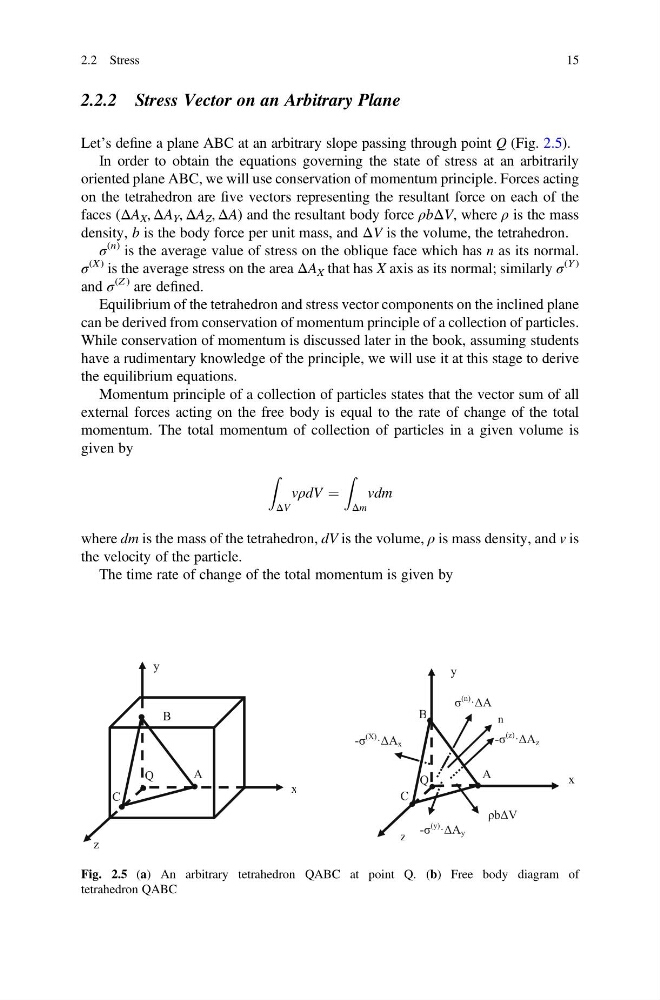
Let’s define a plane ABC at an arbitrary slope passing through point Q (Fig. 2.5).
In order to obtain the equations governing the state of stress at an arbitrarily
oriented plane ABC, we will use conservation of momentum principle. Forces acting
on the tetrahedron are five vectors representing the resultant force on each of the
faces (ΔA X , ΔA Y , ΔA Z , ΔA) and the resultant body force ρbΔV, where ρ is the mass
density, b is the body force per unit mass, and ΔV is the volume, the tetrahedron.
σ
(n) is the average value of stress on the oblique face which has n as its normal.
σ
(X) is the average stress on the area ΔA X that has X axis as its normal; similarly σ
(Y )
and σ
(Z ) are defined.
Equilibrium of the tetrahedron and stress vector components on the inclined plane
can be derived from conservation of momentum principle of a collection of particles.
While conservation of momentum is discussed later in the book, assuming students
have a rudimentary knowledge of the principle, we will use it at this stage to derive
the equilibrium equations.
Momentum principle of a collection of particles states that the vector sum of all
external forces acting on the free body is equal to the rate of change of the total
momentum. The total momentum of collection of particles in a given volume is
given by
Z
ΔV
vρdV ¼
Z
Δm
vdm
where dm is the mass of the tetrahedron, dV is the volume, ρ is mass density, and v is
the velocity of the particle.
The time rate of change of the total momentum is given by
y
x
z
A
B
C
Q
y
x
z
A
B
C
Q
-σ
(X) ·ΔA x
-σ
(y) ·ΔA y
-σ
(z) ·ΔA z
σ
(n) ·ΔA
n
ρbΔV
Fig. 2.5 (a) An arbitrary tetrahedron QABC at point Q. (b) Free body diagram of
tetrahedron QABC
2.2 Stress
15
Let’s define a plane ABC at an arbitrary slope passing through point Q (Fig. 2.5).
In order to obtain the equations governing the state of stress at an arbitrarily
oriented plane ABC, we will use conservation of momentum principle. Forces acting
on the tetrahedron are five vectors representing the resultant force on each of the
faces (ΔA X , ΔA Y , ΔA Z , ΔA) and the resultant body force ρbΔV, where ρ is the mass
density, b is the body force per unit mass, and ΔV is the volume, the tetrahedron.
σ
(n) is the average value of stress on the oblique face which has n as its normal.
σ
(X) is the average stress on the area ΔA X that has X axis as its normal; similarly σ
(Y )
and σ
(Z ) are defined.
Equilibrium of the tetrahedron and stress vector components on the inclined plane
can be derived from conservation of momentum principle of a collection of particles.
While conservation of momentum is discussed later in the book, assuming students
have a rudimentary knowledge of the principle, we will use it at this stage to derive
the equilibrium equations.
Momentum principle of a collection of particles states that the vector sum of all
external forces acting on the free body is equal to the rate of change of the total
momentum. The total momentum of collection of particles in a given volume is
given by
Z
ΔV
vρdV ¼
Z
Δm
vdm
where dm is the mass of the tetrahedron, dV is the volume, ρ is mass density, and v is
the velocity of the particle.
The time rate of change of the total momentum is given by
y
x
z
A
B
C
Q
y
x
z
A
B
C
Q
-σ
(X) ·ΔA x
-σ
(y) ·ΔA y
-σ
(z) ·ΔA z
σ
(n) ·ΔA
n
ρbΔV
Fig. 2.5 (a) An arbitrary tetrahedron QABC at point Q. (b) Free body diagram of
tetrahedron QABC
2.2 Stress
15