

k à ¼ k 0 1 þ
3 1 À v 0
ð
Þ k 1 À k 0
ð
Þφ
3 1 À v 0
ð
Þk 0 þ 1 À φ
ð
Þ 1 þ v 0
ð
Þ k 1 À k 0
ð
Þ
&
'
ð6:1Þ
μ Ã ¼ μ 0 1 þ
15 1 À v 0
ð
Þ μ 1 À μ 0
ð
Þ φ
15 1 À v 0
ð
Þμ 0 þ 1 À φ
ð
Þ 8 À 10v 0
ð
Þμ 1 À μ 0
ð
Þ
&
'
ð6:2Þ
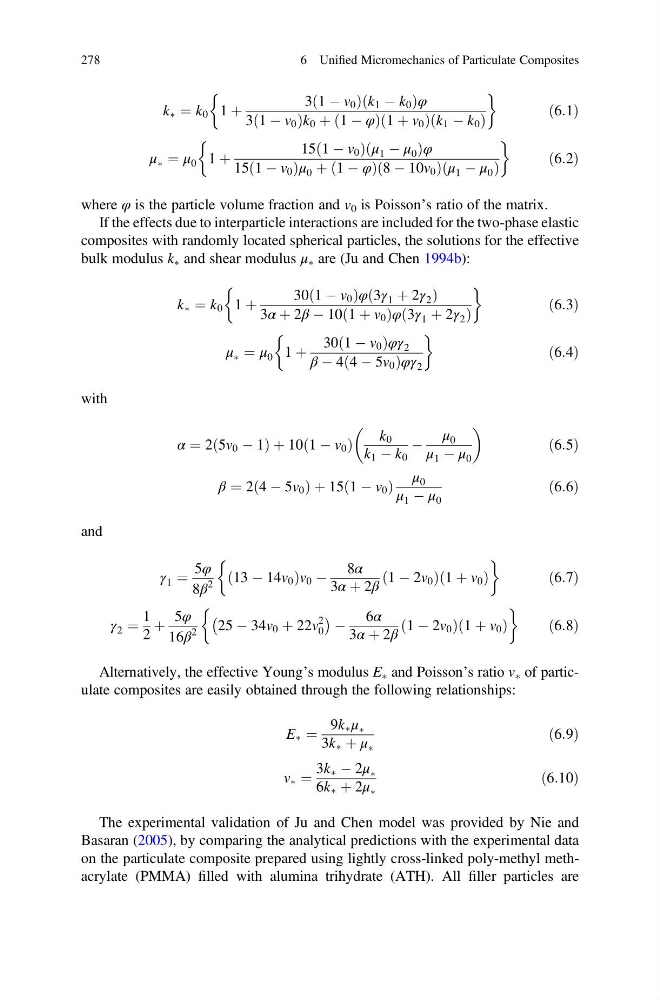
where φ is the particle volume fraction and v 0 is Poisson’s ratio of the matrix.
If the effects due to interparticle interactions are included for the two-phase elastic
composites with randomly located spherical particles, the solutions for the effective
bulk modulus k à and shear modulus μ à are (Ju and Chen 1994b):
k à ¼ k 0 1 þ
30 1 À v 0
ð
Þφ 3γ 1 þ 2γ 2
ð
Þ
3α þ 2β À 10 1 þ v 0
ð
Þφ 3γ 1 þ 2γ 2
ð
Þ
&
'
ð6:3Þ
μ Ã ¼ μ 0 1 þ
30 1 À v 0
ð
Þφγ 2
β À 4 4 À 5v 0
ð
Þ φγ 2
&
'
ð6:4Þ
with
α ¼ 2 5v 0 À 1
ð
Þþ10 1 À v 0
ð
Þ
k 0
k 1 À k 0
À
μ 0
μ 1 À μ 0
ð6:5Þ
β ¼ 2 4 À 5v 0
ð
Þþ15 1 À v 0
ð
Þ
μ 0
μ 1 À μ 0
ð6:6Þ
and
γ 1 ¼
5φ
8β
2
13 À 14v 0
ð
Þ v 0 À
8α
3α þ 2β
1 À 2v 0
ð
Þ1 þ v 0
ð
Þ
&
'
ð6:7Þ
γ 2 ¼
1
2
þ
5φ
16β
2
25 À 34v 0 þ 22v
2
0
À
Á À
6α
3α þ 2β
1 À 2v 0
ð
Þ1 þ v 0
ð
Þ
&
'
ð6:8Þ
Alternatively, the effective Young’s modulus E à and Poisson’s ratio v à of particulate composites are easily obtained through the following relationships:
E Ã ¼
9k à μ Ã
3k à þ μ Ã
ð6:9Þ
v à ¼
3k à À 2μ Ã
6k à þ 2μ Ã
ð6:10Þ
The experimental validation of Ju and Chen model was provided by Nie and
Basaran (2005), by comparing the analytical predictions with the experimental data
on the particulate composite prepared using lightly cross-linked poly-methyl methacrylate (PMMA) filled with alumina trihydrate (ATH). All filler particles are
278
6 Unified Micromechanics of Particulate Composites
3 1 À v 0
ð
Þ k 1 À k 0
ð
Þφ
3 1 À v 0
ð
Þk 0 þ 1 À φ
ð
Þ 1 þ v 0
ð
Þ k 1 À k 0
ð
Þ
&
'
ð6:1Þ
μ Ã ¼ μ 0 1 þ
15 1 À v 0
ð
Þ μ 1 À μ 0
ð
Þ φ
15 1 À v 0
ð
Þμ 0 þ 1 À φ
ð
Þ 8 À 10v 0
ð
Þμ 1 À μ 0
ð
Þ
&
'
ð6:2Þ
where φ is the particle volume fraction and v 0 is Poisson’s ratio of the matrix.
If the effects due to interparticle interactions are included for the two-phase elastic
composites with randomly located spherical particles, the solutions for the effective
bulk modulus k à and shear modulus μ à are (Ju and Chen 1994b):
k à ¼ k 0 1 þ
30 1 À v 0
ð
Þφ 3γ 1 þ 2γ 2
ð
Þ
3α þ 2β À 10 1 þ v 0
ð
Þφ 3γ 1 þ 2γ 2
ð
Þ
&
'
ð6:3Þ
μ Ã ¼ μ 0 1 þ
30 1 À v 0
ð
Þφγ 2
β À 4 4 À 5v 0
ð
Þ φγ 2
&
'
ð6:4Þ
with
α ¼ 2 5v 0 À 1
ð
Þþ10 1 À v 0
ð
Þ
k 0
k 1 À k 0
À
μ 0
μ 1 À μ 0
ð6:5Þ
β ¼ 2 4 À 5v 0
ð
Þþ15 1 À v 0
ð
Þ
μ 0
μ 1 À μ 0
ð6:6Þ
and
γ 1 ¼
5φ
8β
2
13 À 14v 0
ð
Þ v 0 À
8α
3α þ 2β
1 À 2v 0
ð
Þ1 þ v 0
ð
Þ
&
'
ð6:7Þ
γ 2 ¼
1
2
þ
5φ
16β
2
25 À 34v 0 þ 22v
2
0
À
Á À
6α
3α þ 2β
1 À 2v 0
ð
Þ1 þ v 0
ð
Þ
&
'
ð6:8Þ
Alternatively, the effective Young’s modulus E à and Poisson’s ratio v à of particulate composites are easily obtained through the following relationships:
E Ã ¼
9k à μ Ã
3k à þ μ Ã
ð6:9Þ
v à ¼
3k à À 2μ Ã
6k à þ 2μ Ã
ð6:10Þ
The experimental validation of Ju and Chen model was provided by Nie and
Basaran (2005), by comparing the analytical predictions with the experimental data
on the particulate composite prepared using lightly cross-linked poly-methyl methacrylate (PMMA) filled with alumina trihydrate (ATH). All filler particles are
278
6 Unified Micromechanics of Particulate Composites