

dF Δγ
ð Þ
dΔγ
¼ θ 2
b g nþ1
b f nþ1
À
2
3
K
0 b f nþ1
ð5:249Þ
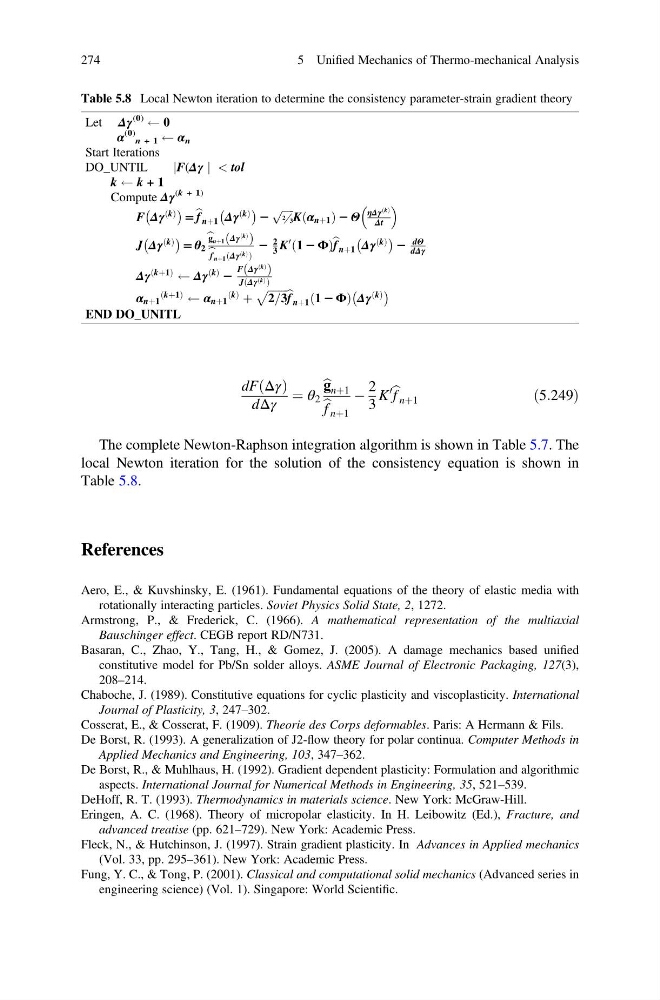
The complete Newton-Raphson integration algorithm is shown in Table 5.7. The
local Newton iteration for the solution of the consistency equation is shown in
Table 5.8.
References
Aero, E., & Kuvshinsky, E. (1961). Fundamental equations of the theory of elastic media with
rotationally interacting particles. Soviet Physics Solid State, 2, 1272.
Armstrong, P., & Frederick, C. (1966). A mathematical representation of the multiaxial
Bauschinger effect. CEGB report RD/N731.
Basaran, C., Zhao, Y., Tang, H., & Gomez, J. (2005). A damage mechanics based unified
constitutive model for Pb/Sn solder alloys. ASME Journal of Electronic Packaging, 127(3),
208–214.
Chaboche, J. (1989). Constitutive equations for cyclic plasticity and viscoplasticity. International
Journal of Plasticity, 3, 247–302.
Cosserat, E., & Cosserat, F. (1909). Theorie des Corps deformables. Paris: A Hermann & Fils.
De Borst, R. (1993). A generalization of J2-flow theory for polar continua. Computer Methods in
Applied Mechanics and Engineering, 103, 347–362.
De Borst, R., & Muhlhaus, H. (1992). Gradient dependent plasticity: Formulation and algorithmic
aspects. International Journal for Numerical Methods in Engineering, 35, 521–539.
DeHoff, R. T. (1993). Thermodynamics in materials science. New York: McGraw-Hill.
Eringen, A. C. (1968). Theory of micropolar elasticity. In H. Leibowitz (Ed.), Fracture, and
advanced treatise (pp. 621–729). New York: Academic Press.
Fleck, N., & Hutchinson, J. (1997). Strain gradient plasticity. In Advances in Applied mechanics
(Vol. 33, pp. 295–361). New York: Academic Press.
Fung, Y. C., & Tong, P. (2001). Classical and computational solid mechanics (Advanced series in
engineering science) (Vol. 1). Singapore: World Scientific.
Table 5.8 Local Newton iteration to determine the consistency parameter-strain gradient theory
Let Δγ
(0)
0
α
(0)
n + 1
α n
Start Iterations
DO_UNTIL
jF(Δγ j < tol
k
k + 1
Compute Δγ
(k + 1)
F Δγ
k
ð Þ
À
Á = b f nþ1 Δγ
k
ð Þ
À
Á 2
ffiffiffiffi ffi
2= 3
p
K α nþ1
ð
Þ2 Θ
ηΔγ
k
ð Þ
Δt
J Δγ
k
ð Þ
À
Á = θ 2
b g nþ1 Δγ
k
ð Þ
ð Þ
b f nþ1 Δγ k
ð Þ
ð
Þ
2
2
3 K
0 1 2 Φ
ð
Þ b f nþ1 Δγ
k
ð Þ
À
Á 2
dΘ
dΔγ
Δγ
kþ1
ð
Þ
Δγ
k
ð Þ 2
F Δγ
k
ð Þ
ð Þ
J Δγ k
ð Þ
ð
Þ
α nþ1
kþ1
ð
Þ
α nþ1
k
ð Þ þ
ffiffiffiffiffiffiffi ffi
2=3
p b f nþ1 1 2 Φ
ð
Þ Δγ
k
ð Þ
À
Á
END DO_UNITL
274
5 Unified Mechanics of Thermo-mechanical Analysis
ð Þ
dΔγ
¼ θ 2
b g nþ1
b f nþ1
À
2
3
K
0 b f nþ1
ð5:249Þ
The complete Newton-Raphson integration algorithm is shown in Table 5.7. The
local Newton iteration for the solution of the consistency equation is shown in
Table 5.8.
References
Aero, E., & Kuvshinsky, E. (1961). Fundamental equations of the theory of elastic media with
rotationally interacting particles. Soviet Physics Solid State, 2, 1272.
Armstrong, P., & Frederick, C. (1966). A mathematical representation of the multiaxial
Bauschinger effect. CEGB report RD/N731.
Basaran, C., Zhao, Y., Tang, H., & Gomez, J. (2005). A damage mechanics based unified
constitutive model for Pb/Sn solder alloys. ASME Journal of Electronic Packaging, 127(3),
208–214.
Chaboche, J. (1989). Constitutive equations for cyclic plasticity and viscoplasticity. International
Journal of Plasticity, 3, 247–302.
Cosserat, E., & Cosserat, F. (1909). Theorie des Corps deformables. Paris: A Hermann & Fils.
De Borst, R. (1993). A generalization of J2-flow theory for polar continua. Computer Methods in
Applied Mechanics and Engineering, 103, 347–362.
De Borst, R., & Muhlhaus, H. (1992). Gradient dependent plasticity: Formulation and algorithmic
aspects. International Journal for Numerical Methods in Engineering, 35, 521–539.
DeHoff, R. T. (1993). Thermodynamics in materials science. New York: McGraw-Hill.
Eringen, A. C. (1968). Theory of micropolar elasticity. In H. Leibowitz (Ed.), Fracture, and
advanced treatise (pp. 621–729). New York: Academic Press.
Fleck, N., & Hutchinson, J. (1997). Strain gradient plasticity. In Advances in Applied mechanics
(Vol. 33, pp. 295–361). New York: Academic Press.
Fung, Y. C., & Tong, P. (2001). Classical and computational solid mechanics (Advanced series in
engineering science) (Vol. 1). Singapore: World Scientific.
Table 5.8 Local Newton iteration to determine the consistency parameter-strain gradient theory
Let Δγ
(0)
0
α
(0)
n + 1
α n
Start Iterations
DO_UNTIL
jF(Δγ j < tol
k
k + 1
Compute Δγ
(k + 1)
F Δγ
k
ð Þ
À
Á = b f nþ1 Δγ
k
ð Þ
À
Á 2
ffiffiffiffi ffi
2= 3
p
K α nþ1
ð
Þ2 Θ
ηΔγ
k
ð Þ
Δt
J Δγ
k
ð Þ
À
Á = θ 2
b g nþ1 Δγ
k
ð Þ
ð Þ
b f nþ1 Δγ k
ð Þ
ð
Þ
2
2
3 K
0 1 2 Φ
ð
Þ b f nþ1 Δγ
k
ð Þ
À
Á 2
dΘ
dΔγ
Δγ
kþ1
ð
Þ
Δγ
k
ð Þ 2
F Δγ
k
ð Þ
ð Þ
J Δγ k
ð Þ
ð
Þ
α nþ1
kþ1
ð
Þ
α nþ1
k
ð Þ þ
ffiffiffiffiffiffiffi ffi
2=3
p b f nþ1 1 2 Φ
ð
Þ Δγ
k
ð Þ
À
Á
END DO_UNITL
274
5 Unified Mechanics of Thermo-mechanical Analysis