

W ¼
E
2 1 þ v
ð
Þ
v
1 À 2v
ε ii ε jj þ ε ij ε ij þ l
2 x ij x ij
ð5:126Þ
A constitutive relationship can be directly derived out of Eq. (5.126) as follows:
σ ij ¼
∂W
∂ε ij
C ijkl ε kl
ð5:127Þ
m ij ¼
∂W
∂x ij
D ijkl x kl
ð5:128Þ
where C ijkl and D ijkl are elastic constitutive tensors relating stress and couple stress
components to elastic strains and elastic curvatures, respectively. The principle of
virtual work for the reduced Cosserat theory can be given by, [in Newtonian
mechanics]
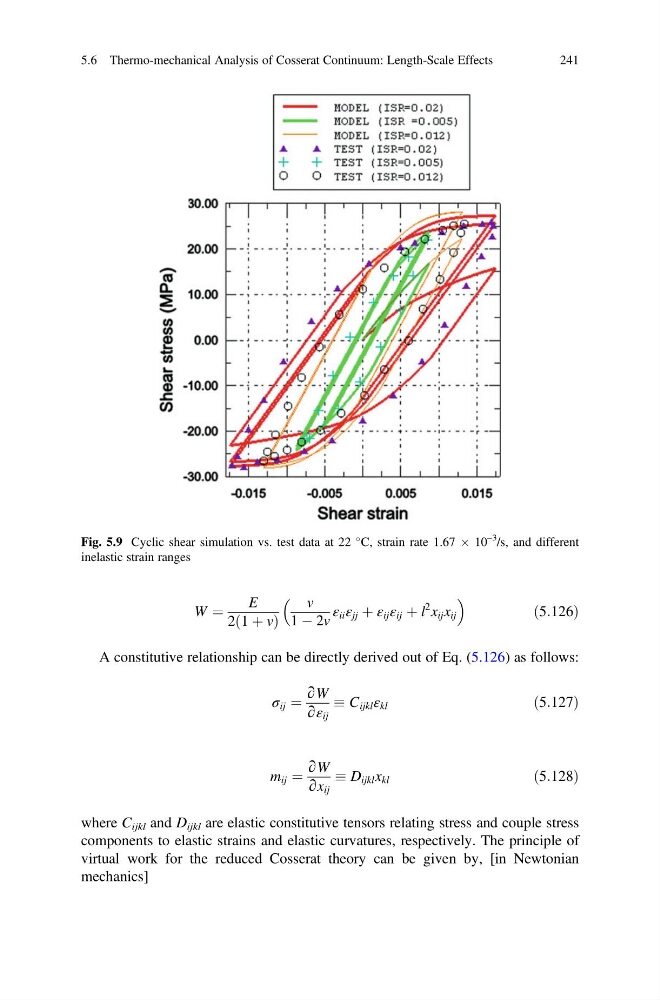
Fig. 5.9 Cyclic shear simulation vs. test data at 22
C, strain rate 1.67 Â 10
–3
/s, and different
inelastic strain ranges
5.6 Thermo-mechanical Analysis of Cosserat Continuum: Length-Scale Effects
241
E
2 1 þ v
ð
Þ
v
1 À 2v
ε ii ε jj þ ε ij ε ij þ l
2 x ij x ij
ð5:126Þ
A constitutive relationship can be directly derived out of Eq. (5.126) as follows:
σ ij ¼
∂W
∂ε ij
C ijkl ε kl
ð5:127Þ
m ij ¼
∂W
∂x ij
D ijkl x kl
ð5:128Þ
where C ijkl and D ijkl are elastic constitutive tensors relating stress and couple stress
components to elastic strains and elastic curvatures, respectively. The principle of
virtual work for the reduced Cosserat theory can be given by, [in Newtonian
mechanics]
Fig. 5.9 Cyclic shear simulation vs. test data at 22
C, strain rate 1.67 Â 10
–3
/s, and different
inelastic strain ranges
5.6 Thermo-mechanical Analysis of Cosserat Continuum: Length-Scale Effects
241