

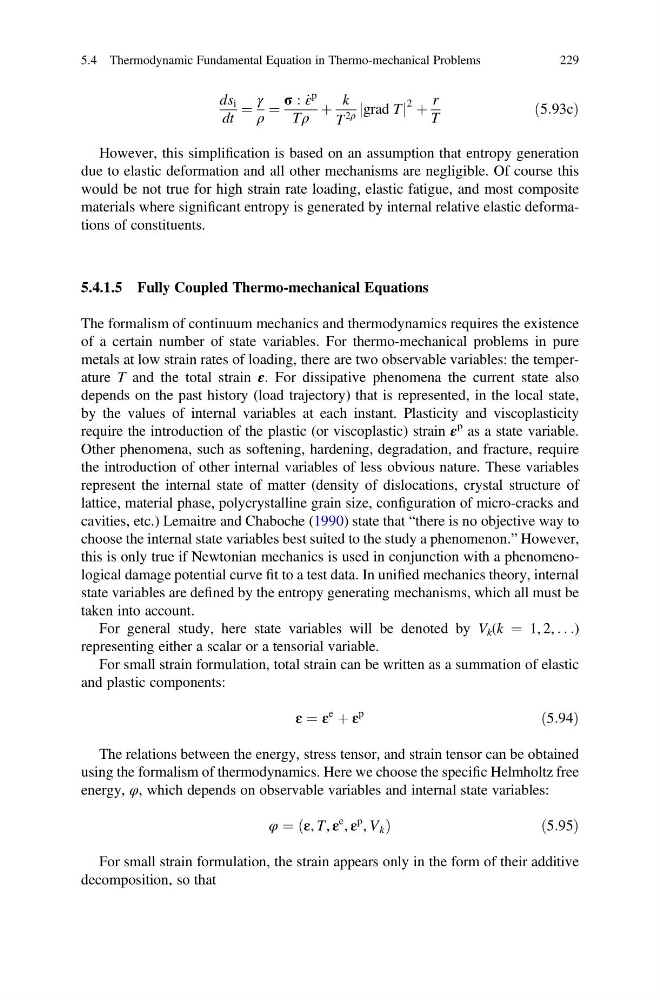
ds i
dt
¼
γ
ρ
¼
σ : _
ε
p
Tρ
þ
k
T
2ρ
grad T
j
j
2 þ
r
T
ð5:93cÞ
However, this simplification is based on an assumption that entropy generation
due to elastic deformation and all other mechanisms are negligible. Of course this
would be not true for high strain rate loading, elastic fatigue, and most composite
materials where significant entropy is generated by internal relative elastic deformations of constituents.
5.4.1.5 Fully Coupled Thermo-mechanical Equations
The formalism of continuum mechanics and thermodynamics requires the existence
of a certain number of state variables. For thermo-mechanical problems in pure
metals at low strain rates of loading, there are two observable variables: the temperature T and the total strain ε. For dissipative phenomena the current state also
depends on the past history (load trajectory) that is represented, in the local state,
by the values of internal variables at each instant. Plasticity and viscoplasticity
require the introduction of the plastic (or viscoplastic) strain ε
p as a state variable.
Other phenomena, such as softening, hardening, degradation, and fracture, require
the introduction of other internal variables of less obvious nature. These variables
represent the internal state of matter (density of dislocations, crystal structure of
lattice, material phase, polycrystalline grain size, configuration of micro-cracks and
cavities, etc.) Lemaitre and Chaboche (1990) state that “there is no objective way to
choose the internal state variables best suited to the study a phenomenon.” However,
this is only true if Newtonian mechanics is used in conjunction with a phenomenological damage potential curve fit to a test data. In unified mechanics theory, internal
state variables are defined by the entropy generating mechanisms, which all must be
taken into account.
For general study, here state variables will be denoted by V k (k ¼ 1, 2, . . .)
representing either a scalar or a tensorial variable.
For small strain formulation, total strain can be written as a summation of elastic
and plastic components:
ε ¼ ε
e
þ ε
p
ð5:94Þ
The relations between the energy, stress tensor, and strain tensor can be obtained
using the formalism of thermodynamics. Here we choose the specific Helmholtz free
energy, φ, which depends on observable variables and internal state variables:
φ ¼ ε, T, ε
e , ε
p , V k
ð
Þ
ð 5:95Þ
For small strain formulation, the strain appears only in the form of their additive
decomposition, so that
5.4 Thermodynamic Fundamental Equation in Thermo-mechanical Problems
229
dt
¼
γ
ρ
¼
σ : _
ε
p
Tρ
þ
k
T
2ρ
grad T
j
j
2 þ
r
T
ð5:93cÞ
However, this simplification is based on an assumption that entropy generation
due to elastic deformation and all other mechanisms are negligible. Of course this
would be not true for high strain rate loading, elastic fatigue, and most composite
materials where significant entropy is generated by internal relative elastic deformations of constituents.
5.4.1.5 Fully Coupled Thermo-mechanical Equations
The formalism of continuum mechanics and thermodynamics requires the existence
of a certain number of state variables. For thermo-mechanical problems in pure
metals at low strain rates of loading, there are two observable variables: the temperature T and the total strain ε. For dissipative phenomena the current state also
depends on the past history (load trajectory) that is represented, in the local state,
by the values of internal variables at each instant. Plasticity and viscoplasticity
require the introduction of the plastic (or viscoplastic) strain ε
p as a state variable.
Other phenomena, such as softening, hardening, degradation, and fracture, require
the introduction of other internal variables of less obvious nature. These variables
represent the internal state of matter (density of dislocations, crystal structure of
lattice, material phase, polycrystalline grain size, configuration of micro-cracks and
cavities, etc.) Lemaitre and Chaboche (1990) state that “there is no objective way to
choose the internal state variables best suited to the study a phenomenon.” However,
this is only true if Newtonian mechanics is used in conjunction with a phenomenological damage potential curve fit to a test data. In unified mechanics theory, internal
state variables are defined by the entropy generating mechanisms, which all must be
taken into account.
For general study, here state variables will be denoted by V k (k ¼ 1, 2, . . .)
representing either a scalar or a tensorial variable.
For small strain formulation, total strain can be written as a summation of elastic
and plastic components:
ε ¼ ε
e
þ ε
p
ð5:94Þ
The relations between the energy, stress tensor, and strain tensor can be obtained
using the formalism of thermodynamics. Here we choose the specific Helmholtz free
energy, φ, which depends on observable variables and internal state variables:
φ ¼ ε, T, ε
e , ε
p , V k
ð
Þ
ð 5:95Þ
For small strain formulation, the strain appears only in the form of their additive
decomposition, so that
5.4 Thermodynamic Fundamental Equation in Thermo-mechanical Problems
229