

when all objects have the same temperature, the energy is no longer available for conversion
into work.
The entropy [energy unavailable for work] of the universe increases or remains constant
in all natural processes. It is possible to find a system for which entropy decreases but only
due to a net increase in a related system. For example, the originally hot objects and cooler
objects reaching thermal equilibrium in an isolated system may be separated, and some of
them put in a refrigerator. The objects would again have different temperatures after a period
of time, but now the system of the refrigerator would have to be included in the analysis of
the complete system. No net decrease in entropy of all the related system occurs. This is yet
another way of stating the second law of thermodynamics (DeHoff 1993).
The concept of entropy has far-reaching implications that tie the order of our universe to
probability and statistics. Imagine a new deck of cards in order by suits, with each unit in
numerical order. As the deck is shuffled, no one would expect the original order to return.
There is a probability that the randomized order of the shuffled deck would return to the
original format, but it is exceedingly small. An ice cube melts, and the molecules in the
liquid form have less order than in the frozen form. An infinitesimally small probability
exists that all of the slower moving molecules will aggregate in one space so that the ice cube
will reform from the pool of water. The entropy, or disorder, of the universe increases as hot
bodies cool and cold bodies warm. Eventually, the entire universe will be at the same
temperature so the energy will be no longer usable (DeHoff 1993).
In order to relate the entropy generation directly to various irreversible processes
that occur in a system, one needs the macroscopic conservation laws of mass,
momentum, and energy in local, i.e., differential form. These conservation laws
contain a number of quantities such as the diffusion flows, the heat flow, and the
stress tensor, which are related to the transport of mass, exchange of energy, and
exchange of energy momentum. Then, the entropy generation can be calculated by
using the thermodynamic Gibbs relation, which connects the rate of the change in
entropy in the medium to the rate of the change in energy and work. Entropy
generation rate has a relatively simple formula: it is a sum of all entropy generating
micro-mechanism terms, each being a product of a flux characterizing an irreversible
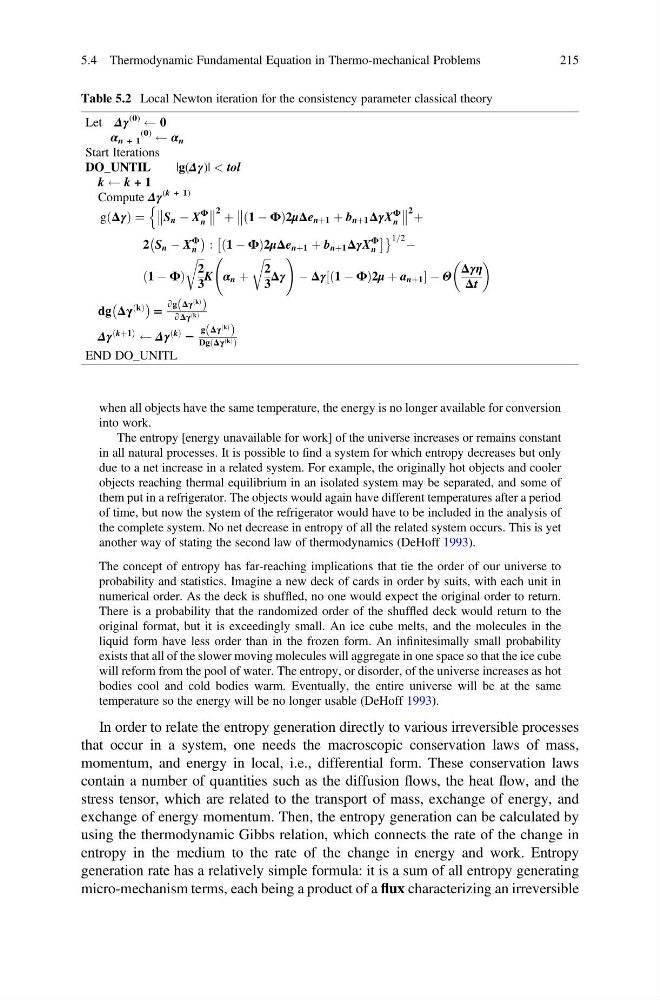
Table 5.2 Local Newton iteration for the consistency parameter classical theory
Let Δγ
(0)
0
α n + 1
(0)
α n
Start Iterations
DO_UNTIL
|g(Δγ)| < tol
k
k + 1
Compute Δγ
(k + 1)
g Δγ
ð Þ ¼ S n À X
Φ
n
2 þ 1 À Φ
ð
Þ 2μΔe nþ1 þ b nþ1 ΔγX
Φ
n
2 þ
n
2 S n À X
Φ
n
À
Á : 1 À Φ
ð
Þ 2μΔe nþ1 þ b nþ1 ΔγX
Φ
n
Â
Ã É 1=2 À
1 À Φ
ð
Þ
ffiffi ffi
2
3
r
K α n þ
ffiffi ffi
2
3
r
Δγ
!
À Δγ 1 À Φ
ð
Þ2μ þ a nþ1
½
À Θ
Δγη
Δt
dg Δγ
k
ð Þ
À
Á =
∂g Δγ
k
ð Þ
ð
Þ
∂Δγ k
ð Þ
Δγ
kþ1
ð
Þ
Δγ
k
ð Þ 2
g Δγ
k
ð Þ
ð
Þ
Dg Δγ k
ð Þ
ð
Þ
END DO_UNITL
5.4 Thermodynamic Fundamental Equation in Thermo-mechanical Problems
215
into work.
The entropy [energy unavailable for work] of the universe increases or remains constant
in all natural processes. It is possible to find a system for which entropy decreases but only
due to a net increase in a related system. For example, the originally hot objects and cooler
objects reaching thermal equilibrium in an isolated system may be separated, and some of
them put in a refrigerator. The objects would again have different temperatures after a period
of time, but now the system of the refrigerator would have to be included in the analysis of
the complete system. No net decrease in entropy of all the related system occurs. This is yet
another way of stating the second law of thermodynamics (DeHoff 1993).
The concept of entropy has far-reaching implications that tie the order of our universe to
probability and statistics. Imagine a new deck of cards in order by suits, with each unit in
numerical order. As the deck is shuffled, no one would expect the original order to return.
There is a probability that the randomized order of the shuffled deck would return to the
original format, but it is exceedingly small. An ice cube melts, and the molecules in the
liquid form have less order than in the frozen form. An infinitesimally small probability
exists that all of the slower moving molecules will aggregate in one space so that the ice cube
will reform from the pool of water. The entropy, or disorder, of the universe increases as hot
bodies cool and cold bodies warm. Eventually, the entire universe will be at the same
temperature so the energy will be no longer usable (DeHoff 1993).
In order to relate the entropy generation directly to various irreversible processes
that occur in a system, one needs the macroscopic conservation laws of mass,
momentum, and energy in local, i.e., differential form. These conservation laws
contain a number of quantities such as the diffusion flows, the heat flow, and the
stress tensor, which are related to the transport of mass, exchange of energy, and
exchange of energy momentum. Then, the entropy generation can be calculated by
using the thermodynamic Gibbs relation, which connects the rate of the change in
entropy in the medium to the rate of the change in energy and work. Entropy
generation rate has a relatively simple formula: it is a sum of all entropy generating
micro-mechanism terms, each being a product of a flux characterizing an irreversible
Table 5.2 Local Newton iteration for the consistency parameter classical theory
Let Δγ
(0)
0
α n + 1
(0)
α n
Start Iterations
DO_UNTIL
|g(Δγ)| < tol
k
k + 1
Compute Δγ
(k + 1)
g Δγ
ð Þ ¼ S n À X
Φ
n
2 þ 1 À Φ
ð
Þ 2μΔe nþ1 þ b nþ1 ΔγX
Φ
n
2 þ
n
2 S n À X
Φ
n
À
Á : 1 À Φ
ð
Þ 2μΔe nþ1 þ b nþ1 ΔγX
Φ
n
Â
Ã É 1=2 À
1 À Φ
ð
Þ
ffiffi ffi
2
3
r
K α n þ
ffiffi ffi
2
3
r
Δγ
!
À Δγ 1 À Φ
ð
Þ2μ þ a nþ1
½
À Θ
Δγη
Δt
dg Δγ
k
ð Þ
À
Á =
∂g Δγ
k
ð Þ
ð
Þ
∂Δγ k
ð Þ
Δγ
kþ1
ð
Þ
Δγ
k
ð Þ 2
g Δγ
k
ð Þ
ð
Þ
Dg Δγ k
ð Þ
ð
Þ
END DO_UNITL
5.4 Thermodynamic Fundamental Equation in Thermo-mechanical Problems
215