

∂b n nþ1
∂ε nþ1
¼
∂b n nþ1
∂B n
∂B n
∂ε nþ1
2μ 1 À Φ
ð
Þ
B n
k k
c
Y À b n nþ1 b n nþ1 À
1
3
I I
þ
1
B n
k k
 I À b n nþ1 b n nþ1
À
Á
:
K 4
K 3
b n nþ1 X
Φ
n
ð5:35bÞ
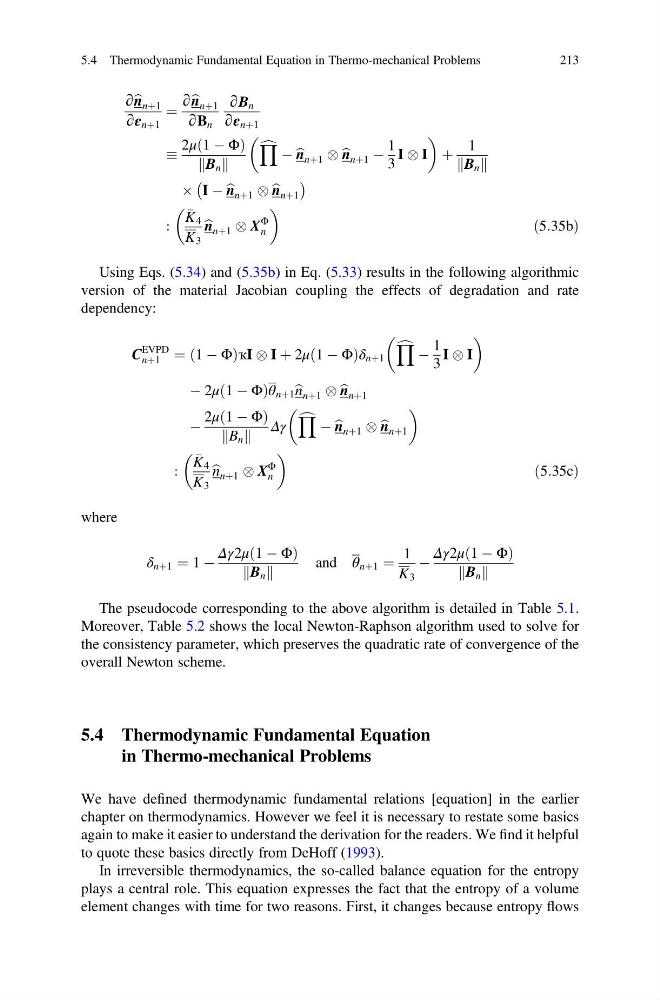
Using Eqs. (5.34) and (5.35b) in Eq. (5.33) results in the following algorithmic
version of the material Jacobian coupling the effects of degradation and rate
dependency:
C
EVPD
nþ1 ¼ 1 À Φ
ð
ÞҡI I þ 2μ 1 À Φ
ð
Þδ nþ1
c
Y
À
1
3
I I
À 2μ 1 À Φ
ð
Þθ nþ1 b n nþ1 b n nþ1
À
2μ 1 À Φ
ð
Þ
B n
k k
Δγ
c
Y À b n nþ1 b n nþ1
:
K 4
K 3
b n nþ1 X
Φ
n
ð5:35cÞ
where
δ nþ1 ¼ 1 À
Δγ2μ 1 À Φ
ð
Þ
B n
k k
and θ nþ1 ¼
1
K 3
À
Δγ2μ 1 À Φ
ð
Þ
B n
k k
The pseudocode corresponding to the above algorithm is detailed in Table 5.1.
Moreover, Table 5.2 shows the local Newton-Raphson algorithm used to solve for
the consistency parameter, which preserves the quadratic rate of convergence of the
overall Newton scheme.
5.4 Thermodynamic Fundamental Equation
in Thermo-mechanical Problems
We have defined thermodynamic fundamental relations [equation] in the earlier
chapter on thermodynamics. However we feel it is necessary to restate some basics
again to make it easier to understand the derivation for the readers. We find it helpful
to quote these basics directly from DeHoff (1993).
In irreversible thermodynamics, the so-called balance equation for the entropy
plays a central role. This equation expresses the fact that the entropy of a volume
element changes with time for two reasons. First, it changes because entropy flows
5.4 Thermodynamic Fundamental Equation in Thermo-mechanical Problems
213
∂ε nþ1
¼
∂b n nþ1
∂B n
∂B n
∂ε nþ1
2μ 1 À Φ
ð
Þ
B n
k k
c
Y À b n nþ1 b n nþ1 À
1
3
I I
þ
1
B n
k k
 I À b n nþ1 b n nþ1
À
Á
:
K 4
K 3
b n nþ1 X
Φ
n
ð5:35bÞ
Using Eqs. (5.34) and (5.35b) in Eq. (5.33) results in the following algorithmic
version of the material Jacobian coupling the effects of degradation and rate
dependency:
C
EVPD
nþ1 ¼ 1 À Φ
ð
ÞҡI I þ 2μ 1 À Φ
ð
Þδ nþ1
c
Y
À
1
3
I I
À 2μ 1 À Φ
ð
Þθ nþ1 b n nþ1 b n nþ1
À
2μ 1 À Φ
ð
Þ
B n
k k
Δγ
c
Y À b n nþ1 b n nþ1
:
K 4
K 3
b n nþ1 X
Φ
n
ð5:35cÞ
where
δ nþ1 ¼ 1 À
Δγ2μ 1 À Φ
ð
Þ
B n
k k
and θ nþ1 ¼
1
K 3
À
Δγ2μ 1 À Φ
ð
Þ
B n
k k
The pseudocode corresponding to the above algorithm is detailed in Table 5.1.
Moreover, Table 5.2 shows the local Newton-Raphson algorithm used to solve for
the consistency parameter, which preserves the quadratic rate of convergence of the
overall Newton scheme.
5.4 Thermodynamic Fundamental Equation
in Thermo-mechanical Problems
We have defined thermodynamic fundamental relations [equation] in the earlier
chapter on thermodynamics. However we feel it is necessary to restate some basics
again to make it easier to understand the derivation for the readers. We find it helpful
to quote these basics directly from DeHoff (1993).
In irreversible thermodynamics, the so-called balance equation for the entropy
plays a central role. This equation expresses the fact that the entropy of a volume
element changes with time for two reasons. First, it changes because entropy flows
5.4 Thermodynamic Fundamental Equation in Thermo-mechanical Problems
213