

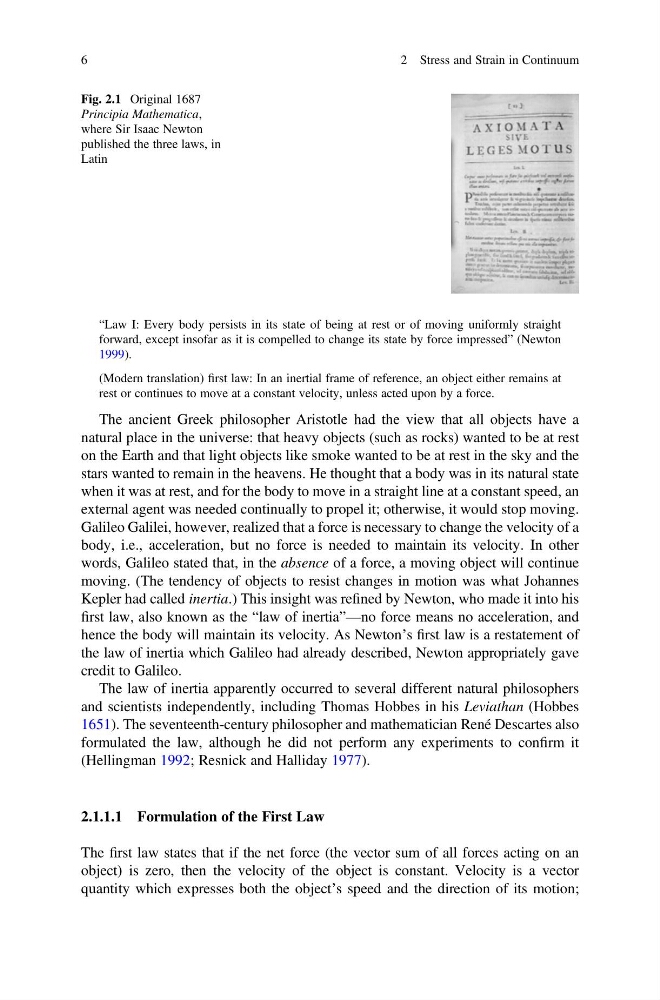
“Law I: Every body persists in its state of being at rest or of moving uniformly straight
forward, except insofar as it is compelled to change its state by force impressed” (Newton
1999).
(Modern translation) first law: In an inertial frame of reference, an object either remains at
rest or continues to move at a constant velocity, unless acted upon by a force.
The ancient Greek philosopher Aristotle had the view that all objects have a
natural place in the universe: that heavy objects (such as rocks) wanted to be at rest
on the Earth and that light objects like smoke wanted to be at rest in the sky and the
stars wanted to remain in the heavens. He thought that a body was in its natural state
when it was at rest, and for the body to move in a straight line at a constant speed, an
external agent was needed continually to propel it; otherwise, it would stop moving.
Galileo Galilei, however, realized that a force is necessary to change the velocity of a
body, i.e., acceleration, but no force is needed to maintain its velocity. In other
words, Galileo stated that, in the absence of a force, a moving object will continue
moving. (The tendency of objects to resist changes in motion was what Johannes
Kepler had called inertia.) This insight was refined by Newton, who made it into his
first law, also known as the “law of inertia”—no force means no acceleration, and
hence the body will maintain its velocity. As Newton’s first law is a restatement of
the law of inertia which Galileo had already described, Newton appropriately gave
credit to Galileo.
The law of inertia apparently occurred to several different natural philosophers
and scientists independently, including Thomas Hobbes in his Leviathan (Hobbes
1651). The seventeenth-century philosopher and mathematician René Descartes also
formulated the law, although he did not perform any experiments to confirm it
(Hellingman 1992; Resnick and Halliday 1977).
2.1.1.1 Formulation of the First Law
The first law states that if the net force (the vector sum of all forces acting on an
object) is zero, then the velocity of the object is constant. Velocity is a vector
quantity which expresses both the object’s speed and the direction of its motion;
Fig. 2.1 Original 1687
Principia Mathematica,
where Sir Isaac Newton
published the three laws, in
Latin
6
2 Stress and Strain in Continuum
forward, except insofar as it is compelled to change its state by force impressed” (Newton
1999).
(Modern translation) first law: In an inertial frame of reference, an object either remains at
rest or continues to move at a constant velocity, unless acted upon by a force.
The ancient Greek philosopher Aristotle had the view that all objects have a
natural place in the universe: that heavy objects (such as rocks) wanted to be at rest
on the Earth and that light objects like smoke wanted to be at rest in the sky and the
stars wanted to remain in the heavens. He thought that a body was in its natural state
when it was at rest, and for the body to move in a straight line at a constant speed, an
external agent was needed continually to propel it; otherwise, it would stop moving.
Galileo Galilei, however, realized that a force is necessary to change the velocity of a
body, i.e., acceleration, but no force is needed to maintain its velocity. In other
words, Galileo stated that, in the absence of a force, a moving object will continue
moving. (The tendency of objects to resist changes in motion was what Johannes
Kepler had called inertia.) This insight was refined by Newton, who made it into his
first law, also known as the “law of inertia”—no force means no acceleration, and
hence the body will maintain its velocity. As Newton’s first law is a restatement of
the law of inertia which Galileo had already described, Newton appropriately gave
credit to Galileo.
The law of inertia apparently occurred to several different natural philosophers
and scientists independently, including Thomas Hobbes in his Leviathan (Hobbes
1651). The seventeenth-century philosopher and mathematician René Descartes also
formulated the law, although he did not perform any experiments to confirm it
(Hellingman 1992; Resnick and Halliday 1977).
2.1.1.1 Formulation of the First Law
The first law states that if the net force (the vector sum of all forces acting on an
object) is zero, then the velocity of the object is constant. Velocity is a vector
quantity which expresses both the object’s speed and the direction of its motion;
Fig. 2.1 Original 1687
Principia Mathematica,
where Sir Isaac Newton
published the three laws, in
Latin
6
2 Stress and Strain in Continuum