

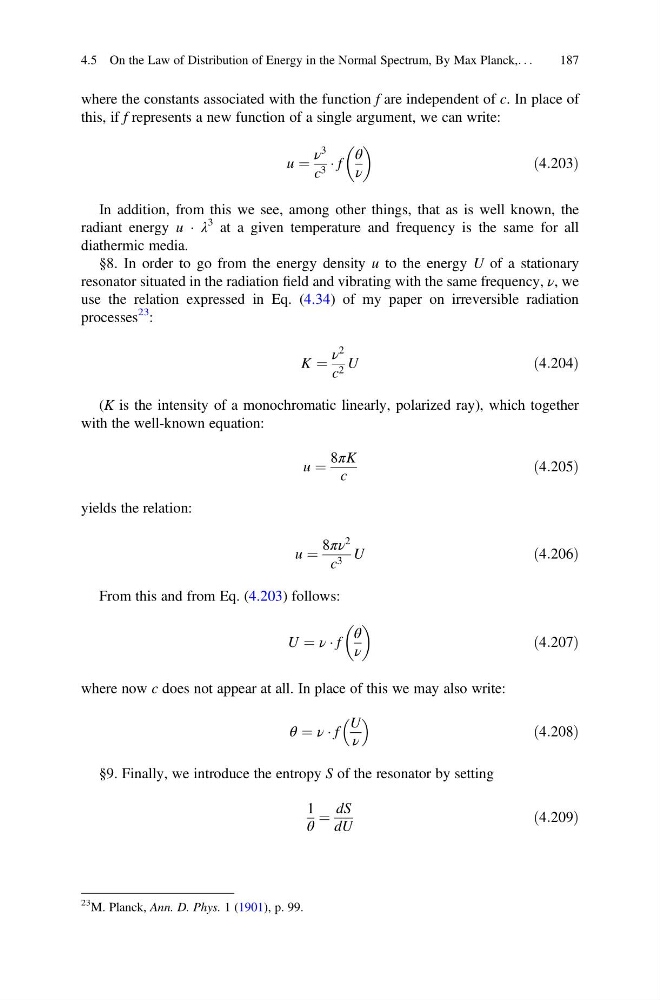
where the constants associated with the function f are independent of c. In place of
this, if f represents a new function of a single argument, we can write:
u ¼
ν
3
c 3 Á f
θ
ν
ð4:203Þ
In addition, from this we see, among other things, that as is well known, the
radiant energy u Á λ
3 at a given temperature and frequency is the same for all
diathermic media.
§8. In order to go from the energy density u to the energy U of a stationary
resonator situated in the radiation field and vibrating with the same frequency, ν, we
use the relation expressed in Eq. (4.34) of my paper on irreversible radiation
processes
23 :
K ¼
ν
2
c 2 U
ð4:204Þ
(K is the intensity of a monochromatic linearly, polarized ray), which together
with the well-known equation:
u ¼
8πK
c
ð4:205Þ
yields the relation:
u ¼
8πν
2
c 3 U
ð4:206Þ
From this and from Eq. (4.203) follows:
U ¼ ν Á f
θ
ν
ð4:207Þ
where now c does not appear at all. In place of this we may also write:
θ ¼ ν Á f
U
ν
ð4:208Þ
§9. Finally, we introduce the entropy S of the resonator by setting
1
θ
¼
dS
dU
ð4:209Þ
23 M. Planck, Ann. D. Phys. 1 (1901), p. 99.
4.5 On the Law of Distribution of Energy in the Normal Spectrum, By Max Planck,. . .
187
this, if f represents a new function of a single argument, we can write:
u ¼
ν
3
c 3 Á f
θ
ν
ð4:203Þ
In addition, from this we see, among other things, that as is well known, the
radiant energy u Á λ
3 at a given temperature and frequency is the same for all
diathermic media.
§8. In order to go from the energy density u to the energy U of a stationary
resonator situated in the radiation field and vibrating with the same frequency, ν, we
use the relation expressed in Eq. (4.34) of my paper on irreversible radiation
processes
23 :
K ¼
ν
2
c 2 U
ð4:204Þ
(K is the intensity of a monochromatic linearly, polarized ray), which together
with the well-known equation:
u ¼
8πK
c
ð4:205Þ
yields the relation:
u ¼
8πν
2
c 3 U
ð4:206Þ
From this and from Eq. (4.203) follows:
U ¼ ν Á f
θ
ν
ð4:207Þ
where now c does not appear at all. In place of this we may also write:
θ ¼ ν Á f
U
ν
ð4:208Þ
§9. Finally, we introduce the entropy S of the resonator by setting
1
θ
¼
dS
dU
ð4:209Þ
23 M. Planck, Ann. D. Phys. 1 (1901), p. 99.
4.5 On the Law of Distribution of Energy in the Normal Spectrum, By Max Planck,. . .
187