

f x, y, z, u, v, w
ð
Þ¼
N
V
4πT
3m
À Á 3=2 Á e
À
3m
4T u
2 þv
2 þw
2
ð
Þ :
ð4:166Þ
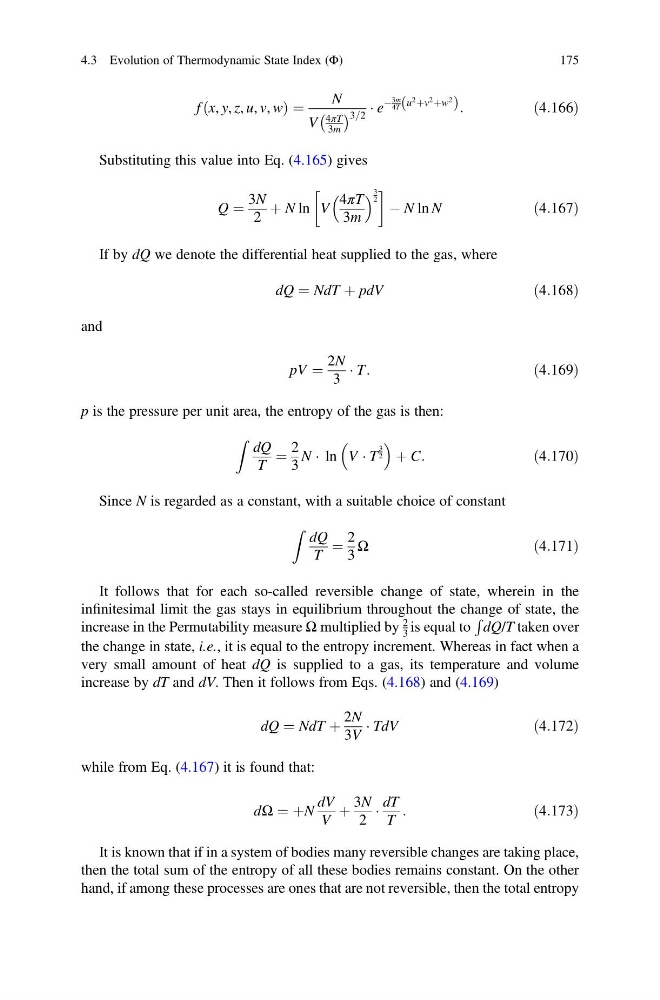
Substituting this value into Eq. (4.165) gives
Q ¼
3N
2
þ N ln V
4πT
3m
3
2
!
À N ln N
ð4:167Þ
If by dQ we denote the differential heat supplied to the gas, where
dQ ¼ NdT þ pdV
ð4:168Þ
and
pV ¼
2N
3
Á T:
ð4:169Þ
p is the pressure per unit area, the entropy of the gas is then:
Z
dQ
T
¼
2
3
N Á ln V Á T
3
2
þ C:
ð4:170Þ
Since N is regarded as a constant, with a suitable choice of constant
Z
dQ
T
¼
2
3
Ω
ð4:171Þ
It follows that for each so-called reversible change of state, wherein in the
infinitesimal limit the gas stays in equilibrium throughout the change of state, the
increase in the Permutability measure Ω multiplied by
2
3 is equal to
R
dQ/T taken over
the change in state, i.e., it is equal to the entropy increment. Whereas in fact when a
very small amount of heat dQ is supplied to a gas, its temperature and volume
increase by dT and dV. Then it follows from Eqs. (4.168) and (4.169)
dQ ¼ NdT þ
2N
3V
Á TdV
ð4:172Þ
while from Eq. (4.167) it is found that:
dΩ ¼ þN
dV
V
þ
3N
2
Á
dT
T
:
ð4:173Þ
It is known that if in a system of bodies many reversible changes are taking place,
then the total sum of the entropy of all these bodies remains constant. On the other
hand, if among these processes are ones that are not reversible, then the total entropy
4.3 Evolution of Thermodynamic State Index (Φ)
175
ð
Þ¼
N
V
4πT
3m
À Á 3=2 Á e
À
3m
4T u
2 þv
2 þw
2
ð
Þ :
ð4:166Þ
Substituting this value into Eq. (4.165) gives
Q ¼
3N
2
þ N ln V
4πT
3m
3
2
!
À N ln N
ð4:167Þ
If by dQ we denote the differential heat supplied to the gas, where
dQ ¼ NdT þ pdV
ð4:168Þ
and
pV ¼
2N
3
Á T:
ð4:169Þ
p is the pressure per unit area, the entropy of the gas is then:
Z
dQ
T
¼
2
3
N Á ln V Á T
3
2
þ C:
ð4:170Þ
Since N is regarded as a constant, with a suitable choice of constant
Z
dQ
T
¼
2
3
Ω
ð4:171Þ
It follows that for each so-called reversible change of state, wherein in the
infinitesimal limit the gas stays in equilibrium throughout the change of state, the
increase in the Permutability measure Ω multiplied by
2
3 is equal to
R
dQ/T taken over
the change in state, i.e., it is equal to the entropy increment. Whereas in fact when a
very small amount of heat dQ is supplied to a gas, its temperature and volume
increase by dT and dV. Then it follows from Eqs. (4.168) and (4.169)
dQ ¼ NdT þ
2N
3V
Á TdV
ð4:172Þ
while from Eq. (4.167) it is found that:
dΩ ¼ þN
dV
V
þ
3N
2
Á
dT
T
:
ð4:173Þ
It is known that if in a system of bodies many reversible changes are taking place,
then the total sum of the entropy of all these bodies remains constant. On the other
hand, if among these processes are ones that are not reversible, then the total entropy
4.3 Evolution of Thermodynamic State Index (Φ)
175