

most probable state distribution and that this corresponds to thermal equilibrium.”
Boltzmann introduces discrete energy levels in Sect. 4.1 of his paper as a convenience and considers them unphysical. In Sect. 4.2 he shows that there is no material
difference compared to using continuous energy levels.
The statistical mechanics formulation of entropy is presented in Section 5 of
Boltzmann (1877). “Boltzmann shows that the statistical mechanics quantity he
denotes by Ω (multiplied by 2/3) is equal to the thermodynamic quantity entropy
(S) as defined by Clausius, with an additive constant. Boltzmann called Ω the
permutabilities, translated here literally as “permutability measure.” Boltzmann
defines permutability measure Ω as follows: A state distribution is specified by the
number of molecules having velocity components within some small interval u and
u + du, v and v + dv, w and w + dw for every u, v, and w velocity values in the
À 1 , + 1 range, and having position coordinates in a differential volume dqdp
ranging over the total volume V. For each state distribution, there are a number of
possible complexions. [Combination of molecules with certain level of energy or
velocity]. One particular state distribution has the most complexions and so therefore
is the most probable. Ω is given by the logarithm of the number of complexions for
that state with the most complexions.”
“Boltzmann (1877) also clearly demonstrates that these are two distinct contributions to entropy generation, one arising from the distribution of heat (kinetic
energy) and then the other due to the distribution in space of atoms or molecules.”
In the initial effort to understand the nature of entropy, Carnot, Clausius, Maxwell
Kelvin, and others focused almost entirely on the contribution from heat.
“Boltzmann unified the entropy due to thermal aspects with special distribution
entropy into one statistical mechanics formulation.” Boltzmann also discovered the
third fundamental contribution to entropy, namely radiation by deriving the StefanBoltzmann Law (1884).
“Careful reading of Boltzmann (1877) is enlightening with regard to a number of
apparent paradoxes. Subsequently, encountered in the development of statistical
mechanics.” It is unfortunate that terms in Boltzmann equations are misinterpreted
in many physics textbooks. “First, regarding permutability measure, Ω, is not the
logarithm of a probability.” That would be obtained by dividing the number of
complexions P for a given state distribution by the total number of complexions.
Boltzmann gives this a different symbol, w, from the first letter of the German word
for probability, [wahrscheinlichkeit] but he does not use it. Confusingly, Planck later
chose to write Boltzmann’s equation for entropy as Planck (1901).
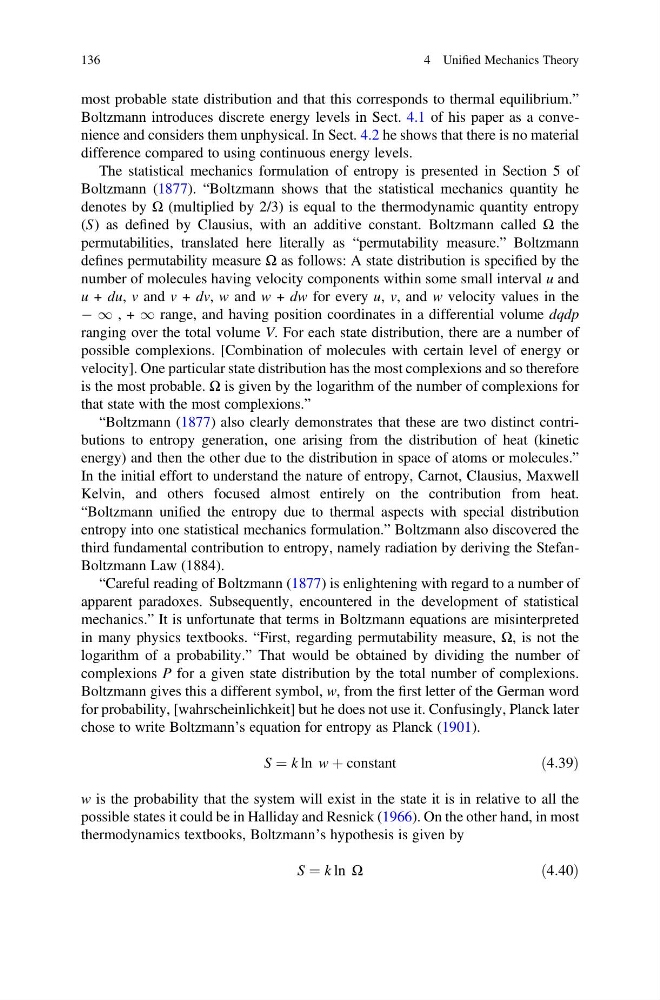
S ¼ k ln w þ constant
ð4:39Þ
w is the probability that the system will exist in the state it is in relative to all the
possible states it could be in Halliday and Resnick (1966). On the other hand, in most
thermodynamics textbooks, Boltzmann’s hypothesis is given by
S ¼ k ln Ω
ð4:40Þ
136
4 Unified Mechanics Theory
Boltzmann introduces discrete energy levels in Sect. 4.1 of his paper as a convenience and considers them unphysical. In Sect. 4.2 he shows that there is no material
difference compared to using continuous energy levels.
The statistical mechanics formulation of entropy is presented in Section 5 of
Boltzmann (1877). “Boltzmann shows that the statistical mechanics quantity he
denotes by Ω (multiplied by 2/3) is equal to the thermodynamic quantity entropy
(S) as defined by Clausius, with an additive constant. Boltzmann called Ω the
permutabilities, translated here literally as “permutability measure.” Boltzmann
defines permutability measure Ω as follows: A state distribution is specified by the
number of molecules having velocity components within some small interval u and
u + du, v and v + dv, w and w + dw for every u, v, and w velocity values in the
À 1 , + 1 range, and having position coordinates in a differential volume dqdp
ranging over the total volume V. For each state distribution, there are a number of
possible complexions. [Combination of molecules with certain level of energy or
velocity]. One particular state distribution has the most complexions and so therefore
is the most probable. Ω is given by the logarithm of the number of complexions for
that state with the most complexions.”
“Boltzmann (1877) also clearly demonstrates that these are two distinct contributions to entropy generation, one arising from the distribution of heat (kinetic
energy) and then the other due to the distribution in space of atoms or molecules.”
In the initial effort to understand the nature of entropy, Carnot, Clausius, Maxwell
Kelvin, and others focused almost entirely on the contribution from heat.
“Boltzmann unified the entropy due to thermal aspects with special distribution
entropy into one statistical mechanics formulation.” Boltzmann also discovered the
third fundamental contribution to entropy, namely radiation by deriving the StefanBoltzmann Law (1884).
“Careful reading of Boltzmann (1877) is enlightening with regard to a number of
apparent paradoxes. Subsequently, encountered in the development of statistical
mechanics.” It is unfortunate that terms in Boltzmann equations are misinterpreted
in many physics textbooks. “First, regarding permutability measure, Ω, is not the
logarithm of a probability.” That would be obtained by dividing the number of
complexions P for a given state distribution by the total number of complexions.
Boltzmann gives this a different symbol, w, from the first letter of the German word
for probability, [wahrscheinlichkeit] but he does not use it. Confusingly, Planck later
chose to write Boltzmann’s equation for entropy as Planck (1901).
S ¼ k ln w þ constant
ð4:39Þ
w is the probability that the system will exist in the state it is in relative to all the
possible states it could be in Halliday and Resnick (1966). On the other hand, in most
thermodynamics textbooks, Boltzmann’s hypothesis is given by
S ¼ k ln Ω
ð4:40Þ
136
4 Unified Mechanics Theory