

Klamecki (1984) attributes this principle, the second law, to Glansdorff and
Prigogone (1971), for reasons beyond our understanding.
As stated by Klamecki (1984) far from thermodynamic equilibrium, no widely
accepted entropy production evolution criterion has been formulated so far. Laws of
thermodynamics are valid around equilibrium points. Since in mechanics all our
problems are around equilibrium points and solved as a sequence of constrained
equilibrium points, not having laws governing far from equilibrium is not a concern.
Recently, Evans et al. (1993) proposed the fluctuation theorem (FT). Laboratory
experiment that verified the validity of the FT was carried out in 2002. Where a
plastic bead was pulled through a solution by a laser. Fluctuations in the velocity
were recorded that were opposite to what the second law of thermodynamics would
dictate for macroscopic systems Wang et al. (2002), Chalmers (2016), and Searles
and Evans (2004).
Fluctuation theorem does not state or prove that the second law of thermodynamics is wrong or invalid. The second law of thermodynamics is valid for macroscopic systems at equilibrium or near equilibrium. Rivas and Martin-Delgado (2017)
have also encountered a partial violation of the second law of thermodynamics in a
quantum system known as Hofstadter lattice. Ostoja-Starzewski (2016) and OstojaStarzewski and Raghavan (2016) proved violations of the second law are relevant as
the length and/or time scales become very small. The second law then needs to be
replaced by the fluctuation theorem, and mathematically the irreversible entropy is a
sub martingale. As indicated above these are far from thermodynamic equilibrium
cases. This partial violation has no place within the framework of classical thermodynamics because it is a spontaneous event that does not effect the laws of thermodynamics at the macroscale at equilibrium or near equilibrium.
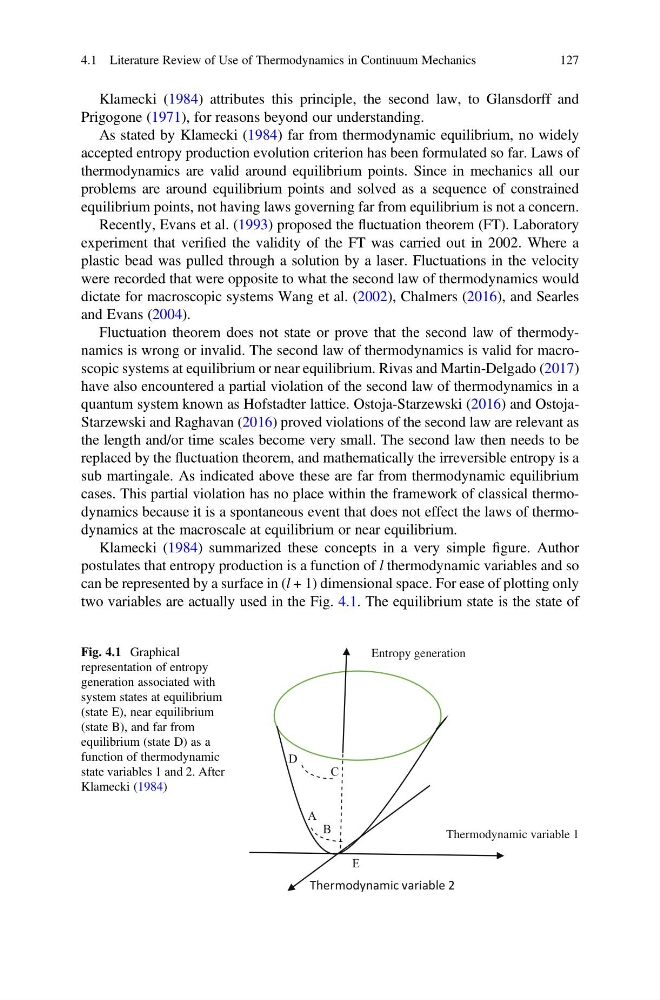
Klamecki (1984) summarized these concepts in a very simple figure. Author
postulates that entropy production is a function of l thermodynamic variables and so
can be represented by a surface in (l + 1) dimensional space. For ease of plotting only
two variables are actually used in the Fig. 4.1. The equilibrium state is the state of
E
B
A
C
D
Thermodynamic variable 2
Entropy generation
Thermodynamic variable 1
Fig. 4.1 Graphical
representation of entropy
generation associated with
system states at equilibrium
(state E), near equilibrium
(state B), and far from
equilibrium (state D) as a
function of thermodynamic
state variables 1 and 2. After
Klamecki (1984)
4.1 Literature Review of Use of Thermodynamics in Continuum Mechanics
127
Prigogone (1971), for reasons beyond our understanding.
As stated by Klamecki (1984) far from thermodynamic equilibrium, no widely
accepted entropy production evolution criterion has been formulated so far. Laws of
thermodynamics are valid around equilibrium points. Since in mechanics all our
problems are around equilibrium points and solved as a sequence of constrained
equilibrium points, not having laws governing far from equilibrium is not a concern.
Recently, Evans et al. (1993) proposed the fluctuation theorem (FT). Laboratory
experiment that verified the validity of the FT was carried out in 2002. Where a
plastic bead was pulled through a solution by a laser. Fluctuations in the velocity
were recorded that were opposite to what the second law of thermodynamics would
dictate for macroscopic systems Wang et al. (2002), Chalmers (2016), and Searles
and Evans (2004).
Fluctuation theorem does not state or prove that the second law of thermodynamics is wrong or invalid. The second law of thermodynamics is valid for macroscopic systems at equilibrium or near equilibrium. Rivas and Martin-Delgado (2017)
have also encountered a partial violation of the second law of thermodynamics in a
quantum system known as Hofstadter lattice. Ostoja-Starzewski (2016) and OstojaStarzewski and Raghavan (2016) proved violations of the second law are relevant as
the length and/or time scales become very small. The second law then needs to be
replaced by the fluctuation theorem, and mathematically the irreversible entropy is a
sub martingale. As indicated above these are far from thermodynamic equilibrium
cases. This partial violation has no place within the framework of classical thermodynamics because it is a spontaneous event that does not effect the laws of thermodynamics at the macroscale at equilibrium or near equilibrium.
Klamecki (1984) summarized these concepts in a very simple figure. Author
postulates that entropy production is a function of l thermodynamic variables and so
can be represented by a surface in (l + 1) dimensional space. For ease of plotting only
two variables are actually used in the Fig. 4.1. The equilibrium state is the state of
E
B
A
C
D
Thermodynamic variable 2
Entropy generation
Thermodynamic variable 1
Fig. 4.1 Graphical
representation of entropy
generation associated with
system states at equilibrium
(state E), near equilibrium
(state B), and far from
equilibrium (state D) as a
function of thermodynamic
state variables 1 and 2. After
Klamecki (1984)
4.1 Literature Review of Use of Thermodynamics in Continuum Mechanics
127