

failure. Author proposed pairing of a phenomenological critical damage parameter
and entropy jump, ΔS, requirement as a local failure criterion. It is important to point
out that Chudnovsky proposed calculating entropy generation in a fracture mechanics problem for all mechanisms, damage, translation, rotation, isotropic expansion,
and distortion of the active crack zone.
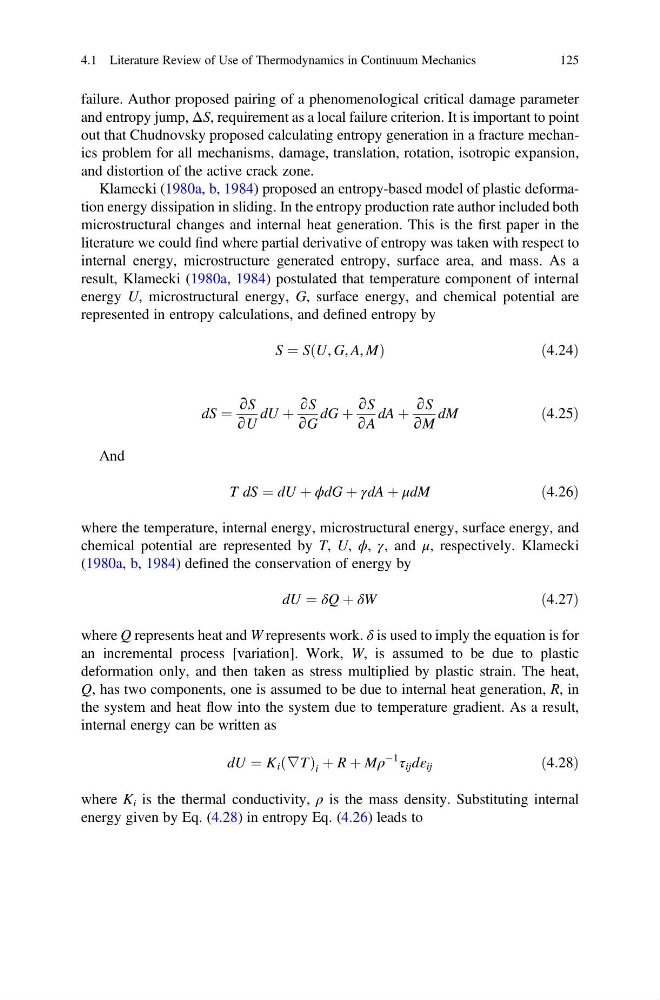
Klamecki (1980a, b, 1984) proposed an entropy-based model of plastic deformation energy dissipation in sliding. In the entropy production rate author included both
microstructural changes and internal heat generation. This is the first paper in the
literature we could find where partial derivative of entropy was taken with respect to
internal energy, microstructure generated entropy, surface area, and mass. As a
result, Klamecki (1980a, 1984) postulated that temperature component of internal
energy U, microstructural energy, G, surface energy, and chemical potential are
represented in entropy calculations, and defined entropy by
S ¼ S U, G, A, M
ð
Þ
ð 4:24Þ
dS ¼
∂S
∂U
dU þ
∂S
∂G
dG þ
∂S
∂A
dA þ
∂S
∂M
dM
ð4:25Þ
And
T dS ¼ dU þ ϕdG þ γdA þ μdM
ð4:26Þ
where the temperature, internal energy, microstructural energy, surface energy, and
chemical potential are represented by T, U, ϕ, γ, and μ, respectively. Klamecki
(1980a, b, 1984) defined the conservation of energy by
dU ¼ δQ þ δW
ð4:27Þ
where Q represents heat and W represents work. δ is used to imply the equation is for
an incremental process [variation]. Work, W, is assumed to be due to plastic
deformation only, and then taken as stress multiplied by plastic strain. The heat,
Q, has two components, one is assumed to be due to internal heat generation, R, in
the system and heat flow into the system due to temperature gradient. As a result,
internal energy can be written as
dU ¼ K i ∇T
ð
Þ i þ R þ Mρ
À1
τ ij dε ij
ð4:28Þ
where K i is the thermal conductivity, ρ is the mass density. Substituting internal
energy given by Eq. (4.28) in entropy Eq. (4.26) leads to
4.1 Literature Review of Use of Thermodynamics in Continuum Mechanics
125
and entropy jump, ΔS, requirement as a local failure criterion. It is important to point
out that Chudnovsky proposed calculating entropy generation in a fracture mechanics problem for all mechanisms, damage, translation, rotation, isotropic expansion,
and distortion of the active crack zone.
Klamecki (1980a, b, 1984) proposed an entropy-based model of plastic deformation energy dissipation in sliding. In the entropy production rate author included both
microstructural changes and internal heat generation. This is the first paper in the
literature we could find where partial derivative of entropy was taken with respect to
internal energy, microstructure generated entropy, surface area, and mass. As a
result, Klamecki (1980a, 1984) postulated that temperature component of internal
energy U, microstructural energy, G, surface energy, and chemical potential are
represented in entropy calculations, and defined entropy by
S ¼ S U, G, A, M
ð
Þ
ð 4:24Þ
dS ¼
∂S
∂U
dU þ
∂S
∂G
dG þ
∂S
∂A
dA þ
∂S
∂M
dM
ð4:25Þ
And
T dS ¼ dU þ ϕdG þ γdA þ μdM
ð4:26Þ
where the temperature, internal energy, microstructural energy, surface energy, and
chemical potential are represented by T, U, ϕ, γ, and μ, respectively. Klamecki
(1980a, b, 1984) defined the conservation of energy by
dU ¼ δQ þ δW
ð4:27Þ
where Q represents heat and W represents work. δ is used to imply the equation is for
an incremental process [variation]. Work, W, is assumed to be due to plastic
deformation only, and then taken as stress multiplied by plastic strain. The heat,
Q, has two components, one is assumed to be due to internal heat generation, R, in
the system and heat flow into the system due to temperature gradient. As a result,
internal energy can be written as
dU ¼ K i ∇T
ð
Þ i þ R þ Mρ
À1
τ ij dε ij
ð4:28Þ
where K i is the thermal conductivity, ρ is the mass density. Substituting internal
energy given by Eq. (4.28) in entropy Eq. (4.26) leads to
4.1 Literature Review of Use of Thermodynamics in Continuum Mechanics
125