

2. Cells are resuspended in 25 mL cell culture medium, centrifugated for 5 min at 800 Â g and cell pellets are resuspended in a
small volume (<5 mL) of PBS.
3. The volume is increased to 25 mL with PBS followed by
recentrifugation for 5 min at 800 Â g.
4. Cells are resuspended in approximately 2.5 mL PBS per T175
flask, equivalent to 1–2 Â 10
7 cells/mL. Cells should be subjected to electroporation immediately although short-term
storage (<1 h) on ice is acceptable.
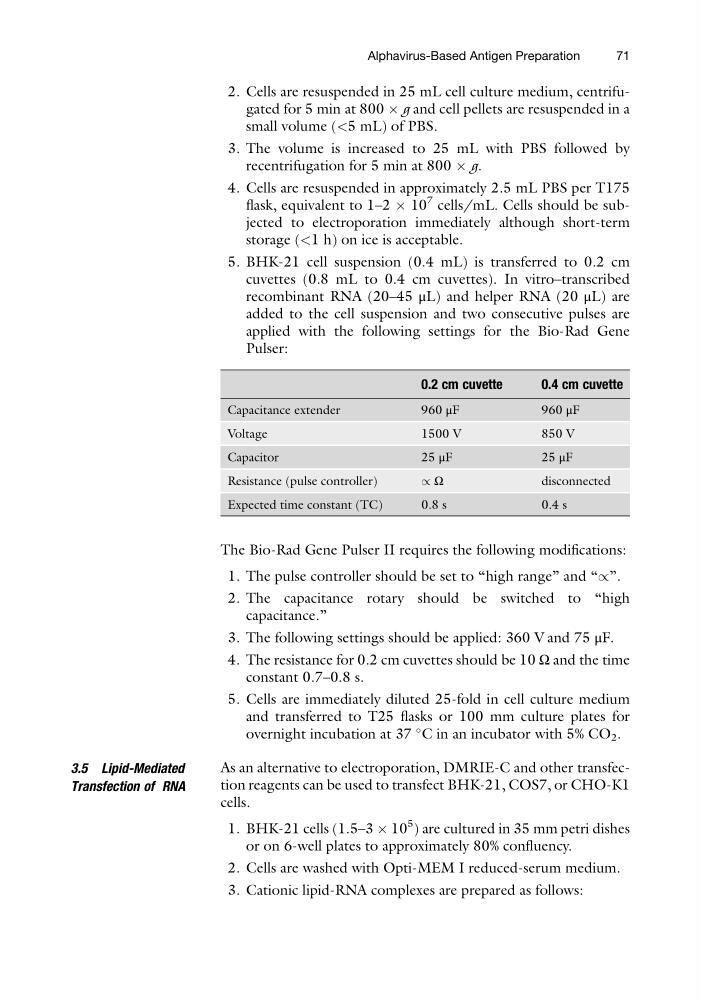
5. BHK-21 cell suspension (0.4 mL) is transferred to 0.2 cm
cuvettes (0.8 mL to 0.4 cm cuvettes). In vitro–transcribed
recombinant RNA (20–45 μL) and helper RNA (20 μL) are
added to the cell suspension and two consecutive pulses are
applied with the following settings for the Bio-Rad Gene
Pulser:
0.2 cm cuvette
0.4 cm cuvette
Capacitance extender
960 μF
960 μF
Voltage
1500 V
850 V
Capacitor
25 μF
2 5 μF
Resistance (pulse controller)
/ Ω
disconnected
Expected time constant (TC)
0.8 s
0.4 s
The Bio-Rad Gene Pulser II requires the following modifications:
1. The pulse controller should be set to “high range” and “/”.
2. The capacitance rotary should be switched to “high
capacitance.”
3. The following settings should be applied: 360 V and 75 μF.
4. The resistance for 0.2 cm cuvettes should be 10 Ω and the time
constant 0.7–0.8 s.
5. Cells are immediately diluted 25-fold in cell culture medium
and transferred to T25 flasks or 100 mm culture plates for
overnight incubation at 37
C in an incubator with 5% CO 2 .
3.5 Lipid-Mediated
Transfection of RNA
As an alternative to electroporation, DMRIE-C and other transfection reagents can be used to transfect BHK-21, COS7, or CHO-K1
cells.
1. BHK-21 cells (1.5–3 Â 10
5 ) are cultured in 35 mm petri dishes
or on 6-well plates to approximately 80% confluency.
2. Cells are washed with Opti-MEM I reduced-serum medium.
3. Cationic lipid-RNA complexes are prepared as follows:
Alphavirus-Based Antigen Preparation
71
small volume (<5 mL) of PBS.
3. The volume is increased to 25 mL with PBS followed by
recentrifugation for 5 min at 800 Â g.
4. Cells are resuspended in approximately 2.5 mL PBS per T175
flask, equivalent to 1–2 Â 10
7 cells/mL. Cells should be subjected to electroporation immediately although short-term
storage (<1 h) on ice is acceptable.
5. BHK-21 cell suspension (0.4 mL) is transferred to 0.2 cm
cuvettes (0.8 mL to 0.4 cm cuvettes). In vitro–transcribed
recombinant RNA (20–45 μL) and helper RNA (20 μL) are
added to the cell suspension and two consecutive pulses are
applied with the following settings for the Bio-Rad Gene
Pulser:
0.2 cm cuvette
0.4 cm cuvette
Capacitance extender
960 μF
960 μF
Voltage
1500 V
850 V
Capacitor
25 μF
2 5 μF
Resistance (pulse controller)
/ Ω
disconnected
Expected time constant (TC)
0.8 s
0.4 s
The Bio-Rad Gene Pulser II requires the following modifications:
1. The pulse controller should be set to “high range” and “/”.
2. The capacitance rotary should be switched to “high
capacitance.”
3. The following settings should be applied: 360 V and 75 μF.
4. The resistance for 0.2 cm cuvettes should be 10 Ω and the time
constant 0.7–0.8 s.
5. Cells are immediately diluted 25-fold in cell culture medium
and transferred to T25 flasks or 100 mm culture plates for
overnight incubation at 37
C in an incubator with 5% CO 2 .
3.5 Lipid-Mediated
Transfection of RNA
As an alternative to electroporation, DMRIE-C and other transfection reagents can be used to transfect BHK-21, COS7, or CHO-K1
cells.
1. BHK-21 cells (1.5–3 Â 10
5 ) are cultured in 35 mm petri dishes
or on 6-well plates to approximately 80% confluency.
2. Cells are washed with Opti-MEM I reduced-serum medium.
3. Cationic lipid-RNA complexes are prepared as follows:
Alphavirus-Based Antigen Preparation
71