

strains and species. In this regard, the pattern of synonymous and
nonsynonymous mutations in protein coding sequences can be
exploited as an additional characteristic to identify potential vaccine
candidates. All this said, neither immunogenicity nor immunodominance predict protective immunity [38]. In fact, immunodominance can be exploited by the pathogen as an immune-evasion
mechanism [39], whereas subdominant epitopes are often more
conserved and may elicit immune responses that, although weaker,
can promote host resistance [40]. As a conclusion, the properties
one should be looking for in trying to identify new antigens for
vaccine design depend greatly on the available knowledge on the
pathogen and its interaction with the immune system.
Here, we present a general methodology for in silico vaccine
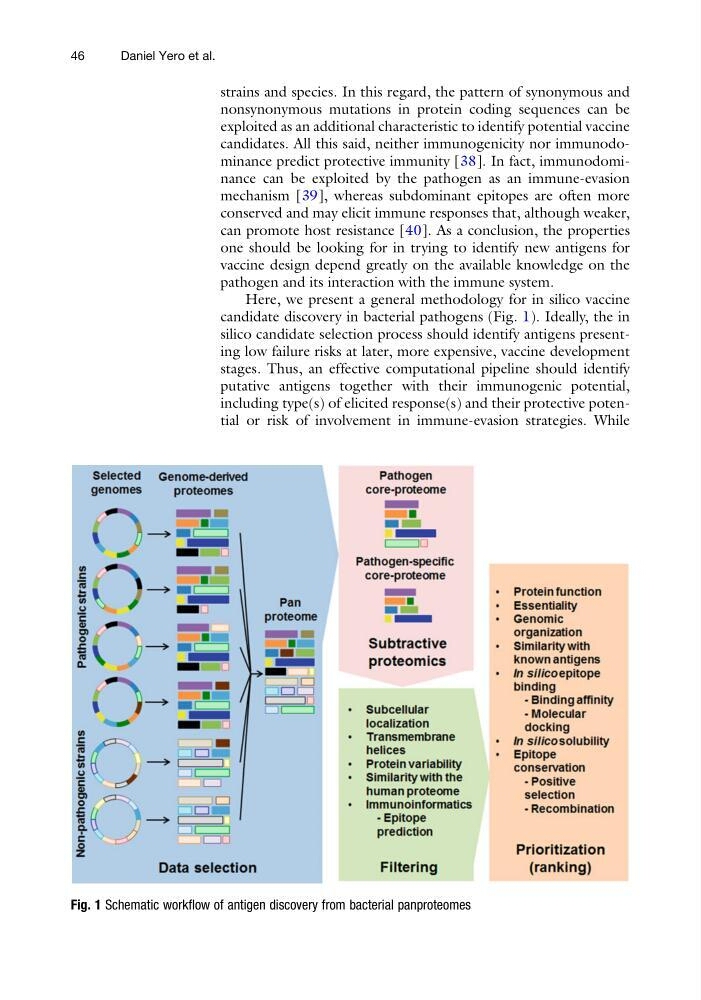
candidate discovery in bacterial pathogens (Fig. 1). Ideally, the in
silico candidate selection process should identify antigens presenting low failure risks at later, more expensive, vaccine development
stages. Thus, an effective computational pipeline should identify
putative antigens together with their immunogenic potential,
including type(s) of elicited response(s) and their protective potential or risk of involvement in immune-evasion strategies. While
Fig. 1 Schematic workflow of antigen discovery from bacterial panproteomes
46
Daniel Yero et al.
nonsynonymous mutations in protein coding sequences can be
exploited as an additional characteristic to identify potential vaccine
candidates. All this said, neither immunogenicity nor immunodominance predict protective immunity [38]. In fact, immunodominance can be exploited by the pathogen as an immune-evasion
mechanism [39], whereas subdominant epitopes are often more
conserved and may elicit immune responses that, although weaker,
can promote host resistance [40]. As a conclusion, the properties
one should be looking for in trying to identify new antigens for
vaccine design depend greatly on the available knowledge on the
pathogen and its interaction with the immune system.
Here, we present a general methodology for in silico vaccine
candidate discovery in bacterial pathogens (Fig. 1). Ideally, the in
silico candidate selection process should identify antigens presenting low failure risks at later, more expensive, vaccine development
stages. Thus, an effective computational pipeline should identify
putative antigens together with their immunogenic potential,
including type(s) of elicited response(s) and their protective potential or risk of involvement in immune-evasion strategies. While
Fig. 1 Schematic workflow of antigen discovery from bacterial panproteomes
46
Daniel Yero et al.