

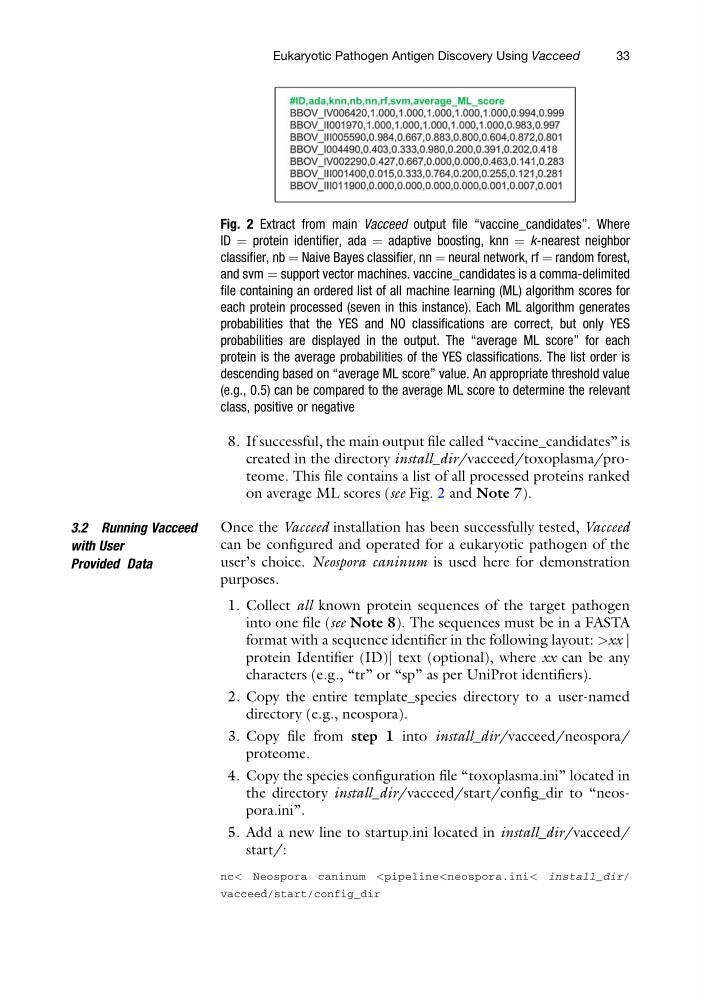
8. If successful, the main output file called “vaccine_candidates” is
created in the directory install_dir/vacceed/toxoplasma/proteome. This file contains a list of all processed proteins ranked
on average ML scores (see Fig. 2 and Note 7).
3.2 Running Vacceed
with User
Provided Data
Once the Vacceed installation has been successfully tested, Vacceed
can be configured and operated for a eukaryotic pathogen of the
user’s choice. Neospora caninum is used here for demonstration
purposes.
1. Collect all known protein sequences of the target pathogen
into one file (see Note 8). The sequences must be in a FASTA
format with a sequence identifier in the following layout: >xx |
protein Identifier (ID)| text (optional), where xx can be any
characters (e.g., “tr” or “sp” as per UniProt identifiers).
2. Copy the entire template_species directory to a user-named
directory (e.g., neospora).
3. Copy file from step 1 into install_dir/vacceed/neospora/
proteome.
4. Copy the species configuration file “toxoplasma.ini” located in
the directory install_dir/vacceed/start/config_dir to “neospora.ini”.
5. Add a new line to startup.ini located in install_dir/vacceed/
start/:
nc< Neospora caninum
Fig. 2 Extract from main Vacceed output file “vaccine_candidates”. Where
ID ¼ protein identifier, ada ¼ adaptive boosting, knn ¼ k-nearest neighbor
classifier, nb ¼ Naive Bayes classifier, nn ¼ neural network, rf ¼ random forest,
and svm ¼ support vector machines. vaccine_candidates is a comma-delimited
file containing an ordered list of all machine learning (ML) algorithm scores for
each protein processed (seven in this instance). Each ML algorithm generates
probabilities that the YES and NO classifications are correct, but only YES
probabilities are displayed in the output. The “average ML score” for each
protein is the average probabilities of the YES classifications. The list order is
descending based on “average ML score” value. An appropriate threshold value
(e.g., 0.5) can be compared to the average ML score to determine the relevant
class, positive or negative
Eukaryotic Pathogen Antigen Discovery Using Vacceed
33
created in the directory install_dir/vacceed/toxoplasma/proteome. This file contains a list of all processed proteins ranked
on average ML scores (see Fig. 2 and Note 7).
3.2 Running Vacceed
with User
Provided Data
Once the Vacceed installation has been successfully tested, Vacceed
can be configured and operated for a eukaryotic pathogen of the
user’s choice. Neospora caninum is used here for demonstration
purposes.
1. Collect all known protein sequences of the target pathogen
into one file (see Note 8). The sequences must be in a FASTA
format with a sequence identifier in the following layout: >xx |
protein Identifier (ID)| text (optional), where xx can be any
characters (e.g., “tr” or “sp” as per UniProt identifiers).
2. Copy the entire template_species directory to a user-named
directory (e.g., neospora).
3. Copy file from step 1 into install_dir/vacceed/neospora/
proteome.
4. Copy the species configuration file “toxoplasma.ini” located in
the directory install_dir/vacceed/start/config_dir to “neospora.ini”.
5. Add a new line to startup.ini located in install_dir/vacceed/
start/:
nc< Neospora caninum
Fig. 2 Extract from main Vacceed output file “vaccine_candidates”. Where
ID ¼ protein identifier, ada ¼ adaptive boosting, knn ¼ k-nearest neighbor
classifier, nb ¼ Naive Bayes classifier, nn ¼ neural network, rf ¼ random forest,
and svm ¼ support vector machines. vaccine_candidates is a comma-delimited
file containing an ordered list of all machine learning (ML) algorithm scores for
each protein processed (seven in this instance). Each ML algorithm generates
probabilities that the YES and NO classifications are correct, but only YES
probabilities are displayed in the output. The “average ML score” for each
protein is the average probabilities of the YES classifications. The list order is
descending based on “average ML score” value. An appropriate threshold value
(e.g., 0.5) can be compared to the average ML score to determine the relevant
class, positive or negative
Eukaryotic Pathogen Antigen Discovery Using Vacceed
33