

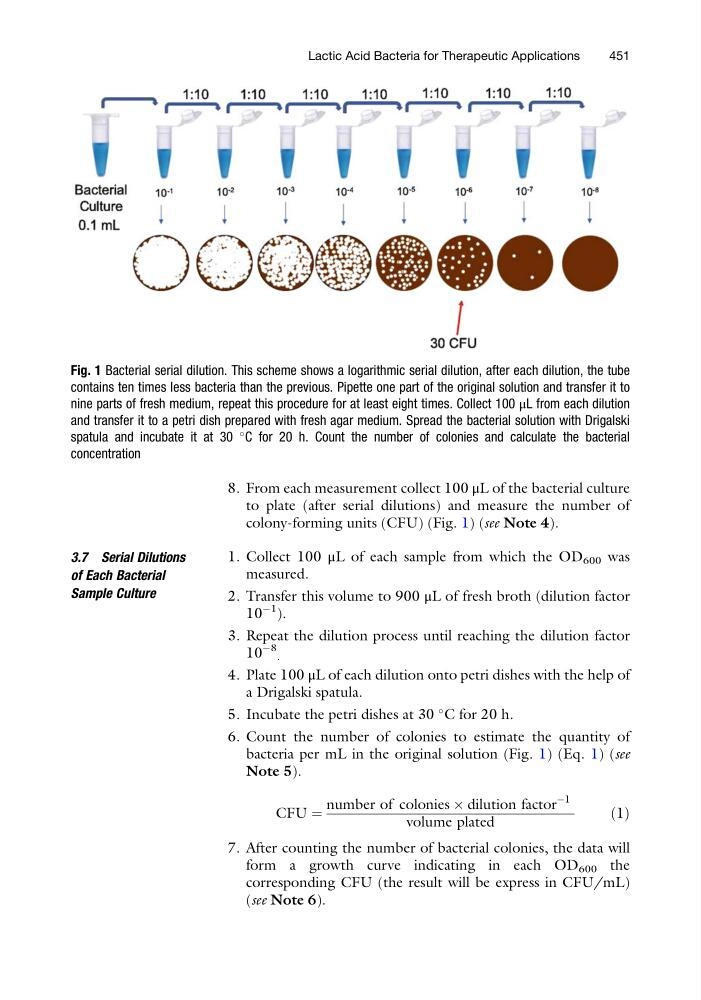
8. From each measurement collect 100 μL of the bacterial culture
to plate (after serial dilutions) and measure the number of
colony-forming units (CFU) (Fig. 1) (see Note 4).
3.7 Serial Dilutions
of Each Bacterial
Sample Culture
1. Collect 100 μL of each sample from which the OD 600 was
measured.
2. Transfer this volume to 900 μL of fresh broth (dilution factor
10
À1 ).
3. Repeat the dilution process until reaching the dilution factor
10
À8
.
4. Plate 100 μL of each dilution onto petri dishes with the help of
a Drigalski spatula.
5. Incubate the petri dishes at 30
C for 20 h.
6. Count the number of colonies to estimate the quantity of
bacteria per mL in the original solution (Fig. 1) (Eq. 1) (see
Note 5).
CFU ¼
number of colonies  dilution factor
À1
volume plated
ð1Þ
7. After counting the number of bacterial colonies, the data will
form a growth curve indicating in each OD 600 the
corresponding CFU (the result will be express in CFU/mL)
(see Note 6).
Fig. 1 Bacterial serial dilution. This scheme shows a logarithmic serial dilution, after each dilution, the tube
contains ten times less bacteria than the previous. Pipette one part of the original solution and transfer it to
nine parts of fresh medium, repeat this procedure for at least eight times. Collect 100 μL from each dilution
and transfer it to a petri dish prepared with fresh agar medium. Spread the bacterial solution with Drigalski
spatula and incubate it at 30
C for 20 h. Count the number of colonies and calculate the bacterial
concentration
Lactic Acid Bacteria for Therapeutic Applications
451
to plate (after serial dilutions) and measure the number of
colony-forming units (CFU) (Fig. 1) (see Note 4).
3.7 Serial Dilutions
of Each Bacterial
Sample Culture
1. Collect 100 μL of each sample from which the OD 600 was
measured.
2. Transfer this volume to 900 μL of fresh broth (dilution factor
10
À1 ).
3. Repeat the dilution process until reaching the dilution factor
10
À8
.
4. Plate 100 μL of each dilution onto petri dishes with the help of
a Drigalski spatula.
5. Incubate the petri dishes at 30
C for 20 h.
6. Count the number of colonies to estimate the quantity of
bacteria per mL in the original solution (Fig. 1) (Eq. 1) (see
Note 5).
CFU ¼
number of colonies  dilution factor
À1
volume plated
ð1Þ
7. After counting the number of bacterial colonies, the data will
form a growth curve indicating in each OD 600 the
corresponding CFU (the result will be express in CFU/mL)
(see Note 6).
Fig. 1 Bacterial serial dilution. This scheme shows a logarithmic serial dilution, after each dilution, the tube
contains ten times less bacteria than the previous. Pipette one part of the original solution and transfer it to
nine parts of fresh medium, repeat this procedure for at least eight times. Collect 100 μL from each dilution
and transfer it to a petri dish prepared with fresh agar medium. Spread the bacterial solution with Drigalski
spatula and incubate it at 30
C for 20 h. Count the number of colonies and calculate the bacterial
concentration
Lactic Acid Bacteria for Therapeutic Applications
451