

hormones in many patients [5, 6] with erythropoietin [7] and
interferon [8, 9] in a few cases. Anesthetic agents like lidocaine,
midazolam, and ketamine have also been delivered using liquid jet
injectors [10–12]. Apart from liquid jet injectors, there have been
considerable developments in technologies which include epidermal powder injections, ultrasound-based needle-free injectors, and
shock wave-based needle-free vaccine delivery systems [1, 2,
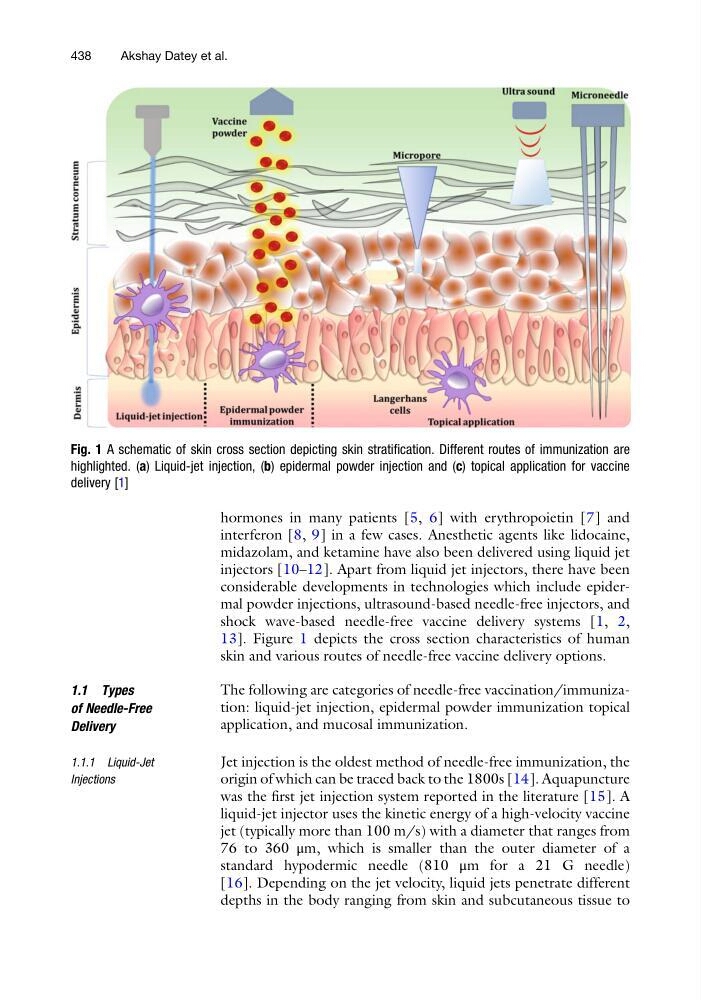
13]. Figure 1 depicts the cross section characteristics of human
skin and various routes of needle-free vaccine delivery options.
1.1 Types
of Needle-Free
Delivery
The following are categories of needle-free vaccination/immunization: liquid-jet injection, epidermal powder immunization topical
application, and mucosal immunization.
1.1.1 Liquid-Jet
Injections
Jet injection is the oldest method of needle-free immunization, the
origin of which can be traced back to the 1800s [14]. Aquapuncture
was the first jet injection system reported in the literature [15]. A
liquid-jet injector uses the kinetic energy of a high-velocity vaccine
jet (typically more than 100 m/s) with a diameter that ranges from
76 to 360 μm, which is smaller than the outer diameter of a
standard hypodermic needle (810 μm for a 21 G needle)
[16]. Depending on the jet velocity, liquid jets penetrate different
depths in the body ranging from skin and subcutaneous tissue to
Fig. 1 A schematic of skin cross section depicting skin stratification. Different routes of immunization are
highlighted. (a) Liquid-jet injection, (b) epidermal powder injection and (c) topical application for vaccine
delivery [1]
438
Akshay Datey et al.
interferon [8, 9] in a few cases. Anesthetic agents like lidocaine,
midazolam, and ketamine have also been delivered using liquid jet
injectors [10–12]. Apart from liquid jet injectors, there have been
considerable developments in technologies which include epidermal powder injections, ultrasound-based needle-free injectors, and
shock wave-based needle-free vaccine delivery systems [1, 2,
13]. Figure 1 depicts the cross section characteristics of human
skin and various routes of needle-free vaccine delivery options.
1.1 Types
of Needle-Free
Delivery
The following are categories of needle-free vaccination/immunization: liquid-jet injection, epidermal powder immunization topical
application, and mucosal immunization.
1.1.1 Liquid-Jet
Injections
Jet injection is the oldest method of needle-free immunization, the
origin of which can be traced back to the 1800s [14]. Aquapuncture
was the first jet injection system reported in the literature [15]. A
liquid-jet injector uses the kinetic energy of a high-velocity vaccine
jet (typically more than 100 m/s) with a diameter that ranges from
76 to 360 μm, which is smaller than the outer diameter of a
standard hypodermic needle (810 μm for a 21 G needle)
[16]. Depending on the jet velocity, liquid jets penetrate different
depths in the body ranging from skin and subcutaneous tissue to
Fig. 1 A schematic of skin cross section depicting skin stratification. Different routes of immunization are
highlighted. (a) Liquid-jet injection, (b) epidermal powder injection and (c) topical application for vaccine
delivery [1]
438
Akshay Datey et al.