

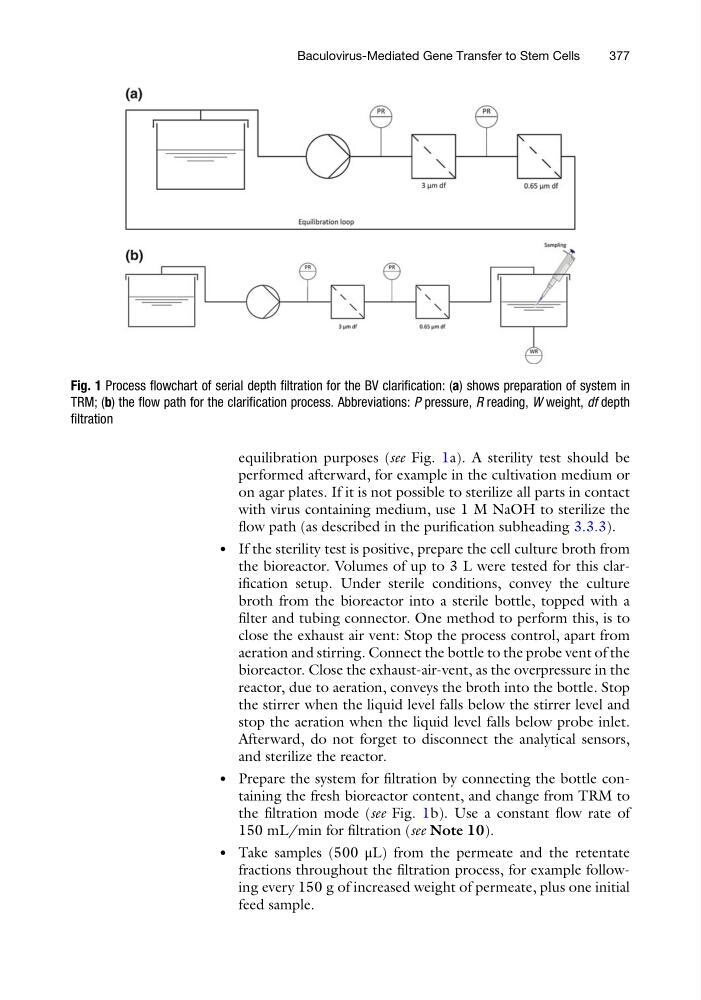
equilibration purposes (see Fig. 1a). A sterility test should be
performed afterward, for example in the cultivation medium or
on agar plates. If it is not possible to sterilize all parts in contact
with virus containing medium, use 1 M NaOH to sterilize the
flow path (as described in the purification subheading 3.3.3).
l
If the sterility test is positive, prepare the cell culture broth from
the bioreactor. Volumes of up to 3 L were tested for this clarification setup. Under sterile conditions, convey the culture
broth from the bioreactor into a sterile bottle, topped with a
filter and tubing connector. One method to perform this, is to
close the exhaust air vent: Stop the process control, apart from
aeration and stirring. Connect the bottle to the probe vent of the
bioreactor. Close the exhaust-air-vent, as the overpressure in the
reactor, due to aeration, conveys the broth into the bottle. Stop
the stirrer when the liquid level falls below the stirrer level and
stop the aeration when the liquid level falls below probe inlet.
Afterward, do not forget to disconnect the analytical sensors,
and sterilize the reactor.
l
Prepare the system for filtration by connecting the bottle containing the fresh bioreactor content, and change from TRM to
the filtration mode (see Fig. 1b). Use a constant flow rate of
150 mL/min for filtration (see Note 10).
l
Take samples (500 μL) from the permeate and the retentate
fractions throughout the filtration process, for example following every 150 g of increased weight of permeate, plus one initial
feed sample.
Fig. 1 Process flowchart of serial depth filtration for the BV clarification: (a) shows preparation of system in
TRM; (b) the flow path for the clarification process. Abbreviations: P pressure, R reading, W weight, df depth
filtration
Baculovirus-Mediated Gene Transfer to Stem Cells
377
performed afterward, for example in the cultivation medium or
on agar plates. If it is not possible to sterilize all parts in contact
with virus containing medium, use 1 M NaOH to sterilize the
flow path (as described in the purification subheading 3.3.3).
l
If the sterility test is positive, prepare the cell culture broth from
the bioreactor. Volumes of up to 3 L were tested for this clarification setup. Under sterile conditions, convey the culture
broth from the bioreactor into a sterile bottle, topped with a
filter and tubing connector. One method to perform this, is to
close the exhaust air vent: Stop the process control, apart from
aeration and stirring. Connect the bottle to the probe vent of the
bioreactor. Close the exhaust-air-vent, as the overpressure in the
reactor, due to aeration, conveys the broth into the bottle. Stop
the stirrer when the liquid level falls below the stirrer level and
stop the aeration when the liquid level falls below probe inlet.
Afterward, do not forget to disconnect the analytical sensors,
and sterilize the reactor.
l
Prepare the system for filtration by connecting the bottle containing the fresh bioreactor content, and change from TRM to
the filtration mode (see Fig. 1b). Use a constant flow rate of
150 mL/min for filtration (see Note 10).
l
Take samples (500 μL) from the permeate and the retentate
fractions throughout the filtration process, for example following every 150 g of increased weight of permeate, plus one initial
feed sample.
Fig. 1 Process flowchart of serial depth filtration for the BV clarification: (a) shows preparation of system in
TRM; (b) the flow path for the clarification process. Abbreviations: P pressure, R reading, W weight, df depth
filtration
Baculovirus-Mediated Gene Transfer to Stem Cells
377