

species by minimizing band diffusion and overlap [24]. Because
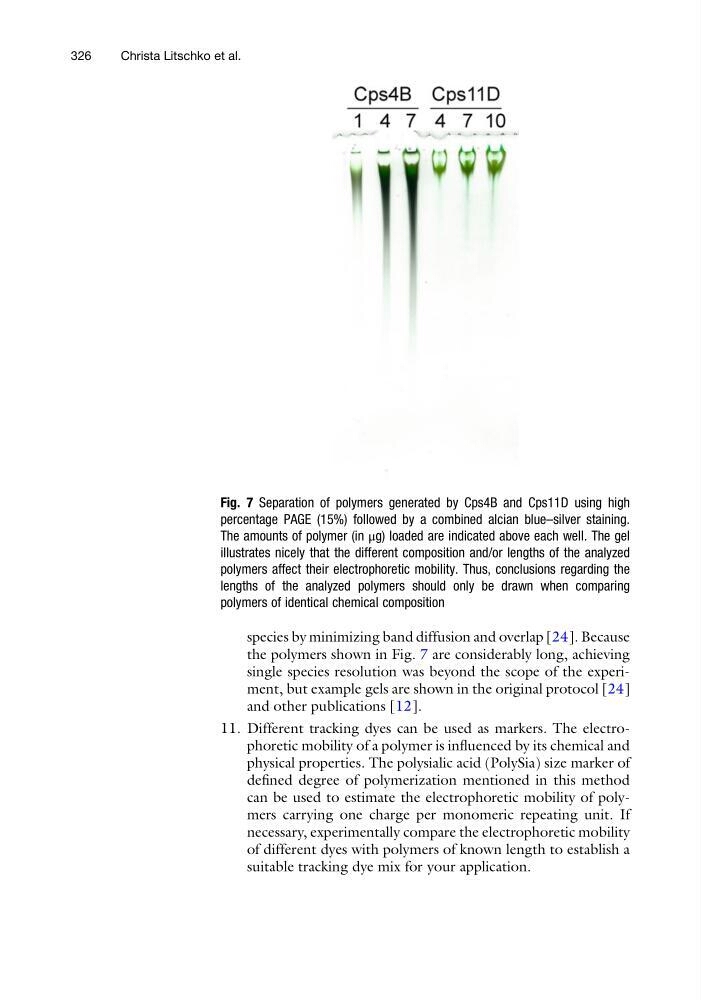
the polymers shown in Fig. 7 are considerably long, achieving
single species resolution was beyond the scope of the experiment, but example gels are shown in the original protocol [24]
and other publications [12].
11. Different tracking dyes can be used as markers. The electrophoretic mobility of a polymer is influenced by its chemical and
physical properties. The polysialic acid (PolySia) size marker of
defined degree of polymerization mentioned in this method
can be used to estimate the electrophoretic mobility of polymers carrying one charge per monomeric repeating unit. If
necessary, experimentally compare the electrophoretic mobility
of different dyes with polymers of known length to establish a
suitable tracking dye mix for your application.
Fig. 7 Separation of polymers generated by Cps4B and Cps11D using high
percentage PAGE (15%) followed by a combined alcian blue–silver staining.
The amounts of polymer (in μg) loaded are indicated above each well. The gel
illustrates nicely that the different composition and/or lengths of the analyzed
polymers affect their electrophoretic mobility. Thus, conclusions regarding the
lengths of the analyzed polymers should only be drawn when comparing
polymers of identical chemical composition
326
Christa Litschko et al.
the polymers shown in Fig. 7 are considerably long, achieving
single species resolution was beyond the scope of the experiment, but example gels are shown in the original protocol [24]
and other publications [12].
11. Different tracking dyes can be used as markers. The electrophoretic mobility of a polymer is influenced by its chemical and
physical properties. The polysialic acid (PolySia) size marker of
defined degree of polymerization mentioned in this method
can be used to estimate the electrophoretic mobility of polymers carrying one charge per monomeric repeating unit. If
necessary, experimentally compare the electrophoretic mobility
of different dyes with polymers of known length to establish a
suitable tracking dye mix for your application.
Fig. 7 Separation of polymers generated by Cps4B and Cps11D using high
percentage PAGE (15%) followed by a combined alcian blue–silver staining.
The amounts of polymer (in μg) loaded are indicated above each well. The gel
illustrates nicely that the different composition and/or lengths of the analyzed
polymers affect their electrophoretic mobility. Thus, conclusions regarding the
lengths of the analyzed polymers should only be drawn when comparing
polymers of identical chemical composition
326
Christa Litschko et al.