

10. Oxidizing solution: 0.7% periodic acid, 40% ethanol, 5% acetic
acid. For 100 mL, weigh 0.7 g periodic acid, add 40 mL of
ethanol and 5 mL of acetic acid and fill with water to a volume
of 100 mL. Mix properly by shaking (see Note 13).
11. Silver nitrate solution (see Note 14): 0.6% silver nitrate, 0.4%
ammonia, 10 mM NaOH. To obtain a ~100 mL solution,
weigh 0.6 g of silver nitrate and properly dissolve the salt in
98 mL of water. After the silver nitrate is completely dissolved,
add 1.2 ml of 33% ammonia and 1 mL of 2 M NaOH.
12. Formaldehyde solution: 0.05% formaldehyde, 240 μM citric
acid. For a 100 mL solution, mix 135 μL of 37% formaldehyde
with water, add 5 mg of citric acid and water up to a volume of
100 mL (see Note 14).
13. Stop solution: 5% acetic acid. Add 5 mL of acetic acid to a
100 mL volumetric flask and make up to 100 mL with water
(see Note 15).
3 Methods
3.1 Enzymatic
Activity Assays
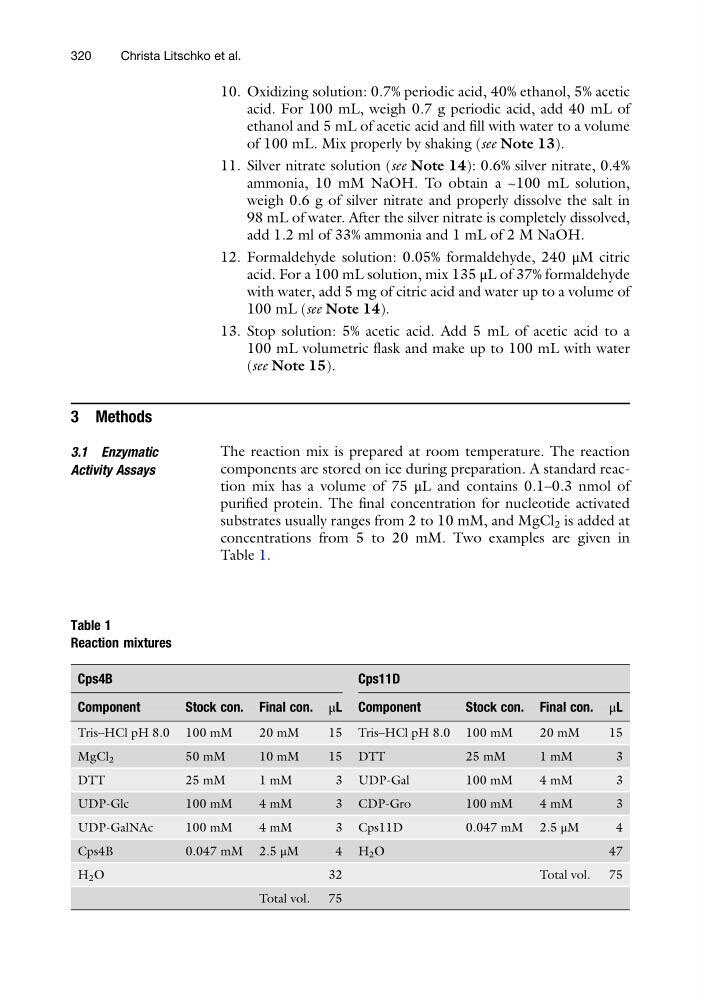
The reaction mix is prepared at room temperature. The reaction
components are stored on ice during preparation. A standard reaction mix has a volume of 75 μL and contains 0.1–0.3 nmol of
purified protein. The final concentration for nucleotide activated
substrates usually ranges from 2 to 10 mM, and MgCl 2 is added at
concentrations from 5 to 20 mM. Two examples are given in
Table 1.
Table 1
Reaction mixtures
Cps4B
Cps11D
Component
Stock con. Final con. μL Component
Stock con. Final con. μL
Tris–HCl pH 8.0 100 mM
20 mM
15 Tris–HCl pH 8.0 100 mM
20 mM
15
MgCl 2
50 mM
10 mM
15 DTT
25 mM
1 mM
3
DTT
25 mM
1 mM
3 UDP-Gal
100 mM
4 mM
3
UDP-Glc
100 mM
4 mM
3 CDP-Gro
100 mM
4 mM
3
UDP-GalNAc
100 mM
4 mM
3 Cps11D
0.047 mM 2.5 μM
4
Cps4B
0.047 mM 2.5 μM
4 H 2 O
4 7
H 2 O
32
Total vol. 75
Total vol. 75
320
Christa Litschko et al.
acid. For 100 mL, weigh 0.7 g periodic acid, add 40 mL of
ethanol and 5 mL of acetic acid and fill with water to a volume
of 100 mL. Mix properly by shaking (see Note 13).
11. Silver nitrate solution (see Note 14): 0.6% silver nitrate, 0.4%
ammonia, 10 mM NaOH. To obtain a ~100 mL solution,
weigh 0.6 g of silver nitrate and properly dissolve the salt in
98 mL of water. After the silver nitrate is completely dissolved,
add 1.2 ml of 33% ammonia and 1 mL of 2 M NaOH.
12. Formaldehyde solution: 0.05% formaldehyde, 240 μM citric
acid. For a 100 mL solution, mix 135 μL of 37% formaldehyde
with water, add 5 mg of citric acid and water up to a volume of
100 mL (see Note 14).
13. Stop solution: 5% acetic acid. Add 5 mL of acetic acid to a
100 mL volumetric flask and make up to 100 mL with water
(see Note 15).
3 Methods
3.1 Enzymatic
Activity Assays
The reaction mix is prepared at room temperature. The reaction
components are stored on ice during preparation. A standard reaction mix has a volume of 75 μL and contains 0.1–0.3 nmol of
purified protein. The final concentration for nucleotide activated
substrates usually ranges from 2 to 10 mM, and MgCl 2 is added at
concentrations from 5 to 20 mM. Two examples are given in
Table 1.
Table 1
Reaction mixtures
Cps4B
Cps11D
Component
Stock con. Final con. μL Component
Stock con. Final con. μL
Tris–HCl pH 8.0 100 mM
20 mM
15 Tris–HCl pH 8.0 100 mM
20 mM
15
MgCl 2
50 mM
10 mM
15 DTT
25 mM
1 mM
3
DTT
25 mM
1 mM
3 UDP-Gal
100 mM
4 mM
3
UDP-Glc
100 mM
4 mM
3 CDP-Gro
100 mM
4 mM
3
UDP-GalNAc
100 mM
4 mM
3 Cps11D
0.047 mM 2.5 μM
4
Cps4B
0.047 mM 2.5 μM
4 H 2 O
4 7
H 2 O
32
Total vol. 75
Total vol. 75
320
Christa Litschko et al.