

Remark: make sure that the centrifuge has
reached 4
C before use.
l
Transfer the supernatant of each sample in 2.0 mL
Wheaton vials. Dry them overnight on centrifugal
evaporator at RT in order to remove HCl.
l
Redissolve the content of each Eppendorf tube in
1440 μL of water and vortex accurately.
(f) Analysis of samples.
Apply a method for saccharide quantification, for
example, HPAEC-PAD for S. paratyphi A OAg, to the
following samples:
l
Sample post deoxycholate, typically undiluted. This
will give the amount of free saccharide in the
conjugate.
l
Spiked sample post deoxycholate, typically diluted of
factor 2 using NaCl 0.1 M solution. This will be used
for the spike recovery.
l
Spike, typically undiluted.
l
Sample solution at 100 μg/mL in NaCl 0.1 M, typically diluted of factor 4 using NaCl 0.1 M solution.
This will give total amount of sugar in the conjugate
sample.
(g) % free OAg is calculated by dividing the amount of free
OAg in the sample post deoxycholate per the total sugar
content quantified in the untreated conjugate sample.
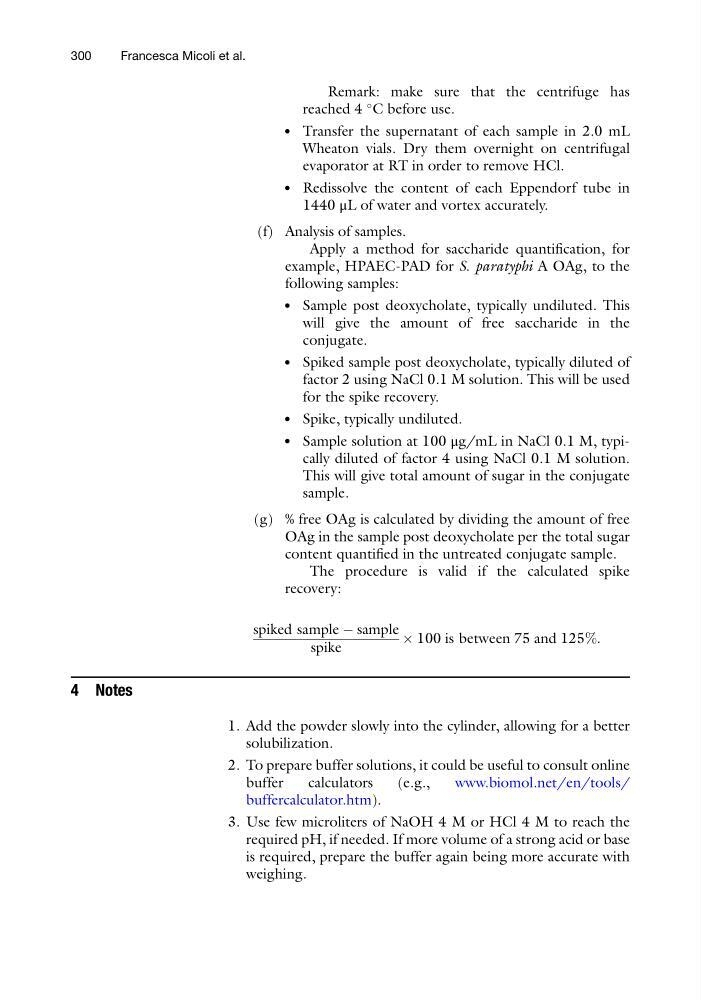
The procedure is valid if the calculated spike
recovery:
spiked sample À sample
spike
 100 is between 75 and 125%:
4 Notes
1. Add the powder slowly into the cylinder, allowing for a better
solubilization.
2. To prepare buffer solutions, it could be useful to consult online
buffer
calculators
(e.g.,
www.biomol.net/en/tools/
buffercalculator.htm).
3. Use few microliters of NaOH 4 M or HCl 4 M to reach the
required pH, if needed. If more volume of a strong acid or base
is required, prepare the buffer again being more accurate with
weighing.
300
Francesca Micoli et al.
reached 4
C before use.
l
Transfer the supernatant of each sample in 2.0 mL
Wheaton vials. Dry them overnight on centrifugal
evaporator at RT in order to remove HCl.
l
Redissolve the content of each Eppendorf tube in
1440 μL of water and vortex accurately.
(f) Analysis of samples.
Apply a method for saccharide quantification, for
example, HPAEC-PAD for S. paratyphi A OAg, to the
following samples:
l
Sample post deoxycholate, typically undiluted. This
will give the amount of free saccharide in the
conjugate.
l
Spiked sample post deoxycholate, typically diluted of
factor 2 using NaCl 0.1 M solution. This will be used
for the spike recovery.
l
Spike, typically undiluted.
l
Sample solution at 100 μg/mL in NaCl 0.1 M, typically diluted of factor 4 using NaCl 0.1 M solution.
This will give total amount of sugar in the conjugate
sample.
(g) % free OAg is calculated by dividing the amount of free
OAg in the sample post deoxycholate per the total sugar
content quantified in the untreated conjugate sample.
The procedure is valid if the calculated spike
recovery:
spiked sample À sample
spike
 100 is between 75 and 125%:
4 Notes
1. Add the powder slowly into the cylinder, allowing for a better
solubilization.
2. To prepare buffer solutions, it could be useful to consult online
buffer
calculators
(e.g.,
www.biomol.net/en/tools/
buffercalculator.htm).
3. Use few microliters of NaOH 4 M or HCl 4 M to reach the
required pH, if needed. If more volume of a strong acid or base
is required, prepare the buffer again being more accurate with
weighing.
300
Francesca Micoli et al.