

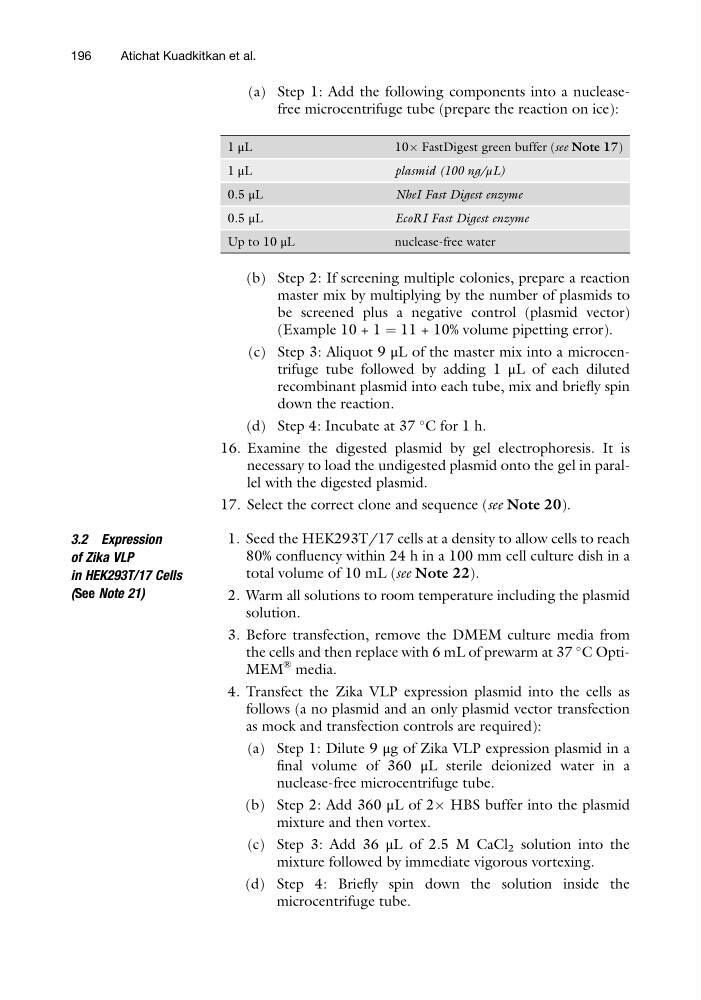
(a) Step 1: Add the following components into a nucleasefree microcentrifuge tube (prepare the reaction on ice):
1 μL
1 0 Â FastDigest green buffer (see Note 17)
1 μL
plasmid (100 ng/μL)
0.5 μL
NheI Fast Digest enzyme
0.5 μL
EcoRI Fast Digest enzyme
Up to 10 μL
nuclease-free water
(b) Step 2: If screening multiple colonies, prepare a reaction
master mix by multiplying by the number of plasmids to
be screened plus a negative control (plasmid vector)
(Example 10 + 1 ¼ 11 + 10% volume pipetting error).
(c) Step 3: Aliquot 9 μL of the master mix into a microcentrifuge tube followed by adding 1 μL of each diluted
recombinant plasmid into each tube, mix and briefly spin
down the reaction.
(d) Step 4: Incubate at 37
C for 1 h.
16. Examine the digested plasmid by gel electrophoresis. It is
necessary to load the undigested plasmid onto the gel in parallel with the digested plasmid.
17. Select the correct clone and sequence (see Note 20).
3.2 Expression
of Zika VLP
in HEK293T/17 Cells
(See Note 21)
1. Seed the HEK293T/17 cells at a density to allow cells to reach
80% confluency within 24 h in a 100 mm cell culture dish in a
total volume of 10 mL (see Note 22).
2. Warm all solutions to room temperature including the plasmid
solution.
3. Before transfection, remove the DMEM culture media from
the cells and then replace with 6 mL of prewarm at 37
C OptiMEM
® media.
4. Transfect the Zika VLP expression plasmid into the cells as
follows (a no plasmid and an only plasmid vector transfection
as mock and transfection controls are required):
(a) Step 1: Dilute 9 μg of Zika VLP expression plasmid in a
final volume of 360 μL sterile deionized water in a
nuclease-free microcentrifuge tube.
(b) Step 2: Add 360 μL of 2Â HBS buffer into the plasmid
mixture and then vortex.
(c) Step 3: Add 36 μL of 2.5 M CaCl 2 solution into the
mixture followed by immediate vigorous vortexing.
(d) Step 4: Briefly spin down the solution inside the
microcentrifuge tube.
196
Atichat Kuadkitkan et al.
1 μL
1 0 Â FastDigest green buffer (see Note 17)
1 μL
plasmid (100 ng/μL)
0.5 μL
NheI Fast Digest enzyme
0.5 μL
EcoRI Fast Digest enzyme
Up to 10 μL
nuclease-free water
(b) Step 2: If screening multiple colonies, prepare a reaction
master mix by multiplying by the number of plasmids to
be screened plus a negative control (plasmid vector)
(Example 10 + 1 ¼ 11 + 10% volume pipetting error).
(c) Step 3: Aliquot 9 μL of the master mix into a microcentrifuge tube followed by adding 1 μL of each diluted
recombinant plasmid into each tube, mix and briefly spin
down the reaction.
(d) Step 4: Incubate at 37
C for 1 h.
16. Examine the digested plasmid by gel electrophoresis. It is
necessary to load the undigested plasmid onto the gel in parallel with the digested plasmid.
17. Select the correct clone and sequence (see Note 20).
3.2 Expression
of Zika VLP
in HEK293T/17 Cells
(See Note 21)
1. Seed the HEK293T/17 cells at a density to allow cells to reach
80% confluency within 24 h in a 100 mm cell culture dish in a
total volume of 10 mL (see Note 22).
2. Warm all solutions to room temperature including the plasmid
solution.
3. Before transfection, remove the DMEM culture media from
the cells and then replace with 6 mL of prewarm at 37
C OptiMEM
® media.
4. Transfect the Zika VLP expression plasmid into the cells as
follows (a no plasmid and an only plasmid vector transfection
as mock and transfection controls are required):
(a) Step 1: Dilute 9 μg of Zika VLP expression plasmid in a
final volume of 360 μL sterile deionized water in a
nuclease-free microcentrifuge tube.
(b) Step 2: Add 360 μL of 2Â HBS buffer into the plasmid
mixture and then vortex.
(c) Step 3: Add 36 μL of 2.5 M CaCl 2 solution into the
mixture followed by immediate vigorous vortexing.
(d) Step 4: Briefly spin down the solution inside the
microcentrifuge tube.
196
Atichat Kuadkitkan et al.