

To describe an example of this process, we will highlight recent
work to formulate a vaccine against the bacterial pathogen Streptococcus pneumoniae. This vaccine was comprised of 20–24 pneumococcal capsular polysaccharides encapsulated within a liposome
[13, 14]. The liposome was also surface-decorated with pneumococcal virulence factors using either a His-tag or streptavidin-biotin
system [13]. Through this approach, the vaccine was able to generate a CD4+ T cell-dependent immune response resulting in significant IgG production against both the capsular polysaccharide and
protein antigens [13, 14]. Moreover, this work also demonstrated
that encapsulation of the polysaccharides, normally a T cellindependent antigen, within a protein decorated liposome was
able to generate a T cell-dependent response. This was driven by
the observation of IgM to IgG class switching that is a hallmark of
the T cell-dependent response. Interestingly, this provided evidence
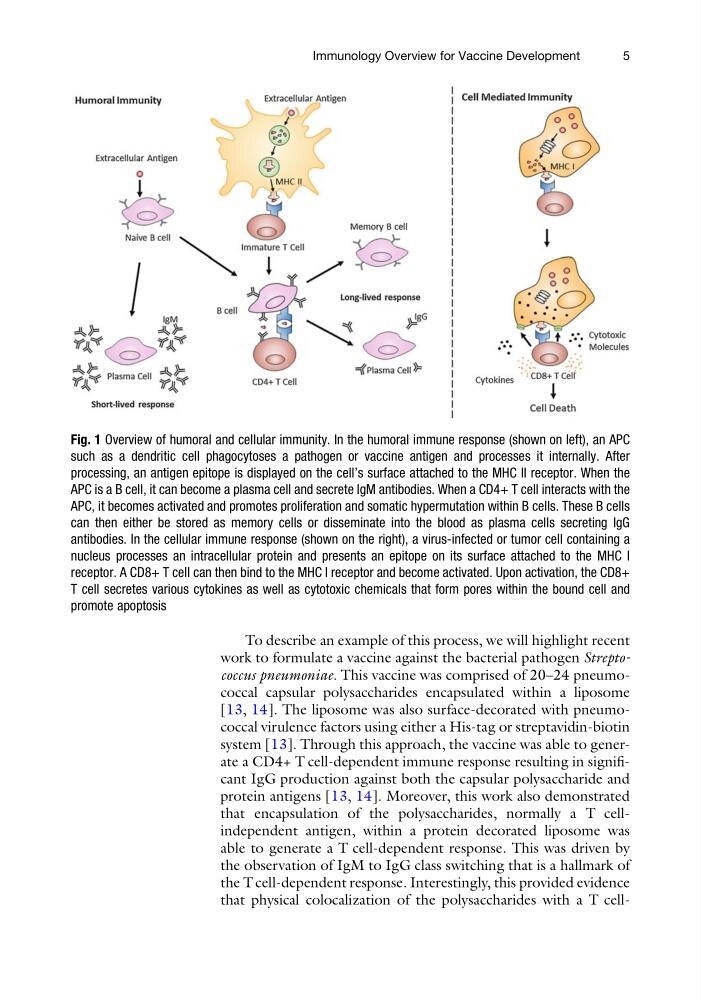
that physical colocalization of the polysaccharides with a T cellFig. 1 Overview of humoral and cellular immunity. In the humoral immune response (shown on left), an APC
such as a dendritic cell phagocytoses a pathogen or vaccine antigen and processes it internally. After
processing, an antigen epitope is displayed on the cell’s surface attached to the MHC II receptor. When the
APC is a B cell, it can become a plasma cell and secrete IgM antibodies. When a CD4+ T cell interacts with the
APC, it becomes activated and promotes proliferation and somatic hypermutation within B cells. These B cells
can then either be stored as memory cells or disseminate into the blood as plasma cells secreting IgG
antibodies. In the cellular immune response (shown on the right), a virus-infected or tumor cell containing a
nucleus processes an intracellular protein and presents an epitope on its surface attached to the MHC I
receptor. A CD8+ T cell can then bind to the MHC I receptor and become activated. Upon activation, the CD8+
T cell secretes various cytokines as well as cytotoxic chemicals that form pores within the bound cell and
promote apoptosis
Immunology Overview for Vaccine Development
5
work to formulate a vaccine against the bacterial pathogen Streptococcus pneumoniae. This vaccine was comprised of 20–24 pneumococcal capsular polysaccharides encapsulated within a liposome
[13, 14]. The liposome was also surface-decorated with pneumococcal virulence factors using either a His-tag or streptavidin-biotin
system [13]. Through this approach, the vaccine was able to generate a CD4+ T cell-dependent immune response resulting in significant IgG production against both the capsular polysaccharide and
protein antigens [13, 14]. Moreover, this work also demonstrated
that encapsulation of the polysaccharides, normally a T cellindependent antigen, within a protein decorated liposome was
able to generate a T cell-dependent response. This was driven by
the observation of IgM to IgG class switching that is a hallmark of
the T cell-dependent response. Interestingly, this provided evidence
that physical colocalization of the polysaccharides with a T cellFig. 1 Overview of humoral and cellular immunity. In the humoral immune response (shown on left), an APC
such as a dendritic cell phagocytoses a pathogen or vaccine antigen and processes it internally. After
processing, an antigen epitope is displayed on the cell’s surface attached to the MHC II receptor. When the
APC is a B cell, it can become a plasma cell and secrete IgM antibodies. When a CD4+ T cell interacts with the
APC, it becomes activated and promotes proliferation and somatic hypermutation within B cells. These B cells
can then either be stored as memory cells or disseminate into the blood as plasma cells secreting IgG
antibodies. In the cellular immune response (shown on the right), a virus-infected or tumor cell containing a
nucleus processes an intracellular protein and presents an epitope on its surface attached to the MHC I
receptor. A CD8+ T cell can then bind to the MHC I receptor and become activated. Upon activation, the CD8+
T cell secretes various cytokines as well as cytotoxic chemicals that form pores within the bound cell and
promote apoptosis
Immunology Overview for Vaccine Development
5