

portion of the population is able to extend protection to the
population that is unvaccinated. This occurs because the pathogens
do not have available hosts through which they can transmit themselves to infect the vulnerable population. The result enables vaccines to provide substantial economic benefits that are typically
presented as quality-adjusted life years (QALYs) or disabilityadjusted life years (DALYs) saved compared to nonvaccination
[2, 3].
The isolation of pathogens subsequently provided an opportunity for the development of vaccines targeting specific targets. Early
vaccine development involved the isolation of various human
pathogens and subjecting them to various procedures to weaken
their virulence. One of the initial studies to achieve this was the
development of a vaccine against anthrax in animals using bacteria
that had been attenuated using carbolic acid [4]. A similar approach
utilized formaldehyde to attenuate the rabies virus that had been
isolated from cerebral tissue [5]. In subsequent vaccines, additional
strategies for the attenuation or inactivation of pathogens were
developed, which include heat, chemical methods (e.g., hydroxylamine, β-propiolactone, and methylene blue), and irradiation (e.g.,
ultraviolet) [6]. These studies have facilitated the development and
manufacturing of whole-pathogen vaccines (WPVs). This laid the
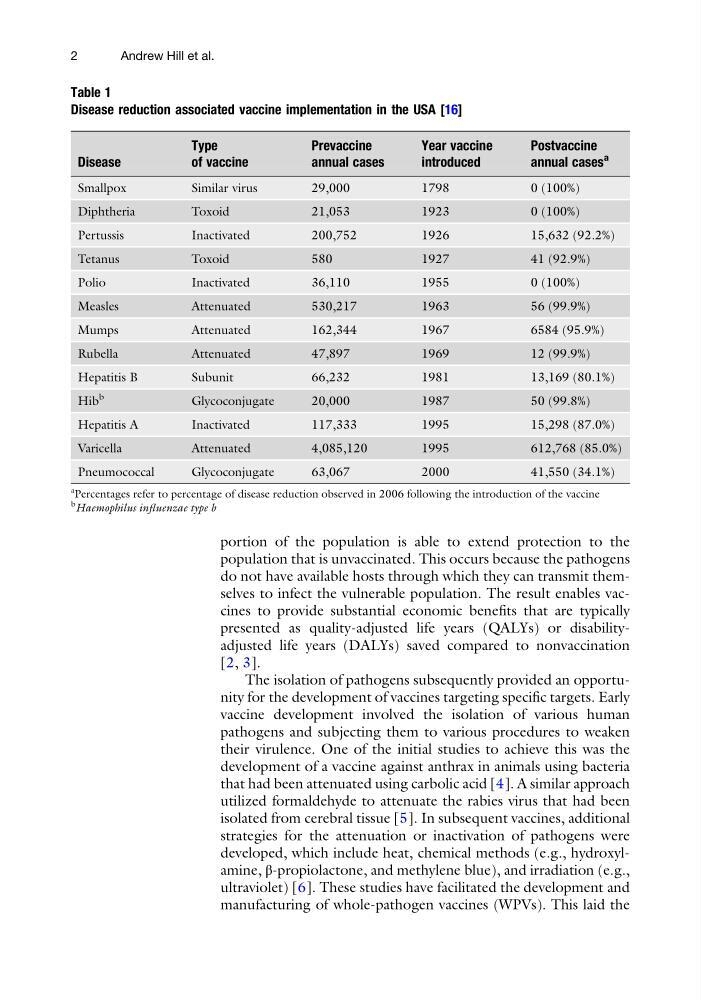
Table 1
Disease reduction associated vaccine implementation in the USA [16]
Disease
Type
of vaccine
Prevaccine
annual cases
Year vaccine
introduced
Postvaccine
annual cases
a
Smallpox
Similar virus
29,000
1798
0 (100%)
Diphtheria
Toxoid
21,053
1923
0 (100%)
Pertussis
Inactivated
200,752
1926
15,632 (92.2%)
Tetanus
Toxoid
580
1927
41 (92.9%)
Polio
Inactivated
36,110
1955
0 (100%)
Measles
Attenuated
530,217
1963
56 (99.9%)
Mumps
Attenuated
162,344
1967
6584 (95.9%)
Rubella
Attenuated
47,897
1969
12 (99.9%)
Hepatitis B
Subunit
66,232
1981
13,169 (80.1%)
Hib
b
Glycoconjugate
20,000
1987
50 (99.8%)
Hepatitis A
Inactivated
117,333
1995
15,298 (87.0%)
Varicella
Attenuated
4,085,120
1995
612,768 (85.0%)
Pneumococcal
Glycoconjugate
63,067
2000
41,550 (34.1%)
a
Percentages refer to percentage of disease reduction observed in 2006 following the introduction of the vaccine
b
Haemophilus influenzae type b
2
Andrew Hill et al.
population that is unvaccinated. This occurs because the pathogens
do not have available hosts through which they can transmit themselves to infect the vulnerable population. The result enables vaccines to provide substantial economic benefits that are typically
presented as quality-adjusted life years (QALYs) or disabilityadjusted life years (DALYs) saved compared to nonvaccination
[2, 3].
The isolation of pathogens subsequently provided an opportunity for the development of vaccines targeting specific targets. Early
vaccine development involved the isolation of various human
pathogens and subjecting them to various procedures to weaken
their virulence. One of the initial studies to achieve this was the
development of a vaccine against anthrax in animals using bacteria
that had been attenuated using carbolic acid [4]. A similar approach
utilized formaldehyde to attenuate the rabies virus that had been
isolated from cerebral tissue [5]. In subsequent vaccines, additional
strategies for the attenuation or inactivation of pathogens were
developed, which include heat, chemical methods (e.g., hydroxylamine, β-propiolactone, and methylene blue), and irradiation (e.g.,
ultraviolet) [6]. These studies have facilitated the development and
manufacturing of whole-pathogen vaccines (WPVs). This laid the
Table 1
Disease reduction associated vaccine implementation in the USA [16]
Disease
Type
of vaccine
Prevaccine
annual cases
Year vaccine
introduced
Postvaccine
annual cases
a
Smallpox
Similar virus
29,000
1798
0 (100%)
Diphtheria
Toxoid
21,053
1923
0 (100%)
Pertussis
Inactivated
200,752
1926
15,632 (92.2%)
Tetanus
Toxoid
580
1927
41 (92.9%)
Polio
Inactivated
36,110
1955
0 (100%)
Measles
Attenuated
530,217
1963
56 (99.9%)
Mumps
Attenuated
162,344
1967
6584 (95.9%)
Rubella
Attenuated
47,897
1969
12 (99.9%)
Hepatitis B
Subunit
66,232
1981
13,169 (80.1%)
Hib
b
Glycoconjugate
20,000
1987
50 (99.8%)
Hepatitis A
Inactivated
117,333
1995
15,298 (87.0%)
Varicella
Attenuated
4,085,120
1995
612,768 (85.0%)
Pneumococcal
Glycoconjugate
63,067
2000
41,550 (34.1%)
a
Percentages refer to percentage of disease reduction observed in 2006 following the introduction of the vaccine
b
Haemophilus influenzae type b
2
Andrew Hill et al.