

11. Disinfect the connectors and connect the inoculation bottle to
the bioreactor.
12. Open the tubing clamps of the inoculation bottle and use
gravity to inoculate the reactor.
13. Start data acquisition.
3.7.3 Viral Infection
of the Culture
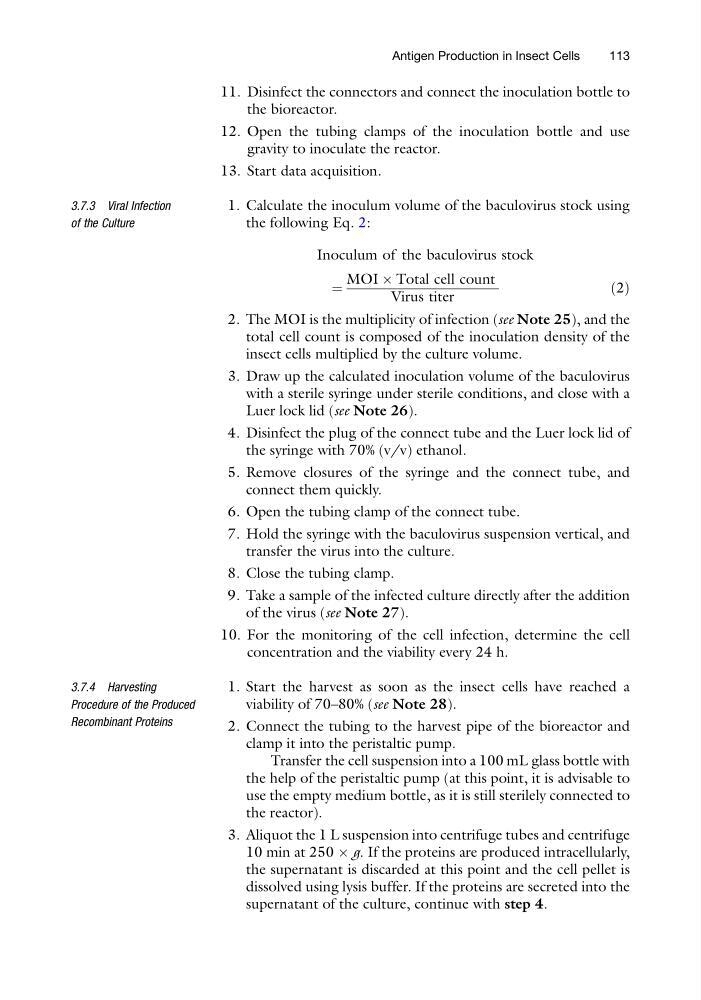
1. Calculate the inoculum volume of the baculovirus stock using
the following Eq. 2:
Inoculum of the baculovirus stock
¼
MOI Â Total cell count
Virus titer
ð2Þ
2. The MOI is the multiplicity of infection (see Note 25), and the
total cell count is composed of the inoculation density of the
insect cells multiplied by the culture volume.
3. Draw up the calculated inoculation volume of the baculovirus
with a sterile syringe under sterile conditions, and close with a
Luer lock lid (see Note 26).
4. Disinfect the plug of the connect tube and the Luer lock lid of
the syringe with 70% (v/v) ethanol.
5. Remove closures of the syringe and the connect tube, and
connect them quickly.
6. Open the tubing clamp of the connect tube.
7. Hold the syringe with the baculovirus suspension vertical, and
transfer the virus into the culture.
8. Close the tubing clamp.
9. Take a sample of the infected culture directly after the addition
of the virus (see Note 27).
10. For the monitoring of the cell infection, determine the cell
concentration and the viability every 24 h.
3.7.4 Harvesting
Procedure of the Produced
Recombinant Proteins
1. Start the harvest as soon as the insect cells have reached a
viability of 70–80% (see Note 28).
2. Connect the tubing to the harvest pipe of the bioreactor and
clamp it into the peristaltic pump.
Transfer the cell suspension into a 100 mL glass bottle with
the help of the peristaltic pump (at this point, it is advisable to
use the empty medium bottle, as it is still sterilely connected to
the reactor).
3. Aliquot the 1 L suspension into centrifuge tubes and centrifuge
10 min at 250 Â g. If the proteins are produced intracellularly,
the supernatant is discarded at this point and the cell pellet is
dissolved using lysis buffer. If the proteins are secreted into the
supernatant of the culture, continue with step 4.
Antigen Production in Insect Cells
113
the bioreactor.
12. Open the tubing clamps of the inoculation bottle and use
gravity to inoculate the reactor.
13. Start data acquisition.
3.7.3 Viral Infection
of the Culture
1. Calculate the inoculum volume of the baculovirus stock using
the following Eq. 2:
Inoculum of the baculovirus stock
¼
MOI Â Total cell count
Virus titer
ð2Þ
2. The MOI is the multiplicity of infection (see Note 25), and the
total cell count is composed of the inoculation density of the
insect cells multiplied by the culture volume.
3. Draw up the calculated inoculation volume of the baculovirus
with a sterile syringe under sterile conditions, and close with a
Luer lock lid (see Note 26).
4. Disinfect the plug of the connect tube and the Luer lock lid of
the syringe with 70% (v/v) ethanol.
5. Remove closures of the syringe and the connect tube, and
connect them quickly.
6. Open the tubing clamp of the connect tube.
7. Hold the syringe with the baculovirus suspension vertical, and
transfer the virus into the culture.
8. Close the tubing clamp.
9. Take a sample of the infected culture directly after the addition
of the virus (see Note 27).
10. For the monitoring of the cell infection, determine the cell
concentration and the viability every 24 h.
3.7.4 Harvesting
Procedure of the Produced
Recombinant Proteins
1. Start the harvest as soon as the insect cells have reached a
viability of 70–80% (see Note 28).
2. Connect the tubing to the harvest pipe of the bioreactor and
clamp it into the peristaltic pump.
Transfer the cell suspension into a 100 mL glass bottle with
the help of the peristaltic pump (at this point, it is advisable to
use the empty medium bottle, as it is still sterilely connected to
the reactor).
3. Aliquot the 1 L suspension into centrifuge tubes and centrifuge
10 min at 250 Â g. If the proteins are produced intracellularly,
the supernatant is discarded at this point and the cell pellet is
dissolved using lysis buffer. If the proteins are secreted into the
supernatant of the culture, continue with step 4.
Antigen Production in Insect Cells
113