

high product titers at the same time. Posttranslational modification
and protein folding are well supported, although the glycosylation
pattern is not human. Genetically and metabolically engineered
insect cell lines can be used for the production of recombinant
products with humanized glycosylation [2]. As an additional
benefit, insect cell-specific viruses, such as the AcNPV, are not
capable of gene expression in mammalian organisms, thus, meeting
required safety regulations [3]. Due to the lytic nature of BEVS, a
tight process control is necessary for large-scale bioreactor processes to ensure the effective timing of the key events—infection
and harvesting. Therefore, advanced biomass monitoring strategies, for example based on dielectric spectroscopy (DS), have to
be employed to generate data beyond the standard parameters: pH,
dissolved oxygen, and stirrer speed [4, 5].
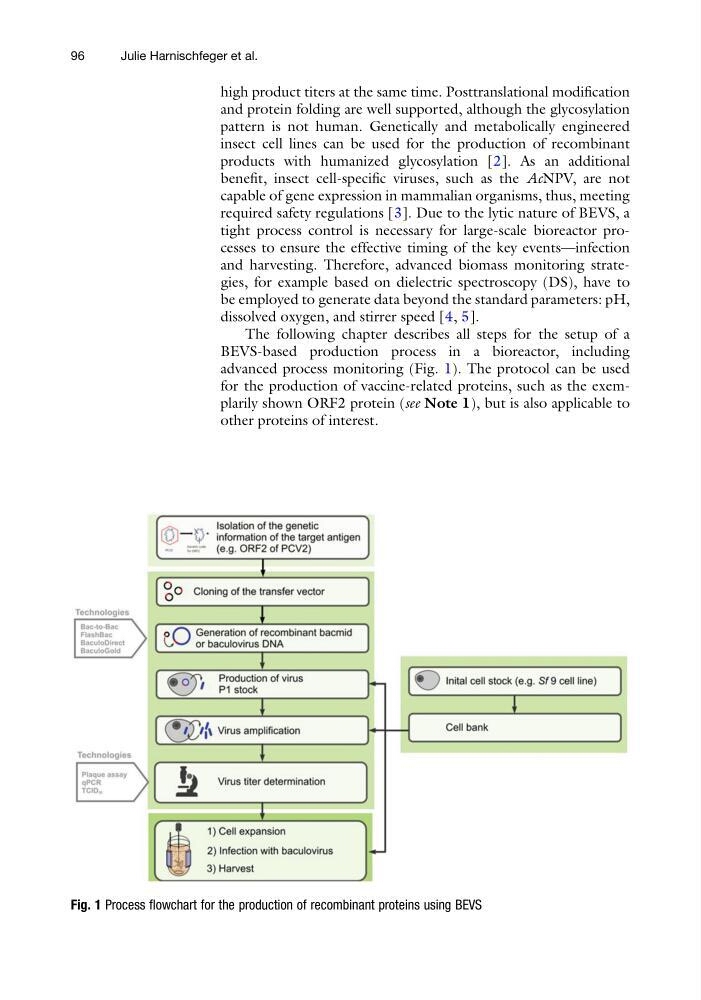
The following chapter describes all steps for the setup of a
BEVS-based production process in a bioreactor, including
advanced process monitoring (Fig. 1). The protocol can be used
for the production of vaccine-related proteins, such as the exemplarily shown ORF2 protein (see Note 1), but is also applicable to
other proteins of interest.
Fig. 1 Process flowchart for the production of recombinant proteins using BEVS
96
Julie Harnischfeger et al.
and protein folding are well supported, although the glycosylation
pattern is not human. Genetically and metabolically engineered
insect cell lines can be used for the production of recombinant
products with humanized glycosylation [2]. As an additional
benefit, insect cell-specific viruses, such as the AcNPV, are not
capable of gene expression in mammalian organisms, thus, meeting
required safety regulations [3]. Due to the lytic nature of BEVS, a
tight process control is necessary for large-scale bioreactor processes to ensure the effective timing of the key events—infection
and harvesting. Therefore, advanced biomass monitoring strategies, for example based on dielectric spectroscopy (DS), have to
be employed to generate data beyond the standard parameters: pH,
dissolved oxygen, and stirrer speed [4, 5].
The following chapter describes all steps for the setup of a
BEVS-based production process in a bioreactor, including
advanced process monitoring (Fig. 1). The protocol can be used
for the production of vaccine-related proteins, such as the exemplarily shown ORF2 protein (see Note 1), but is also applicable to
other proteins of interest.
Fig. 1 Process flowchart for the production of recombinant proteins using BEVS
96
Julie Harnischfeger et al.