

78
2 Optical Fiber Structures and Light Guiding Principles
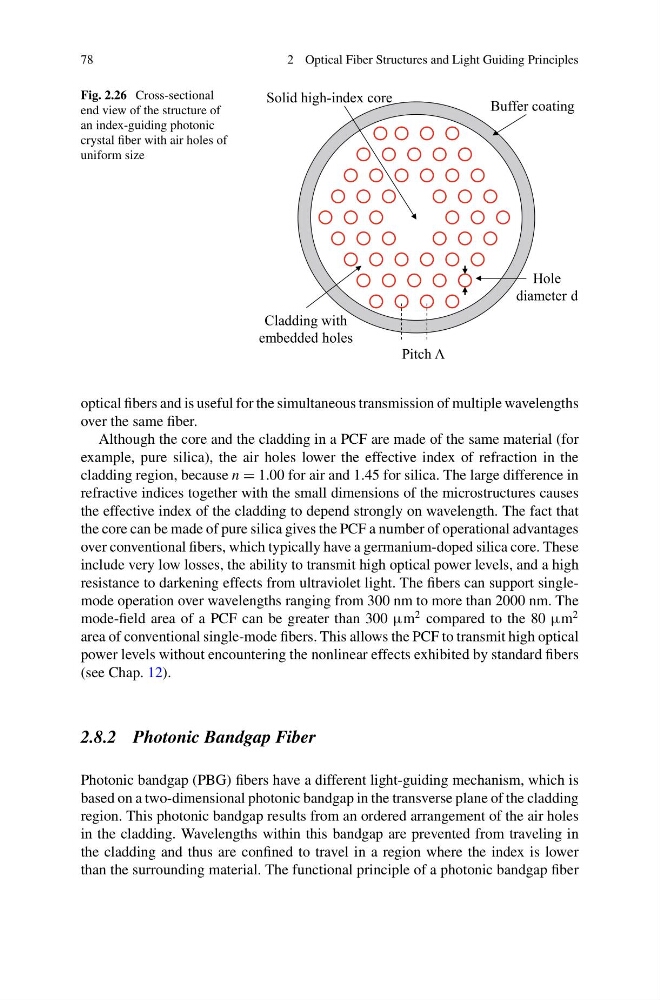
Fig. 2.26 Cross-sectional
end view of the structure of
an index-guiding photonic
crystal fiber with air holes of
uniform size
Solid high-index core
Buffer coating
Cladding with
embedded holes
Pitch Λ
Hole
diameter d
optical fibers and is useful for the simultaneous transmission of multiple wavelengths
over the same fiber.
Although the core and the cladding in a PCF are made of the same material (for
example, pure silica), the air holes lower the effective index of refraction in the
cladding region, because n = 1.00 for air and 1.45 for silica. The large difference in
refractive indices together with the small dimensions of the microstructures causes
the effective index of the cladding to depend strongly on wavelength. The fact that
the core can be made of pure silica gives the PCF a number of operational advantages
over conventional fibers, which typically have a germanium-doped silica core. These
include very low losses, the ability to transmit high optical power levels, and a high
resistance to darkening effects from ultraviolet light. The fibers can support singlemode operation over wavelengths ranging from 300 nm to more than 2000 nm. The
mode-field area of a PCF can be greater than 300 μm
2 compared to the 80 μm
2
area of conventional single-mode fibers. This allows the PCF to transmit high optical
power levels without encountering the nonlinear effects exhibited by standard fibers
(see Chap. 12).
2.8.2 Photonic Bandgap Fiber
Photonic bandgap (PBG) fibers have a different light-guiding mechanism, which is
based on a two-dimensional photonic bandgap in the transverse plane of the cladding
region. This photonic bandgap results from an ordered arrangement of the air holes
in the cladding. Wavelengths within this bandgap are prevented from traveling in
the cladding and thus are confined to travel in a region where the index is lower
than the surrounding material. The functional principle of a photonic bandgap fiber
2 Optical Fiber Structures and Light Guiding Principles
Fig. 2.26 Cross-sectional
end view of the structure of
an index-guiding photonic
crystal fiber with air holes of
uniform size
Solid high-index core
Buffer coating
Cladding with
embedded holes
Pitch Λ
Hole
diameter d
optical fibers and is useful for the simultaneous transmission of multiple wavelengths
over the same fiber.
Although the core and the cladding in a PCF are made of the same material (for
example, pure silica), the air holes lower the effective index of refraction in the
cladding region, because n = 1.00 for air and 1.45 for silica. The large difference in
refractive indices together with the small dimensions of the microstructures causes
the effective index of the cladding to depend strongly on wavelength. The fact that
the core can be made of pure silica gives the PCF a number of operational advantages
over conventional fibers, which typically have a germanium-doped silica core. These
include very low losses, the ability to transmit high optical power levels, and a high
resistance to darkening effects from ultraviolet light. The fibers can support singlemode operation over wavelengths ranging from 300 nm to more than 2000 nm. The
mode-field area of a PCF can be greater than 300 μm
2 compared to the 80 μm
2
area of conventional single-mode fibers. This allows the PCF to transmit high optical
power levels without encountering the nonlinear effects exhibited by standard fibers
(see Chap. 12).
2.8.2 Photonic Bandgap Fiber
Photonic bandgap (PBG) fibers have a different light-guiding mechanism, which is
based on a two-dimensional photonic bandgap in the transverse plane of the cladding
region. This photonic bandgap results from an ordered arrangement of the air holes
in the cladding. Wavelengths within this bandgap are prevented from traveling in
the cladding and thus are confined to travel in a region where the index is lower
than the surrounding material. The functional principle of a photonic bandgap fiber