

2.7 Optical Fiber Materials
75
2.7.2 Standard Fiber Fabrication
Two basic techniques are used in the fabrication of all-glass optical waveguides.
These are the vapor-phase oxidation processes and the direct-melt methods. The
direct-melt method follows traditional glass-making procedures in that optical fibers
are made directly from the molten state of purified components of silicate glasses. In
the vapor-phase oxidation process, highly pure vapors of metal halides (e.g., SiCl 4
and GeCl 4 ) react with oxygen to form a white powder of SiO 2 particles. The particles
are then collected on the surface of a bulk glass by one of four different commonly
used processes and are sintered (transformed to a homogeneous glass mass by heating
without melting) by one of a variety of techniques to form a clear glass rod or tube
(depending on the process). This rod or tube is called a preform. It is typically around
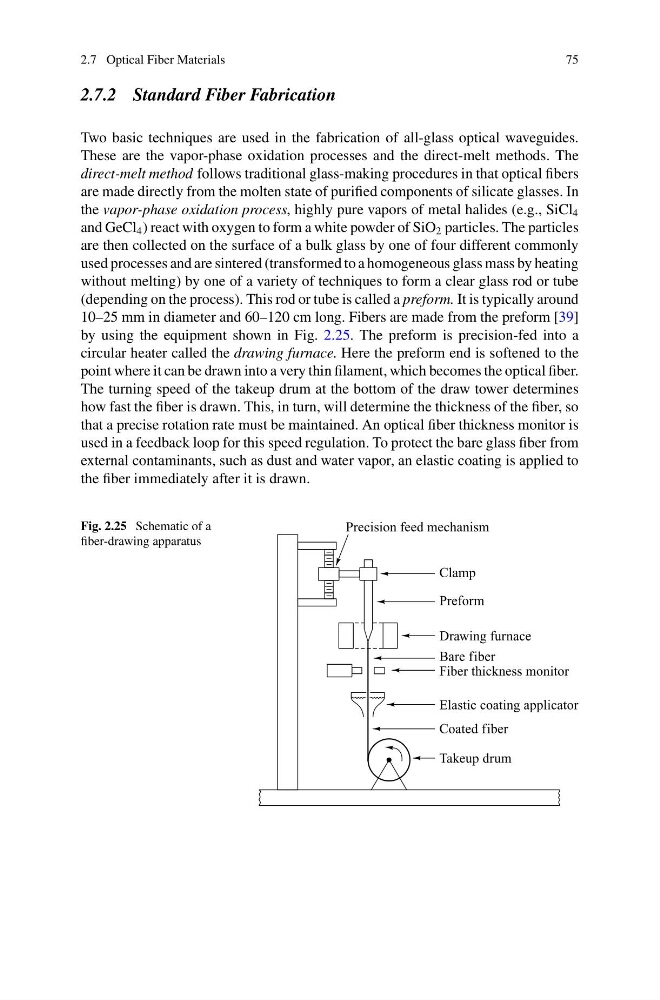
10–25 mm in diameter and 60–120 cm long. Fibers are made from the preform [39]
by using the equipment shown in Fig. 2.25. The preform is precision-fed into a
circular heater called the drawing furnace. Here the preform end is softened to the
point where it can be drawn into a very thin filament, which becomes the optical fiber.
The turning speed of the takeup drum at the bottom of the draw tower determines
how fast the fiber is drawn. This, in turn, will determine the thickness of the fiber, so
that a precise rotation rate must be maintained. An optical fiber thickness monitor is
used in a feedback loop for this speed regulation. To protect the bare glass fiber from
external contaminants, such as dust and water vapor, an elastic coating is applied to
the fiber immediately after it is drawn.
Fig. 2.25 Schematic of a
fiber-drawing apparatus
75
2.7.2 Standard Fiber Fabrication
Two basic techniques are used in the fabrication of all-glass optical waveguides.
These are the vapor-phase oxidation processes and the direct-melt methods. The
direct-melt method follows traditional glass-making procedures in that optical fibers
are made directly from the molten state of purified components of silicate glasses. In
the vapor-phase oxidation process, highly pure vapors of metal halides (e.g., SiCl 4
and GeCl 4 ) react with oxygen to form a white powder of SiO 2 particles. The particles
are then collected on the surface of a bulk glass by one of four different commonly
used processes and are sintered (transformed to a homogeneous glass mass by heating
without melting) by one of a variety of techniques to form a clear glass rod or tube
(depending on the process). This rod or tube is called a preform. It is typically around
10–25 mm in diameter and 60–120 cm long. Fibers are made from the preform [39]
by using the equipment shown in Fig. 2.25. The preform is precision-fed into a
circular heater called the drawing furnace. Here the preform end is softened to the
point where it can be drawn into a very thin filament, which becomes the optical fiber.
The turning speed of the takeup drum at the bottom of the draw tower determines
how fast the fiber is drawn. This, in turn, will determine the thickness of the fiber, so
that a precise rotation rate must be maintained. An optical fiber thickness monitor is
used in a feedback loop for this speed regulation. To protect the bare glass fiber from
external contaminants, such as dust and water vapor, an elastic coating is applied to
the fiber immediately after it is drawn.
Fig. 2.25 Schematic of a
fiber-drawing apparatus