

2.6 Graded-Index (GI) Fibers
73
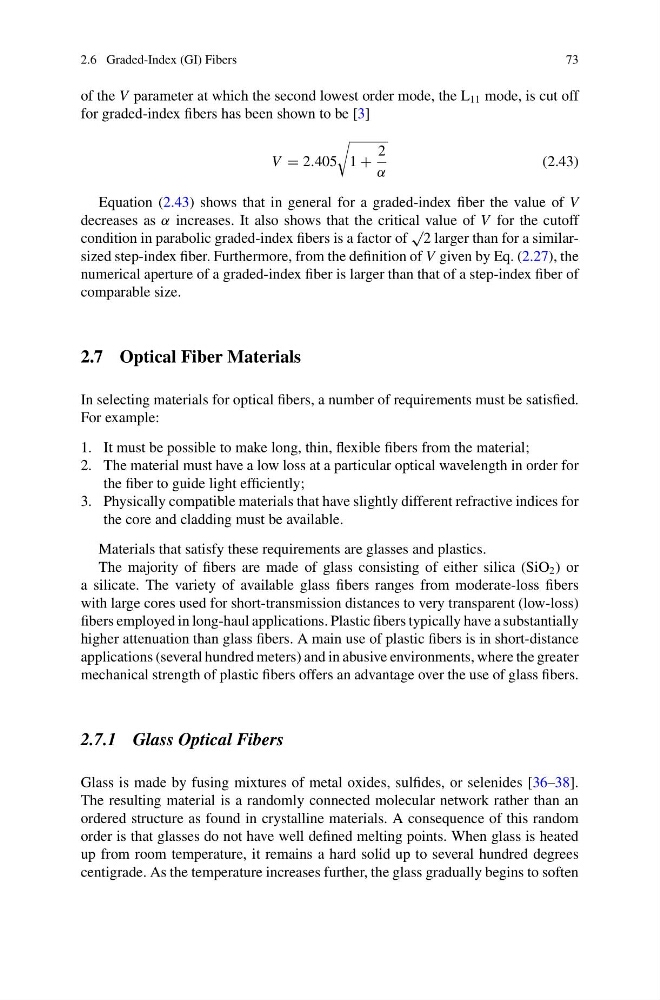
of the V parameter at which the second lowest order mode, the L 11 mode, is cut off
for graded-index fibers has been shown to be [3]
V = 2.405
1 +
2
α
(2.43)
Equation (2.43) shows that in general for a graded-index fiber the value of V
decreases as α increases. It also shows that the critical value of V for the cutoff
condition in parabolic graded-index fibers is a factor of
√
2 larger than for a similarsized step-index fiber. Furthermore, from the definition of V given by Eq. (2.27), the
numerical aperture of a graded-index fiber is larger than that of a step-index fiber of
comparable size.
2.7 Optical Fiber Materials
In selecting materials for optical fibers, a number of requirements must be satisfied.
For example:
1. It must be possible to make long, thin, flexible fibers from the material;
2. The material must have a low loss at a particular optical wavelength in order for
the fiber to guide light efficiently;
3. Physically compatible materials that have slightly different refractive indices for
the core and cladding must be available.
Materials that satisfy these requirements are glasses and plastics.
The majority of fibers are made of glass consisting of either silica (SiO 2 ) or
a silicate. The variety of available glass fibers ranges from moderate-loss fibers
with large cores used for short-transmission distances to very transparent (low-loss)
fibers employed in long-haul applications. Plastic fibers typically have a substantially
higher attenuation than glass fibers. A main use of plastic fibers is in short-distance
applications (several hundred meters) and in abusive environments, where the greater
mechanical strength of plastic fibers offers an advantage over the use of glass fibers.
2.7.1 Glass Optical Fibers
Glass is made by fusing mixtures of metal oxides, sulfides, or selenides [36–38].
The resulting material is a randomly connected molecular network rather than an
ordered structure as found in crystalline materials. A consequence of this random
order is that glasses do not have well defined melting points. When glass is heated
up from room temperature, it remains a hard solid up to several hundred degrees
centigrade. As the temperature increases further, the glass gradually begins to soften
73
of the V parameter at which the second lowest order mode, the L 11 mode, is cut off
for graded-index fibers has been shown to be [3]
V = 2.405
1 +
2
α
(2.43)
Equation (2.43) shows that in general for a graded-index fiber the value of V
decreases as α increases. It also shows that the critical value of V for the cutoff
condition in parabolic graded-index fibers is a factor of
√
2 larger than for a similarsized step-index fiber. Furthermore, from the definition of V given by Eq. (2.27), the
numerical aperture of a graded-index fiber is larger than that of a step-index fiber of
comparable size.
2.7 Optical Fiber Materials
In selecting materials for optical fibers, a number of requirements must be satisfied.
For example:
1. It must be possible to make long, thin, flexible fibers from the material;
2. The material must have a low loss at a particular optical wavelength in order for
the fiber to guide light efficiently;
3. Physically compatible materials that have slightly different refractive indices for
the core and cladding must be available.
Materials that satisfy these requirements are glasses and plastics.
The majority of fibers are made of glass consisting of either silica (SiO 2 ) or
a silicate. The variety of available glass fibers ranges from moderate-loss fibers
with large cores used for short-transmission distances to very transparent (low-loss)
fibers employed in long-haul applications. Plastic fibers typically have a substantially
higher attenuation than glass fibers. A main use of plastic fibers is in short-distance
applications (several hundred meters) and in abusive environments, where the greater
mechanical strength of plastic fibers offers an advantage over the use of glass fibers.
2.7.1 Glass Optical Fibers
Glass is made by fusing mixtures of metal oxides, sulfides, or selenides [36–38].
The resulting material is a randomly connected molecular network rather than an
ordered structure as found in crystalline materials. A consequence of this random
order is that glasses do not have well defined melting points. When glass is heated
up from room temperature, it remains a hard solid up to several hundred degrees
centigrade. As the temperature increases further, the glass gradually begins to soften