

2.5 Single-Mode Fibers
69
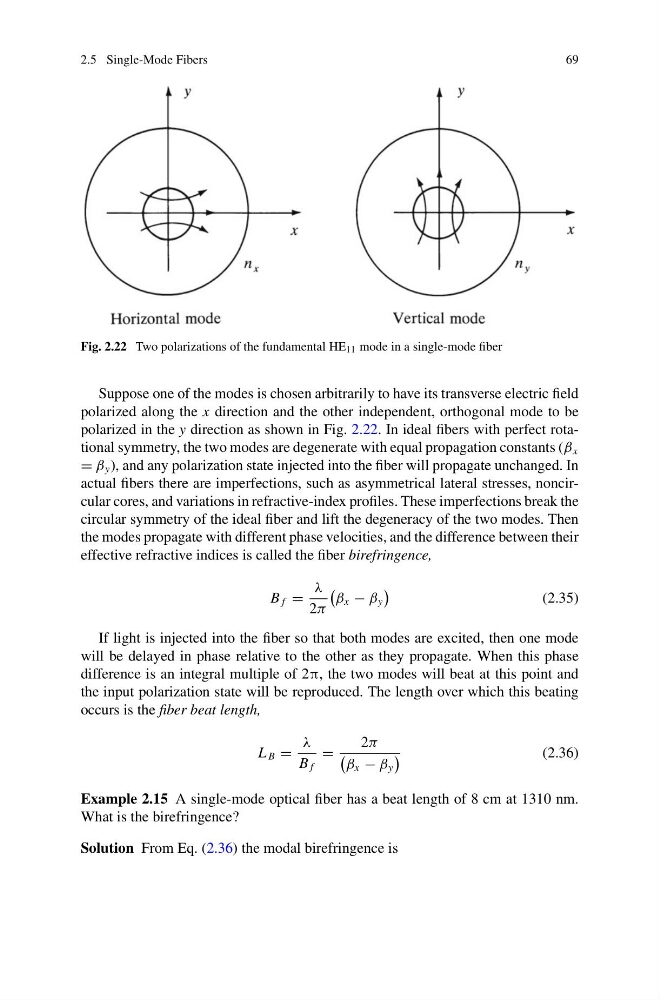
Fig. 2.22 Two polarizations of the fundamental HE 11 mode in a single-mode fiber
Suppose one of the modes is chosen arbitrarily to have its transverse electric field
polarized along the x direction and the other independent, orthogonal mode to be
polarized in the y direction as shown in Fig. 2.22. In ideal fibers with perfect rotational symmetry, the two modes are degenerate with equal propagation constants (β x
= β y ), and any polarization state injected into the fiber will propagate unchanged. In
actual fibers there are imperfections, such as asymmetrical lateral stresses, noncircular cores, and variations in refractive-index profiles. These imperfections break the
circular symmetry of the ideal fiber and lift the degeneracy of the two modes. Then
the modes propagate with different phase velocities, and the difference between their
effective refractive indices is called the fiber birefringence,
B f =
λ
2π
β x − β y
(2.35)
If light is injected into the fiber so that both modes are excited, then one mode
will be delayed in phase relative to the other as they propagate. When this phase
difference is an integral multiple of 2π, the two modes will beat at this point and
the input polarization state will be reproduced. The length over which this beating
occurs is the fiber beat length,
L B =
λ
B f
=
2π
β x − β y
(2.36)
Example 2.15 A single-mode optical fiber has a beat length of 8 cm at 1310 nm.
What is the birefringence?
Solution From Eq. (2.36) the modal birefringence is
69
Fig. 2.22 Two polarizations of the fundamental HE 11 mode in a single-mode fiber
Suppose one of the modes is chosen arbitrarily to have its transverse electric field
polarized along the x direction and the other independent, orthogonal mode to be
polarized in the y direction as shown in Fig. 2.22. In ideal fibers with perfect rotational symmetry, the two modes are degenerate with equal propagation constants (β x
= β y ), and any polarization state injected into the fiber will propagate unchanged. In
actual fibers there are imperfections, such as asymmetrical lateral stresses, noncircular cores, and variations in refractive-index profiles. These imperfections break the
circular symmetry of the ideal fiber and lift the degeneracy of the two modes. Then
the modes propagate with different phase velocities, and the difference between their
effective refractive indices is called the fiber birefringence,
B f =
λ
2π
β x − β y
(2.35)
If light is injected into the fiber so that both modes are excited, then one mode
will be delayed in phase relative to the other as they propagate. When this phase
difference is an integral multiple of 2π, the two modes will beat at this point and
the input polarization state will be reproduced. The length over which this beating
occurs is the fiber beat length,
L B =
λ
B f
=
2π
β x − β y
(2.36)
Example 2.15 A single-mode optical fiber has a beat length of 8 cm at 1310 nm.
What is the birefringence?
Solution From Eq. (2.36) the modal birefringence is