

56
2 Optical Fiber Structures and Light Guiding Principles
n 2
n 2
n 1
θ
B
C
D
F
A
s 2
s 1
Phase front of
downward-traveling wave
d
Phase front of
upward-traveling wave
θ
θ
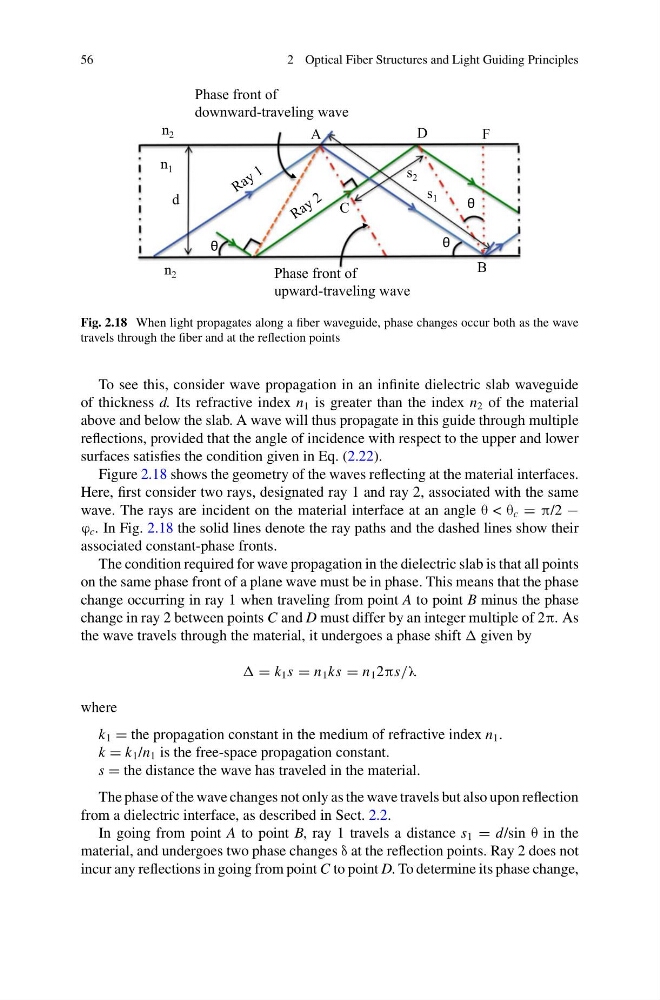
Fig. 2.18 When light propagates along a fiber waveguide, phase changes occur both as the wave
travels through the fiber and at the reflection points
To see this, consider wave propagation in an infinite dielectric slab waveguide
of thickness d. Its refractive index n 1 is greater than the index n 2 of the material
above and below the slab. A wave will thus propagate in this guide through multiple
reflections, provided that the angle of incidence with respect to the upper and lower
surfaces satisfies the condition given in Eq. (2.22).
Figure 2.18 shows the geometry of the waves reflecting at the material interfaces.
Here, first consider two rays, designated ray 1 and ray 2, associated with the same
wave. The rays are incident on the material interface at an angle θ < θ c = π/2 −
ϕ c . In Fig. 2.18 the solid lines denote the ray paths and the dashed lines show their
associated constant-phase fronts.
The condition required for wave propagation in the dielectric slab is that all points
on the same phase front of a plane wave must be in phase. This means that the phase
change occurring in ray 1 when traveling from point A to point B minus the phase
change in ray 2 between points C and D must differ by an integer multiple of 2π. As
the wave travels through the material, it undergoes a phase shift given by
= k 1 s = n 1 ks = n 1 2πs/λ
where
k 1 = the propagation constant in the medium of refractive index n 1 .
k = k 1 /n 1 is the free-space propagation constant.
s = the distance the wave has traveled in the material.
The phase of the wave changes not only as the wave travels but also upon reflection
from a dielectric interface, as described in Sect. 2.2.
In going from point A to point B, ray 1 travels a distance s 1 = d/sin θ in the
material, and undergoes two phase changes δ at the reflection points. Ray 2 does not
incur any reflections in going from point C to point D. To determine its phase change,
2 Optical Fiber Structures and Light Guiding Principles
n 2
n 2
n 1
θ
B
C
D
F
A
s 2
s 1
Phase front of
downward-traveling wave
d
Phase front of
upward-traveling wave
θ
θ
Fig. 2.18 When light propagates along a fiber waveguide, phase changes occur both as the wave
travels through the fiber and at the reflection points
To see this, consider wave propagation in an infinite dielectric slab waveguide
of thickness d. Its refractive index n 1 is greater than the index n 2 of the material
above and below the slab. A wave will thus propagate in this guide through multiple
reflections, provided that the angle of incidence with respect to the upper and lower
surfaces satisfies the condition given in Eq. (2.22).
Figure 2.18 shows the geometry of the waves reflecting at the material interfaces.
Here, first consider two rays, designated ray 1 and ray 2, associated with the same
wave. The rays are incident on the material interface at an angle θ < θ c = π/2 −
ϕ c . In Fig. 2.18 the solid lines denote the ray paths and the dashed lines show their
associated constant-phase fronts.
The condition required for wave propagation in the dielectric slab is that all points
on the same phase front of a plane wave must be in phase. This means that the phase
change occurring in ray 1 when traveling from point A to point B minus the phase
change in ray 2 between points C and D must differ by an integer multiple of 2π. As
the wave travels through the material, it undergoes a phase shift given by
= k 1 s = n 1 ks = n 1 2πs/λ
where
k 1 = the propagation constant in the medium of refractive index n 1 .
k = k 1 /n 1 is the free-space propagation constant.
s = the distance the wave has traveled in the material.
The phase of the wave changes not only as the wave travels but also upon reflection
from a dielectric interface, as described in Sect. 2.2.
In going from point A to point B, ray 1 travels a distance s 1 = d/sin θ in the
material, and undergoes two phase changes δ at the reflection points. Ray 2 does not
incur any reflections in going from point C to point D. To determine its phase change,