

46
2 Optical Fiber Structures and Light Guiding Principles
the refracted beam is transmitted entirely into the glass, whereas the perpendicular
component is only partially refracted. How much of the refracted light is polarized
depends on the angle at which the light approaches the surface and on the material
composition.
2.2.4 Polarization-Sensitive Devices
The polarization characteristics of light are important when examining the behavior
of materials for devices such as optical isolators and light filters. Three polarizationsensitive materials or devices that are used in such components are polarizers, Faraday
rotators, and birefringent crystals.
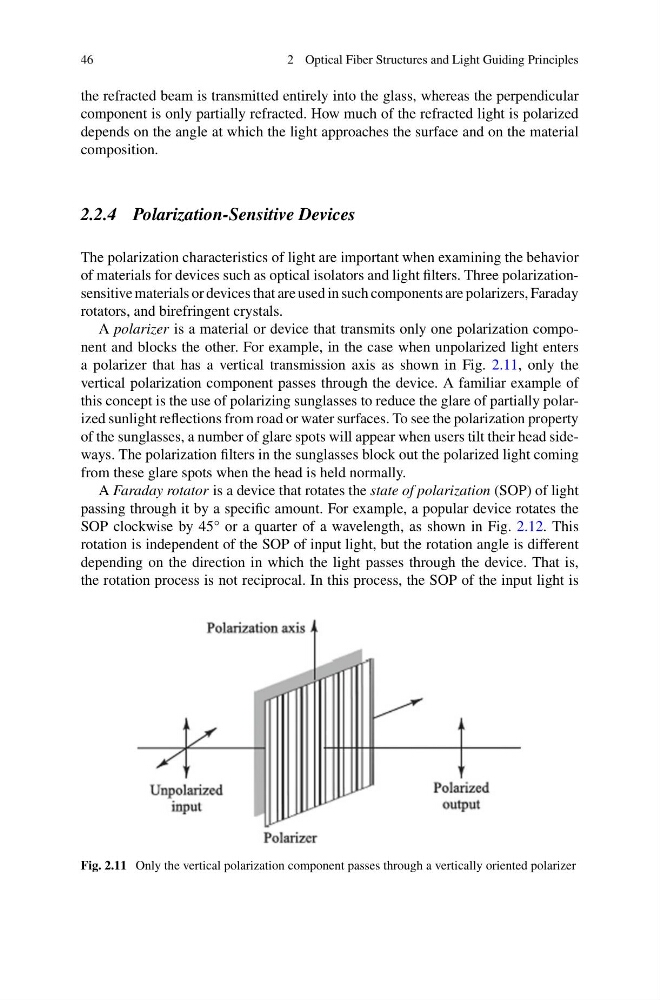
A polarizer is a material or device that transmits only one polarization component and blocks the other. For example, in the case when unpolarized light enters
a polarizer that has a vertical transmission axis as shown in Fig. 2.11, only the
vertical polarization component passes through the device. A familiar example of
this concept is the use of polarizing sunglasses to reduce the glare of partially polarized sunlight reflections from road or water surfaces. To see the polarization property
of the sunglasses, a number of glare spots will appear when users tilt their head sideways. The polarization filters in the sunglasses block out the polarized light coming
from these glare spots when the head is held normally.
A Faraday rotator is a device that rotates the state of polarization (SOP) of light
passing through it by a specific amount. For example, a popular device rotates the
SOP clockwise by 45° or a quarter of a wavelength, as shown in Fig. 2.12. This
rotation is independent of the SOP of input light, but the rotation angle is different
depending on the direction in which the light passes through the device. That is,
the rotation process is not reciprocal. In this process, the SOP of the input light is
Fig. 2.11 Only the vertical polarization component passes through a vertically oriented polarizer
2 Optical Fiber Structures and Light Guiding Principles
the refracted beam is transmitted entirely into the glass, whereas the perpendicular
component is only partially refracted. How much of the refracted light is polarized
depends on the angle at which the light approaches the surface and on the material
composition.
2.2.4 Polarization-Sensitive Devices
The polarization characteristics of light are important when examining the behavior
of materials for devices such as optical isolators and light filters. Three polarizationsensitive materials or devices that are used in such components are polarizers, Faraday
rotators, and birefringent crystals.
A polarizer is a material or device that transmits only one polarization component and blocks the other. For example, in the case when unpolarized light enters
a polarizer that has a vertical transmission axis as shown in Fig. 2.11, only the
vertical polarization component passes through the device. A familiar example of
this concept is the use of polarizing sunglasses to reduce the glare of partially polarized sunlight reflections from road or water surfaces. To see the polarization property
of the sunglasses, a number of glare spots will appear when users tilt their head sideways. The polarization filters in the sunglasses block out the polarized light coming
from these glare spots when the head is held normally.
A Faraday rotator is a device that rotates the state of polarization (SOP) of light
passing through it by a specific amount. For example, a popular device rotates the
SOP clockwise by 45° or a quarter of a wavelength, as shown in Fig. 2.12. This
rotation is independent of the SOP of input light, but the rotation angle is different
depending on the direction in which the light passes through the device. That is,
the rotation process is not reciprocal. In this process, the SOP of the input light is
Fig. 2.11 Only the vertical polarization component passes through a vertically oriented polarizer