

Appendix B
Decibels
B.1 Definition
In designing and implementing an optical fiber link, it is of interest to establish,
measure, and/or interrelate the signal levels at the transmitter, at the receiver, at the
cable connection and splice points, at the input and output of a link component, and
in the cable. A convenient method for this is to reference the signal level either to
some absolute value or to a noise level. This is normally done in terms of a power
ratio measured in decibels (dB) defined as
Power ratio in dB = 10 log
P 2
P 1
(B.1)
where P 1 and P 2 are electric or optical powers.
The logarithmic nature of the decibel allows a large ratio to be expressed in
a fairly simple manner. Power levels differing by many orders of magnitude can
be compared easily when they are in decibel form. Some very helpful figures to
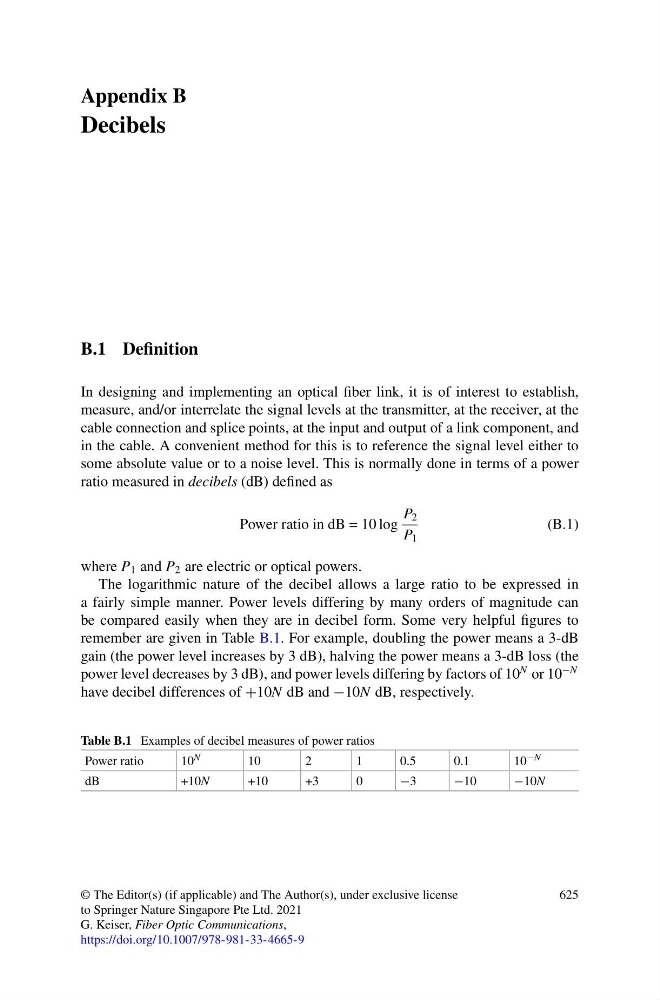
remember are given in Table B.1. For example, doubling the power means a 3-dB
gain (the power level increases by 3 dB), halving the power means a 3-dB loss (the
power level decreases by 3 dB), and power levels differing by factors of 10
N or 10
−N
have decibel differences of +10N dB and −10N dB, respectively.
Table B.1 Examples of decibel measures of power ratios
Power ratio
10 N
10
2
1
0.5
0.1
10 −N
dB
+10N
+10
+3
0
−3
−10
−10N
© The Editor(s) (if applicable) and The Author(s), under exclusive license
to Springer Nature Singapore Pte Ltd. 2021
G. Keiser, Fiber Optic Communications,
https://doi.org/10.1007/978-981-33-4665-9
625