

612
14 Basic Measurement and Monitoring Techniques
14.8.1 BER Measurements
The BER is an important performance quality indicator of a digital communication
link. Because BER is a statistical parameter, its value depends on the measurement
time and on the factors that cause the errors, such as signal dispersion, accumulated
excess noise, and timing jitter. When BER measurements are made, both the number
of misinterpreted bits and the total number of received bits are counted in a specific
time window which is called the gating time. If the errors are due to Gaussian
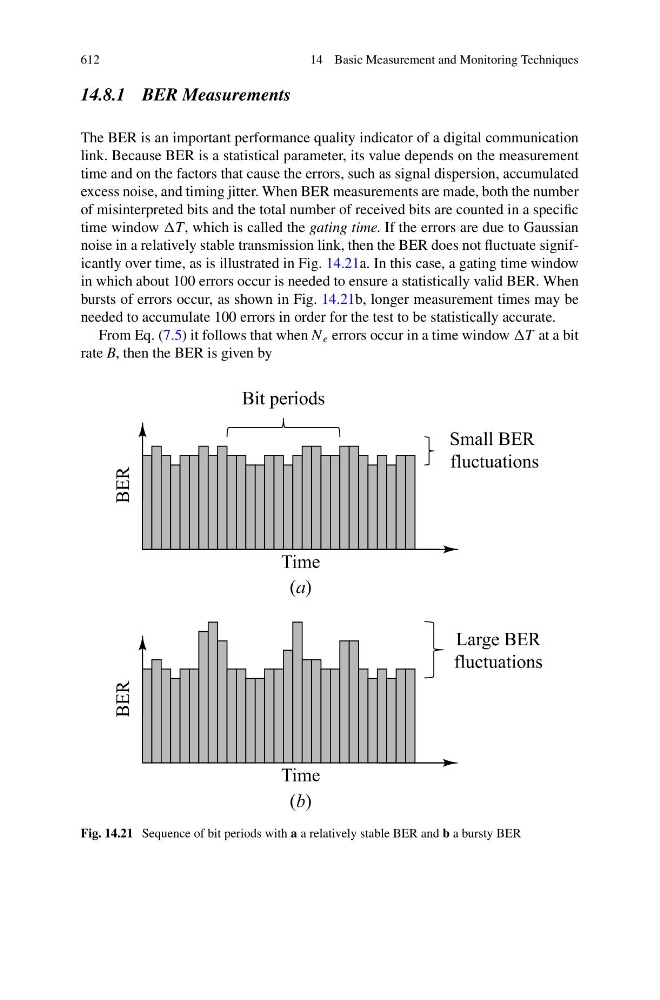
noise in a relatively stable transmission link, then the BER does not fluctuate significantly over time, as is illustrated in Fig. 14.21a. In this case, a gating time window
in which about 100 errors occur is needed to ensure a statistically valid BER. When
bursts of errors occur, as shown in Fig. 14.21b, longer measurement times may be
needed to accumulate 100 errors in order for the test to be statistically accurate.
From Eq. (7.5) it follows that when N e errors occur in a time window at a bit
rate B, then the BER is given by
Fig. 14.21 Sequence of bit periods with a a relatively stable BER and b a bursty BER