

14.7 Optical Performance Monitoring
609
and variable optical attenuators. More complex OPM systems are needed in reconfigurable networks to track the amount of accumulated dispersion on a per channel
basis, because the effect on system performance of this impairment will vary as the
network configuration changes.
14.7.4 OPM Architecture for Network Maintenance
An OPM taps off a small portion of the light signals in a fiber and separates
the wavelengths or scans them onto a detector or detector array. This enables the
measurement of individual channel powers, wavelength, and OSNR. These devices
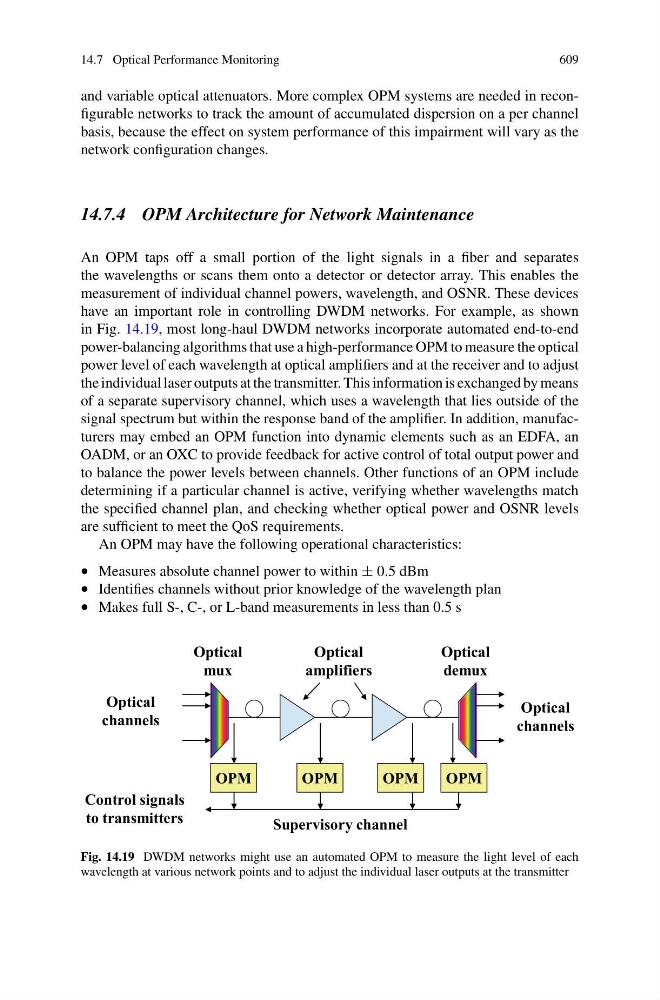
have an important role in controlling DWDM networks. For example, as shown
in Fig. 14.19, most long-haul DWDM networks incorporate automated end-to-end
power-balancing algorithms that use a high-performance OPM to measure the optical
power level of each wavelength at optical amplifiers and at the receiver and to adjust
the individual laser outputs at the transmitter. This information is exchanged by means
of a separate supervisory channel, which uses a wavelength that lies outside of the
signal spectrum but within the response band of the amplifier. In addition, manufacturers may embed an OPM function into dynamic elements such as an EDFA, an
OADM, or an OXC to provide feedback for active control of total output power and
to balance the power levels between channels. Other functions of an OPM include
determining if a particular channel is active, verifying whether wavelengths match
the specified channel plan, and checking whether optical power and OSNR levels
are sufficient to meet the QoS requirements.
An OPM may have the following operational characteristics:
• Measures absolute channel power to within ± 0.5 dBm
• Identifies channels without prior knowledge of the wavelength plan
• Makes full S-, C-, or L-band measurements in less than 0.5 s
Optical
mux
Optical
demux
Optical
amplifiers
Optical
channels
Optical
channels
OPM
Supervisory channel
Control signals
to transmitters
OPM
OPM
OPM
Fig. 14.19 DWDM networks might use an automated OPM to measure the light level of each
wavelength at various network points and to adjust the individual laser outputs at the transmitter